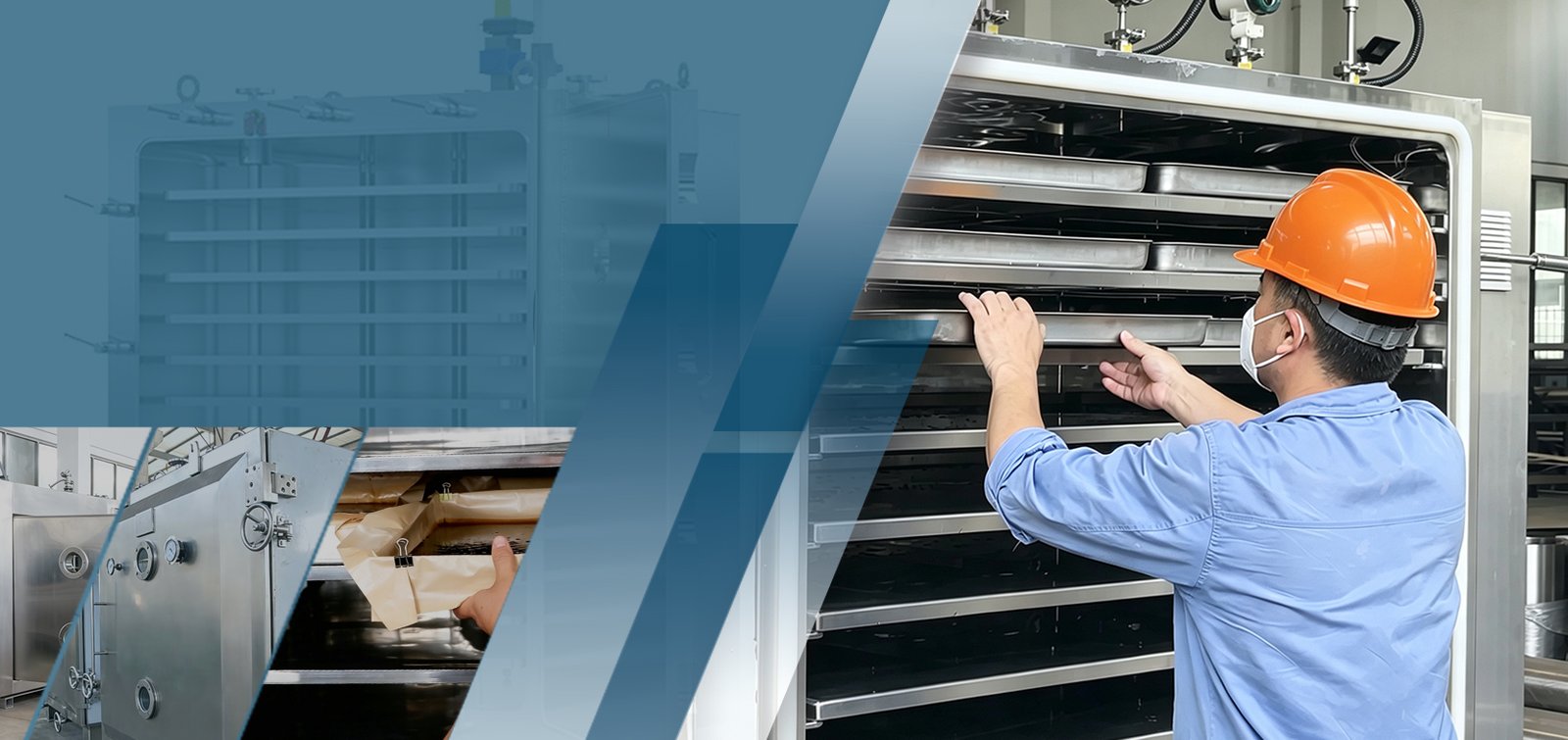
Vacuum Tray Dryer
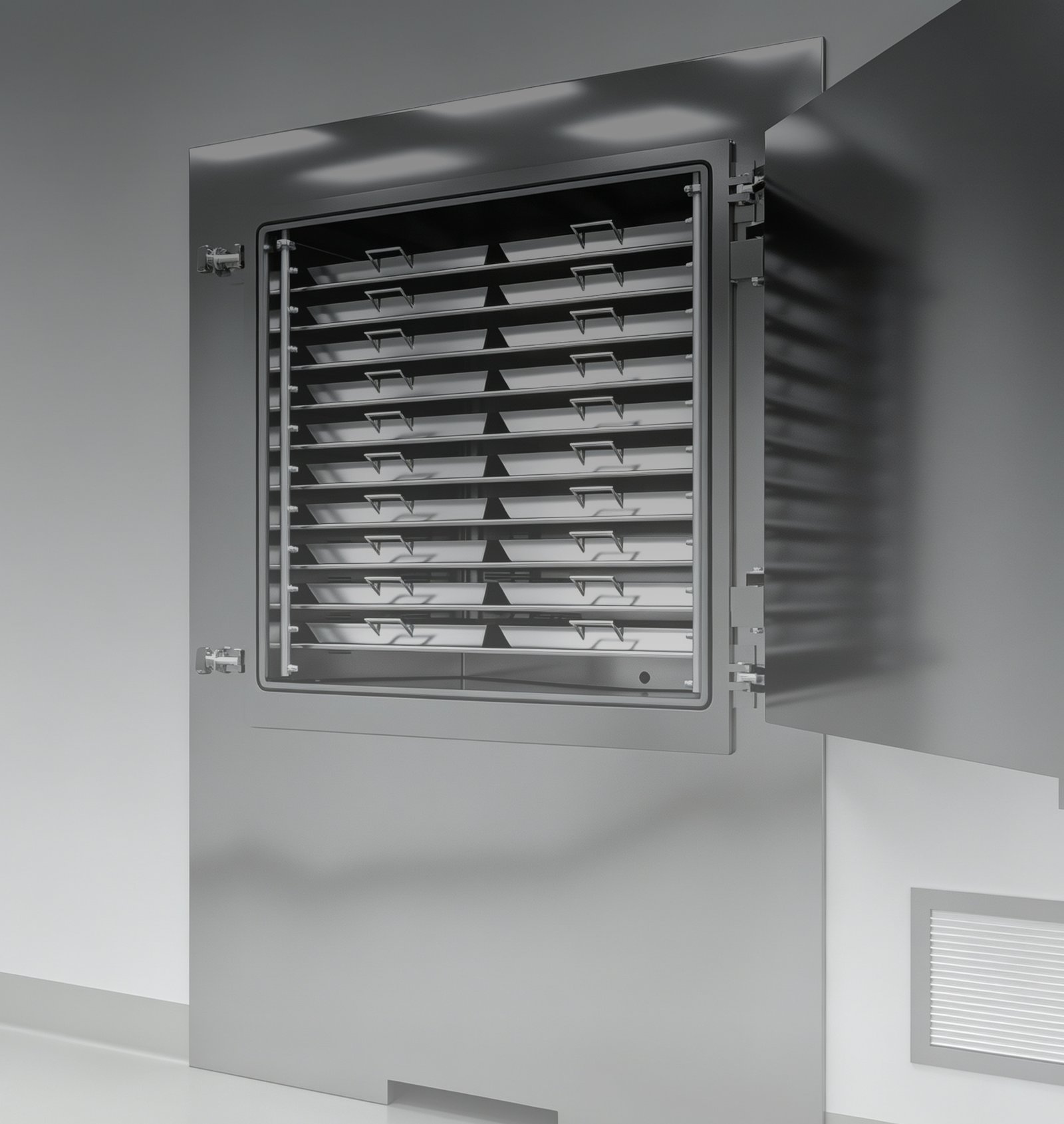
Dry heat-sensitive, oxidation-sensitive or solvent-containing materials at reduced pressure using indirect shelf heating. Available in 16, 32 and 48-tray configurations, with the final design selected according to batch load and material properties.
- 16 / 32 / 48-Tray Configurations
- SS304 or SS316L Product-Contact Parts
- Material Testing Available
- FAT Before Shipment
What Is a Vacuum Tray Dryer?
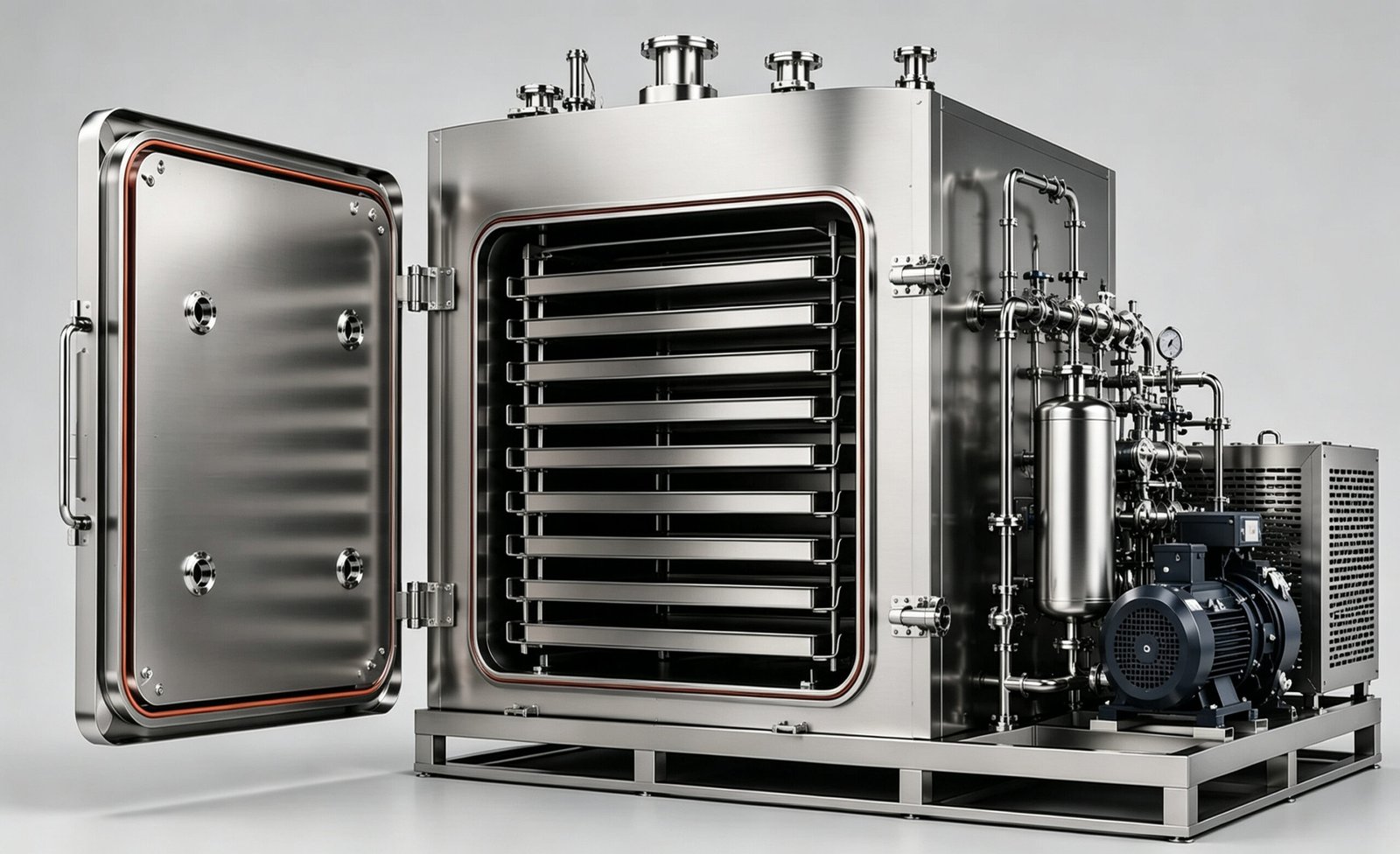
It is a sealed, batch-operated dryer in which product-filled trays rest on heated shelves under reduced pressure. Moisture or solvent evaporates at a lower temperature and is removed through the vacuum line, with a condenser added when condensate or solvent recovery is required.
Not sure whether your material suits static tray drying?
Discuss Your Material
When Conventional Hot-Air Drying Creates Product Risk
Atmospheric hot-air drying is effective for many products, but specific material properties demand the enclosed, reduced-pressure environment of a vacuum tray dryer.
Heat-sensitive products
Problem: Discoloration, decomposition or loss of active components at elevated temperature.
Response: Reduced pressure permits moisture removal at a lower product temperature.

Oxidation-sensitive materials
Problem: Exposure to circulating air can affect color, purity or chemical stability.
Response: The enclosed vacuum chamber limits contact with atmospheric oxygen; inert-gas operation can be offered when required.
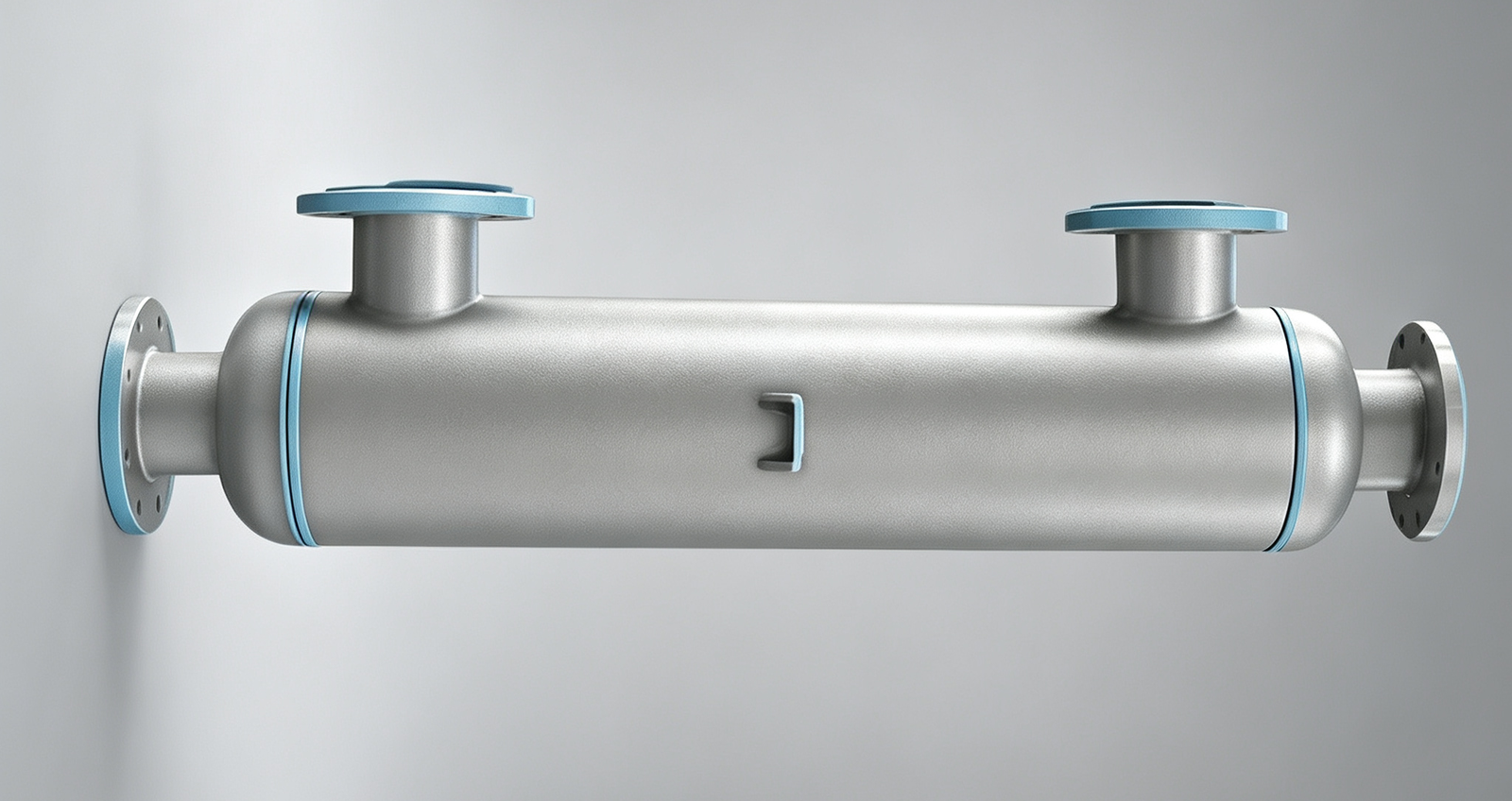
Solvent-containing materials
Problem: Vapors should not be discharged directly into the workshop.
Response: A condenser and receiver can be integrated for condensate collection or solvent recovery, subject to solvent properties and safety requirements.
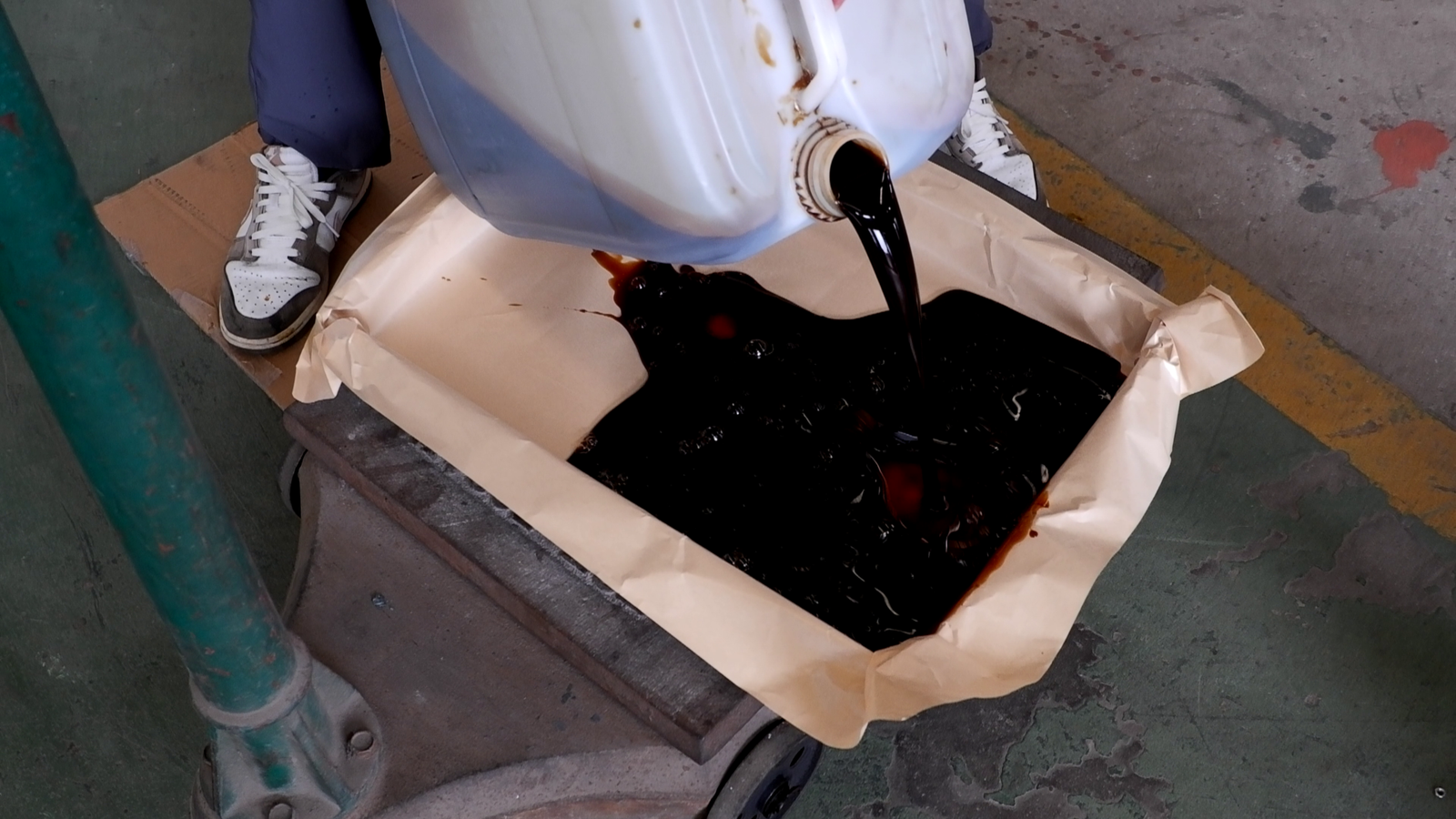
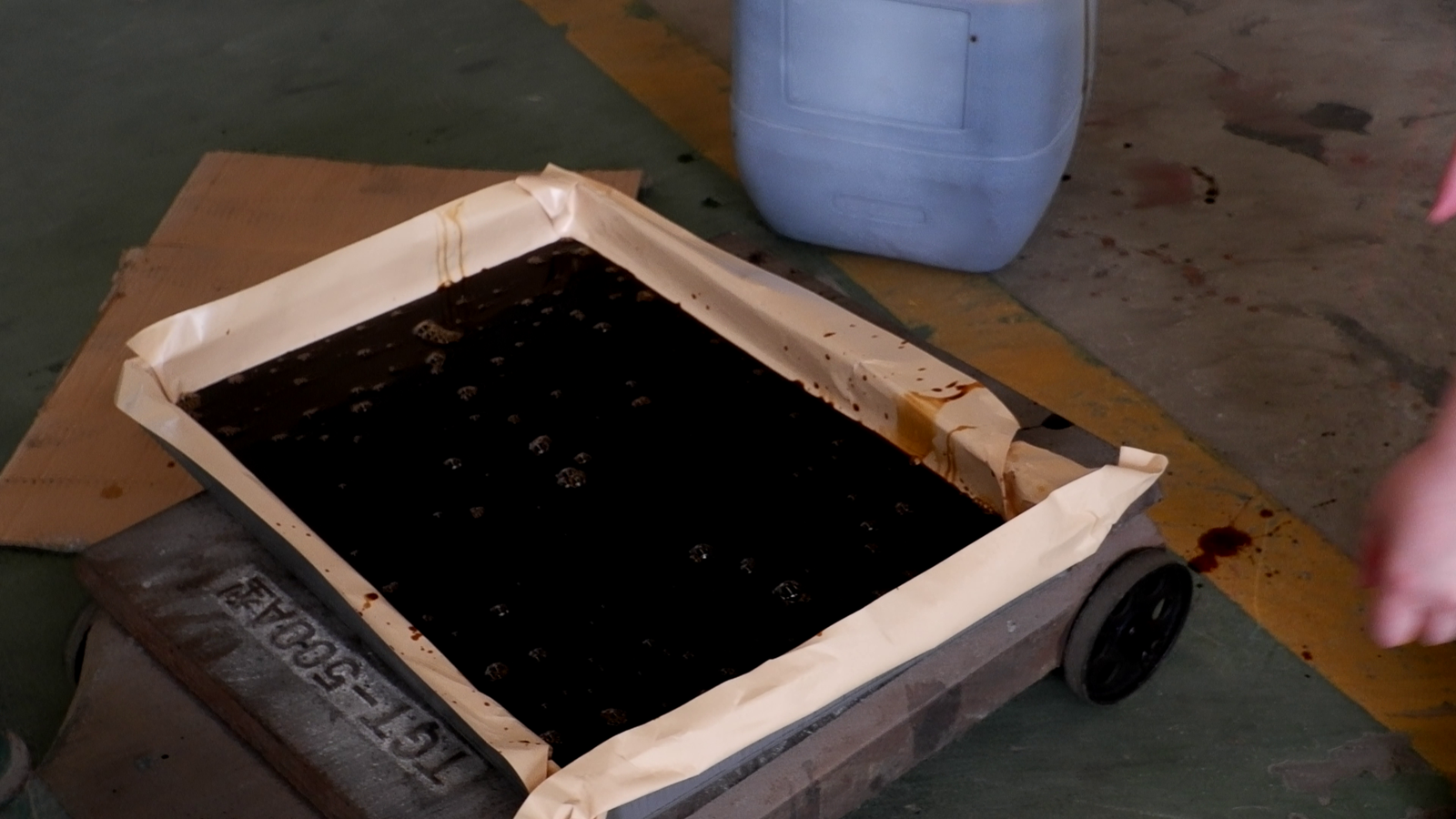
Sticky materials and pastes
Problem: Sticky or high-viscosity feed may be unsuitable for pneumatic conveying or hot-air contact drying.
Response: The material can be spread directly into removable trays without passing through an atomizer or pneumatic drying pipe.
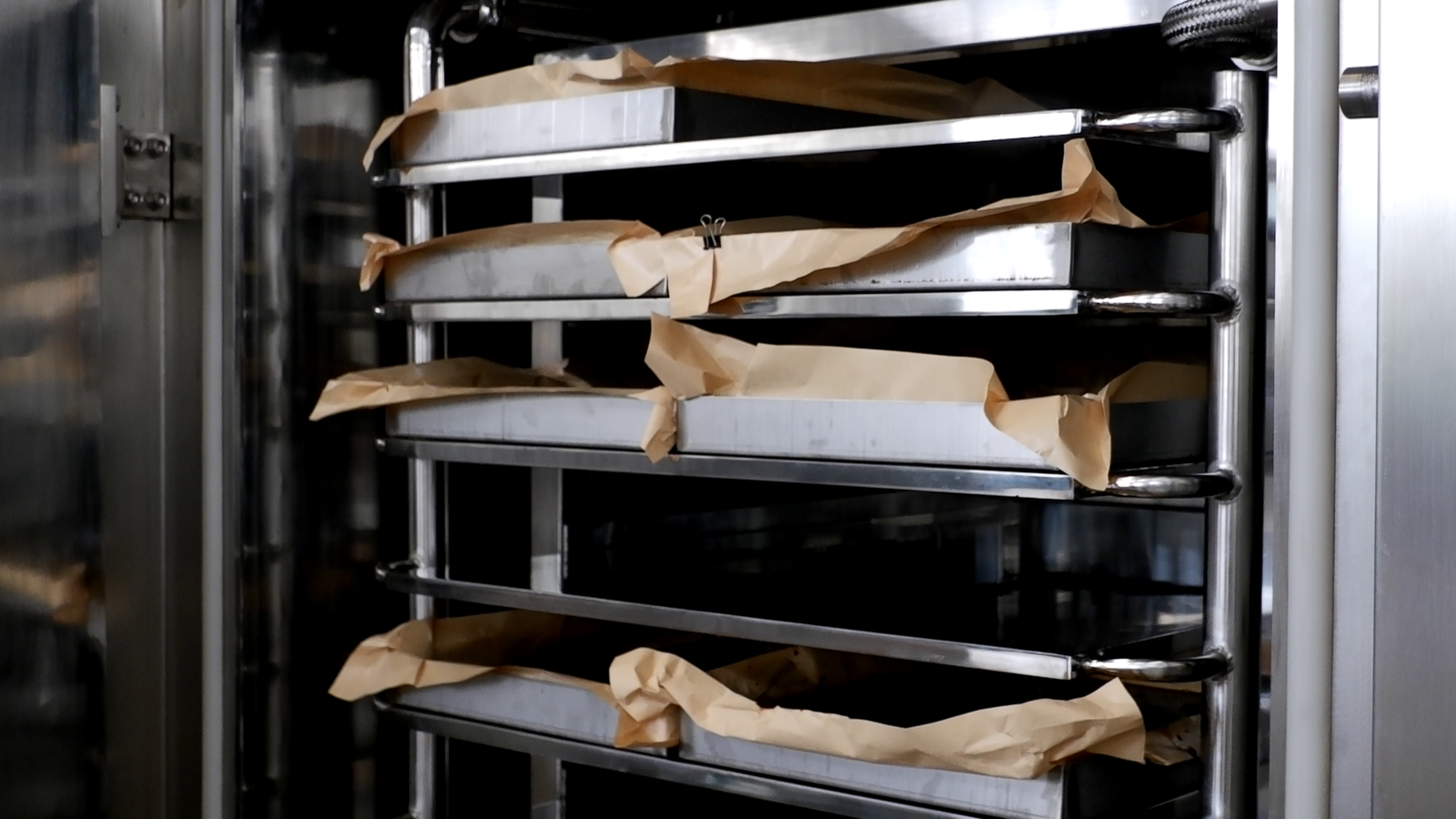
Crystals and fragile granules
Problem: Agitation can damage crystal shape or create excessive fines.
Response: Static drying avoids mechanical agitation during the drying stage.
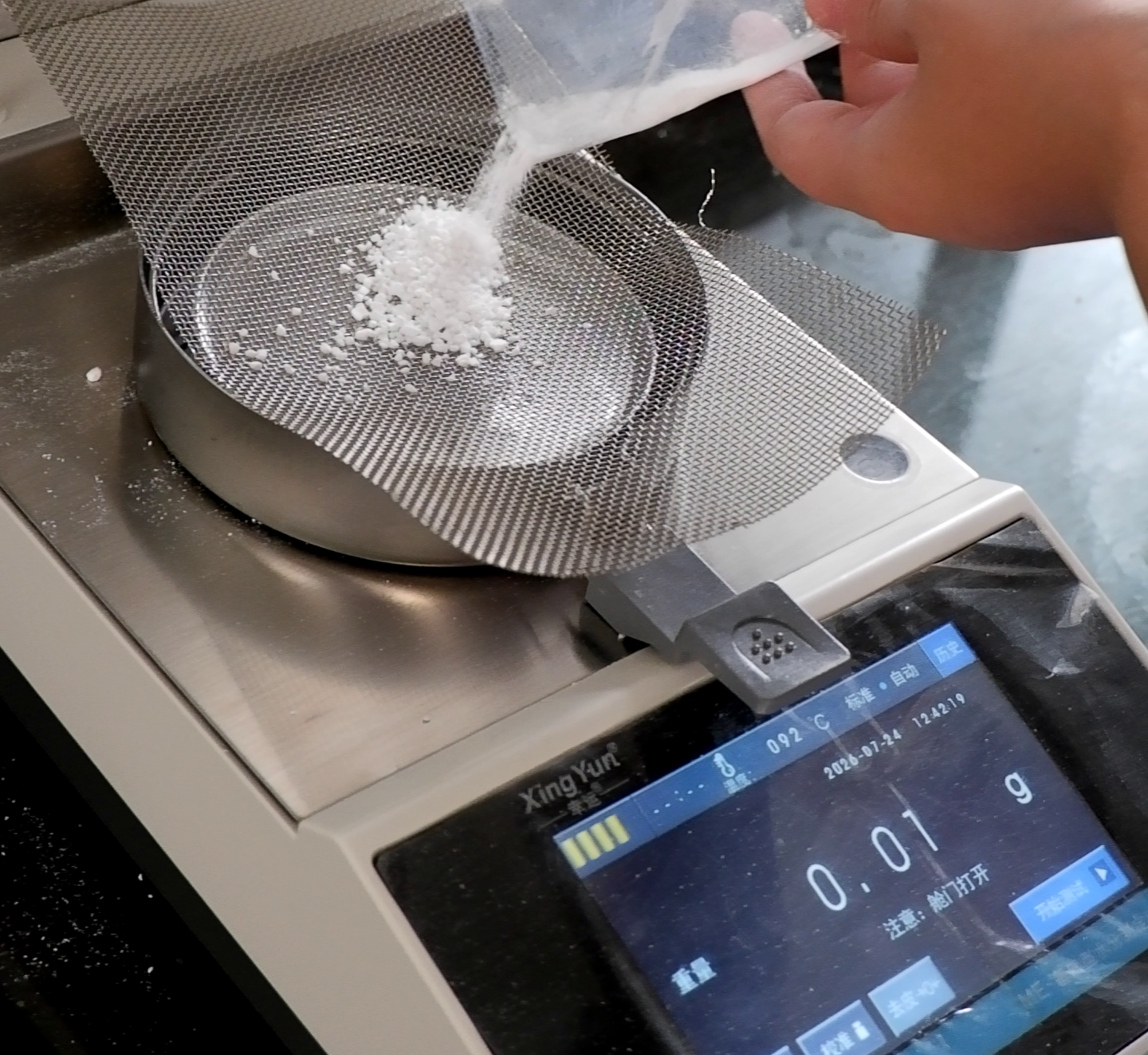
Very low residual-moisture
Problem: Bound moisture can be difficult to remove at atmospheric pressure.
Response: Vacuum operation can improve the driving force for moisture removal, but final moisture must be confirmed through testing or process data.
How Does a Vacuum Tray Dryer Work?
Material is spread in trays and placed on heated shelves inside the vacuum chamber. Under vacuum, water or solvent evaporates at a lower temperature. Heat passes from the shelves through the trays, while the vapor is drawn out and, when required, collected through a condenser.
Load
Wet powder, granules, crystals, filter cake or paste are distributed evenly in trays.
Heat
The trays are placed in contact with internally heated shelves. Steam, hot water, thermal oil or an electrically heated circulation unit supplies heat.
Create Vacuum
The sealed chamber is evacuated, reducing the boiling point of the liquid in the product.
Remove Vapor
Water vapor or solvent vapor leaves the material and flows toward the condenser or vacuum system.
Condense and Unload
Condensate is collected when a condenser is installed. After the drying endpoint is reached, the chamber is returned to safe pressure and the trays are unloaded.
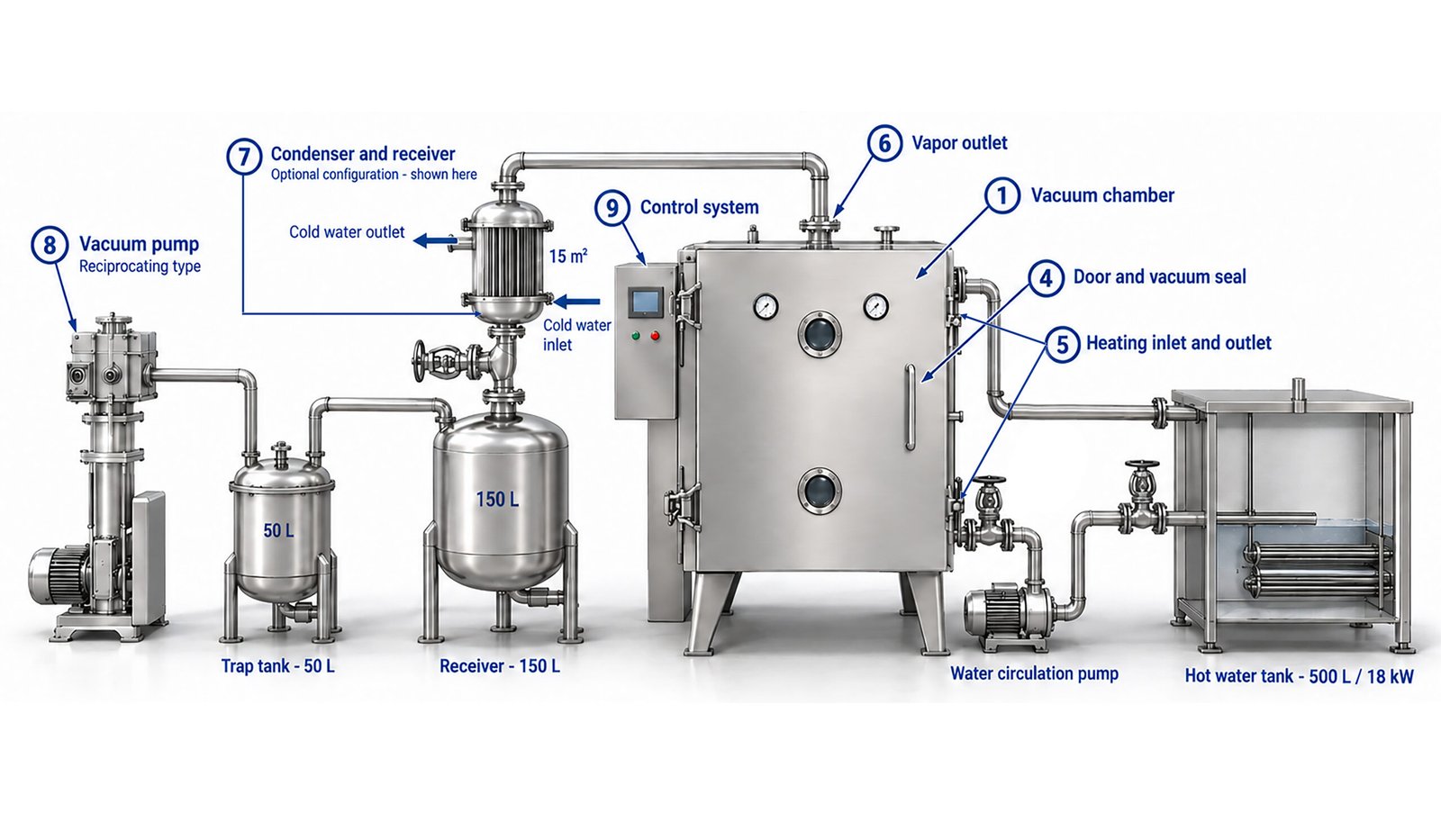
Diagram illustrates: Sealed vacuum chamber, heated shelf, product tray, heating-medium connections, vapor outlet, condenser, receiver, and vacuum pump.
16, 32 and 48-Tray Vacuum Dryer Configurations
JEXDRY configures the chamber size based on the required tray area. Do not assign a fixed kilogram capacity unless confirmed by the material’s bulk density, loading thickness and tray dimensions.
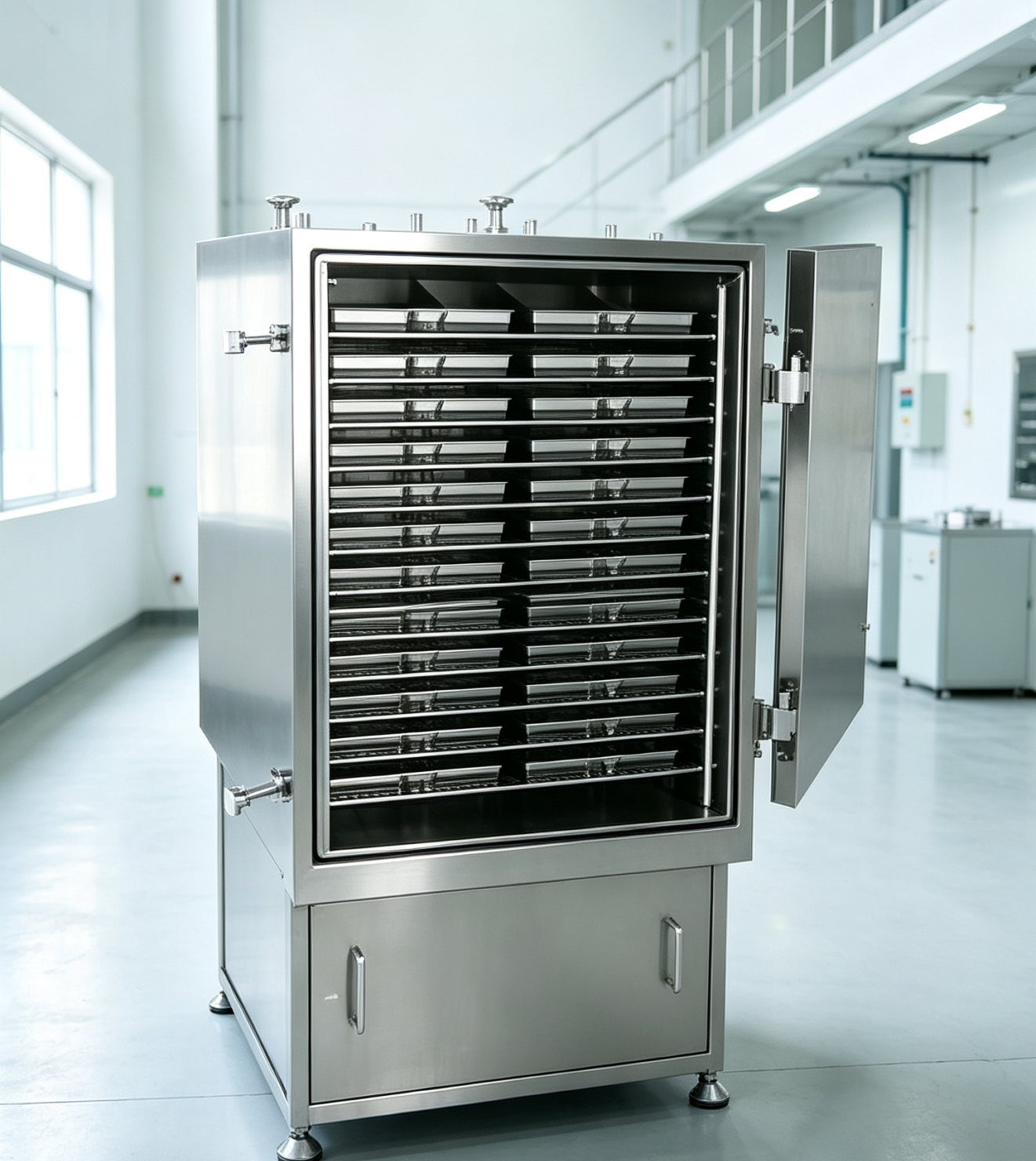
16-Tray Vacuum Tray Dryer
For smaller batches, pilot production, high-value materials or frequent product changeovers.
- Trays: 16
- Contact Material: SS304 / SS316L
- Heating: Steam, Water, Oil, Electric
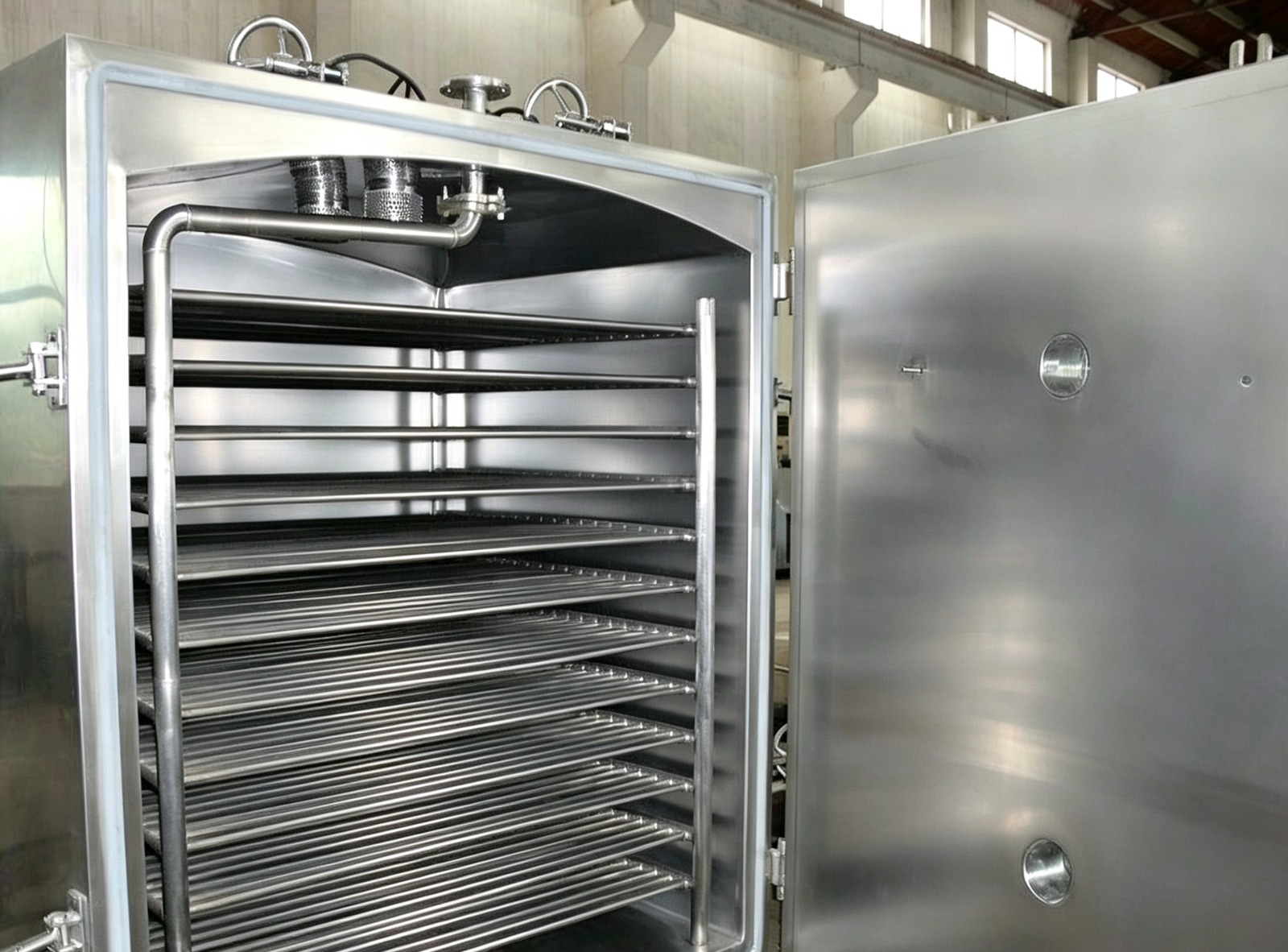
32-Tray Vacuum Tray Dryer
For routine batch production requiring a balance between drying area, floor space and manual handling.
- Trays: 32
- Contact Material: SS304 / SS316L
- Heating: Steam, Water, Oil, Electric
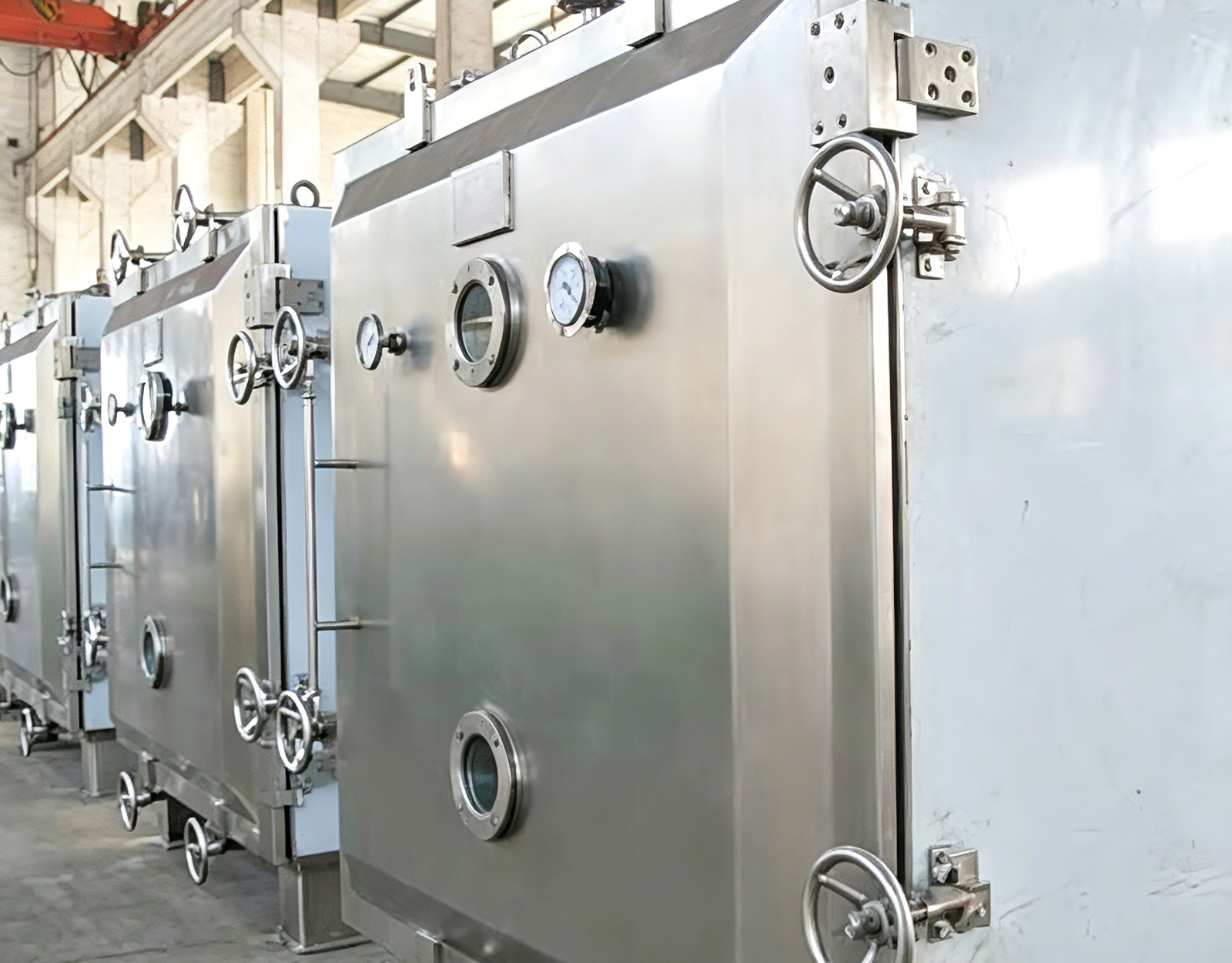
48-Tray Vacuum Tray Dryer
For larger batch requirements where additional tray area is needed within one chamber.
- Trays: 48
- Contact Material: SS304 / SS316L
- Heating: Steam, Water, Oil, Electric
Tray count does not equal a universal kilogram capacity. Actual batch loading is calculated from usable tray area, product-layer thickness, bulk density, initial moisture, final moisture and drying behavior.
Vacuum Tray Dryer Technical Specifications
JEXDRY vacuum tray dryers are static batch drying systems in which materials remain stationary in removable trays while heat is transferred indirectly through heated shelves. Round and rectangular chamber configurations can be engineered according to the required batch capacity, material properties and installation conditions.
| Parameter | Specification / Available Configuration |
|---|---|
| Dryer Type | Static batch vacuum tray dryer / vacuum shelf dryer |
| Chamber Design | Round or rectangular vacuum chamber |
| Batch Capacity | Project-specific; calculated according to tray area, loading depth, wet bulk density and moisture-removal load |
| Tray Quantity | Selected according to batch capacity; common configurations include 4–48 trays, with other quantities available by custom design |
| Heated Shelf Levels | Reference configurations: 4–12 levels; customized according to chamber size and tray arrangement |
| Reference Tray Sizes | 310 × 600 × 45 mm, 520 × 410 × 45 mm or 460 × 640 × 45 mm; custom sizes available |
| Shelf Spacing | Reference options: 82, 102 or 122 mm; adjustable according to product depth and operating requirements |
| Heating Method | Indirect conductive heating through hollow shelves |
| Heating Medium | Steam or hot water; other arrangements subject to engineering confirmation |
| Heating Shelf Temperature | Reference equipment range: 35–150°C |
| Reference Chamber Vacuum | Approximately −0.09 to −0.096 MPa gauge, subject to process and vacuum-system design |
| Heating Circuit Pressure | Up to 0.784 MPa in listed reference configurations |
| Vacuum and Recovery System | Vacuum pump selected according to chamber size and vapor load; condenser and solvent receiver available |
| Product-Contact Material | Selected according to corrosion, purity and hygiene requirements; 304 or 316L stainless steel can be specified |
| Optional Features | Solvent recovery, explosion-protection design, polished contact surfaces and project-specific control systems |
Capacity Configuration
Vacuum tray dryer capacity is not determined by tray quantity alone. The same 32-tray dryer may process different kilograms per batch depending on the material’s bulk density, loading depth, initial moisture, target moisture and required drying time.
Configurations are therefore not limited to 16, 32 or 48 trays. Final chamber dimensions, tray quantity, shelf arrangement, vacuum-pump capacity and condenser duty are selected for each application.
*Specifications shown are preliminary reference values. Final parameters are subject to the confirmed material data, technical proposal and approved engineering drawings.*
How Is Vacuum Tray Dryer Capacity Determined?
While precise thermodynamic sizing involves many variables, we use a straightforward rule of thumb to give you a quick estimate.
The Basic Rule: 2.5 kg Per Tray
For most standard materials, the required number of trays is directly determined by your total wet batch weight.
You don't need to worry about complex calculations involving bulk density, porosity, layer resistance, or drying curves. Simply tell us your batch weight, and our engineering team will handle the exact model selection for you.
Quick Estimation Example
- Your Wet Batch Weight: 100 kg
- Estimated Loading: 2.5 kg / tray
- Resulting Trays: 40 Trays
- Recommended Model: FZG-40
Let Us Size Your Dryer
Provide your basic parameters, and our engineers will calculate the exact tray area and select the right model for you.
Inside the JEXDRY Vacuum Tray Dryer
Understanding the core components and optional supporting equipment.
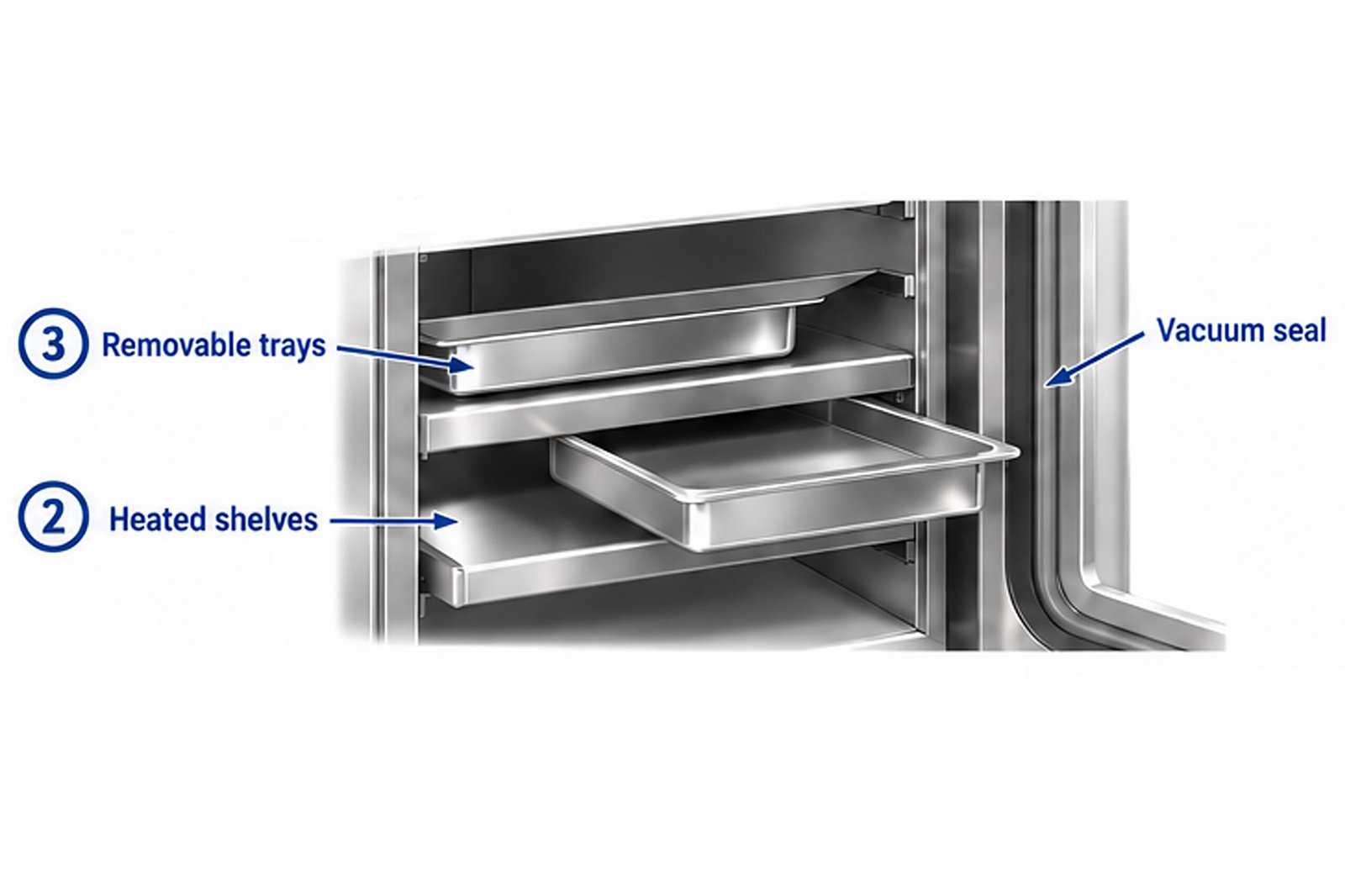
Choose the Heating Method That Matches Your Utilities
The internal shelves can be designed to circulate different heating media depending on your available plant resources and temperature requirements.
Steam Heating
Suitable when stable plant steam is available. Show steam inlet, condensate outlet and shelf circulation.
Utility: Plant steam
Temp Control: Pressure regulation
Hot-Water Heating
Suitable for lower-temperature processes requiring controlled shelf temperature.
Utility: Hot water source
Temp Control: Water temp regulation
Thermal-Oil Heating
Suitable where the specified temperature range or existing utility system favors thermal oil.
Utility: Thermal oil boiler
Temp Control: Oil flow/temp control
Electric Heating
Use an external electric heating circulation unit to heat and circulate water or thermal oil through the shelves.
Utility: Industrial electricity
Temp Control: Electric heater control
Materials Commonly Evaluated for Vacuum Tray Drying
Material compatibility, tray material, allowable loading thickness, solvent safety and achievable drying endpoint must be confirmed for each application.

Pharmaceutical & Biotech
- Pharmaceutical intermediates
- Herbal extracts
- Heat-sensitive powders
- Active ingredients (subject to process)

Fine Chemicals
- Pigments and dyes
- Catalysts
- Crystalline products
- Solvent-containing filter cakes

Food & Ingredients
- Plant extracts
- Flavors and nutritional ingredients
- High-value food powders
- Heat-sensitive pastes

Advanced Materials
- Battery-related powders
- Ceramic materials
- Polymer-related materials
- Specialty inorganic compounds
What the Vacuum Tray Design Solves in Practice
Drying consistency depends on even tray loading, material-layer thickness, shelf temperature distribution and operating procedure.
Lower-temperature moisture removal
Reduced pressure lowers the liquid’s evaporation temperature, helping limit thermal exposure.
No mechanical agitation
Suitable when crystal form, granule structure or fragile material shape should be maintained.
Enclosed batch processing
The product remains inside a sealed chamber during drying, preventing external contamination.
Configurable solvent recovery
A condenser and receiver can be incorporated according to the solvent, vapor load and recovery requirement.
Flexible material contact surfaces
SS304 and SS316L can be selected according to corrosion, hygiene and product-contact requirements.
Adaptable utilities and controls
Heating source, vacuum system, instrumentation and control level are selected around the customer’s plant conditions.
Vacuum Tray Dryer vs. Hot-Air Tray Dryer
Understanding the difference between reduced-pressure conduction drying and atmospheric convection drying.
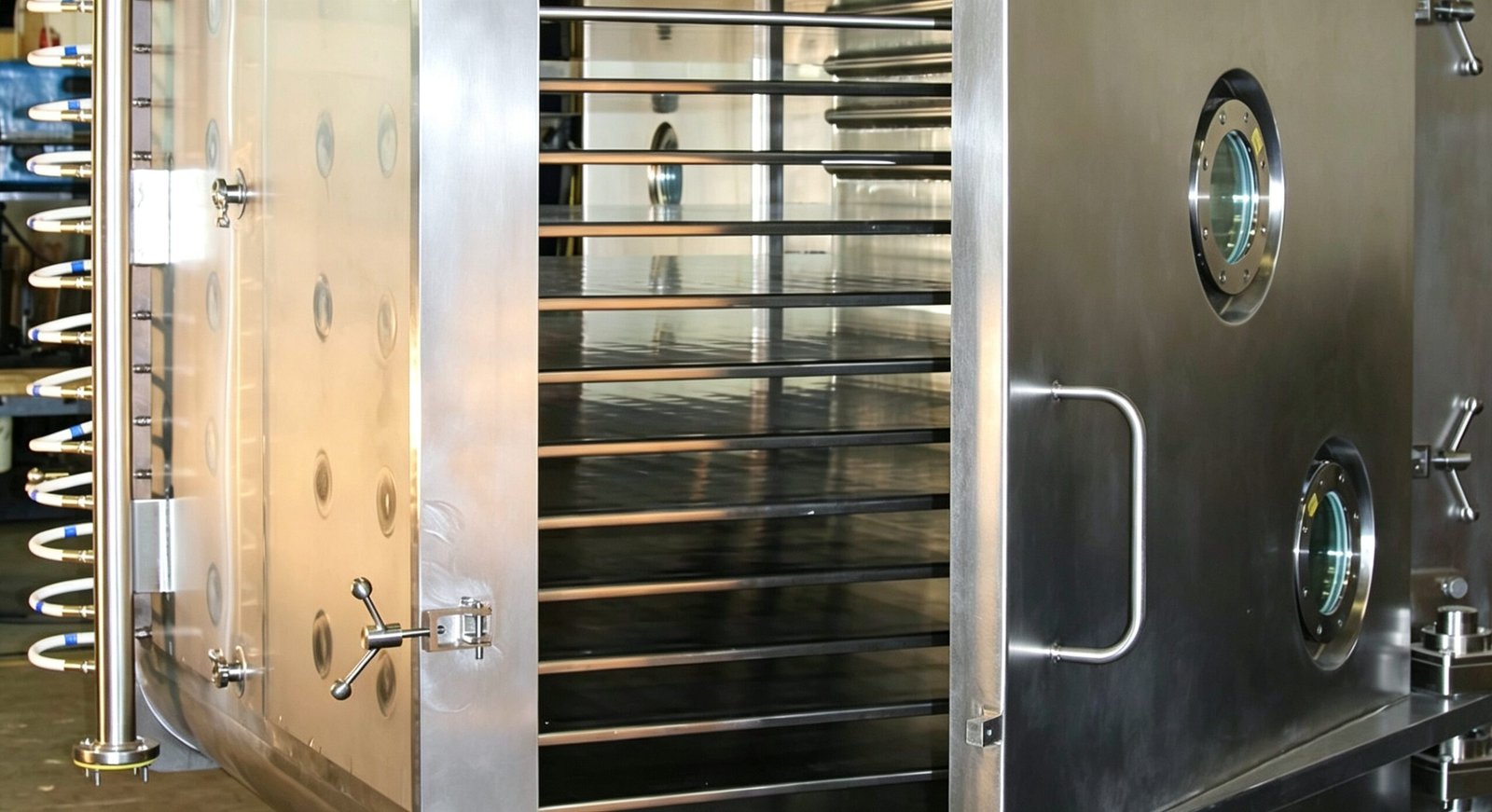
Vacuum Tray Dryer
- Operating pressure Vacuum (Reduced)
- Main heat-transfer Conduction (Shelves)
- Drying atmosphere Sealed / Inert optional
- Product temperature Lower (Evap point drops)
- Exposure to oxygen Minimal
- Solvent-vapor handling Condenser configurable
- Material sensitivity High heat/oxidation risk
- Equipment complexity Higher (Vacuum system)
Choose when: The product is sensitive to heat or oxygen, requires an enclosed environment, contains recoverable solvent, or is difficult to dry effectively with circulating air.
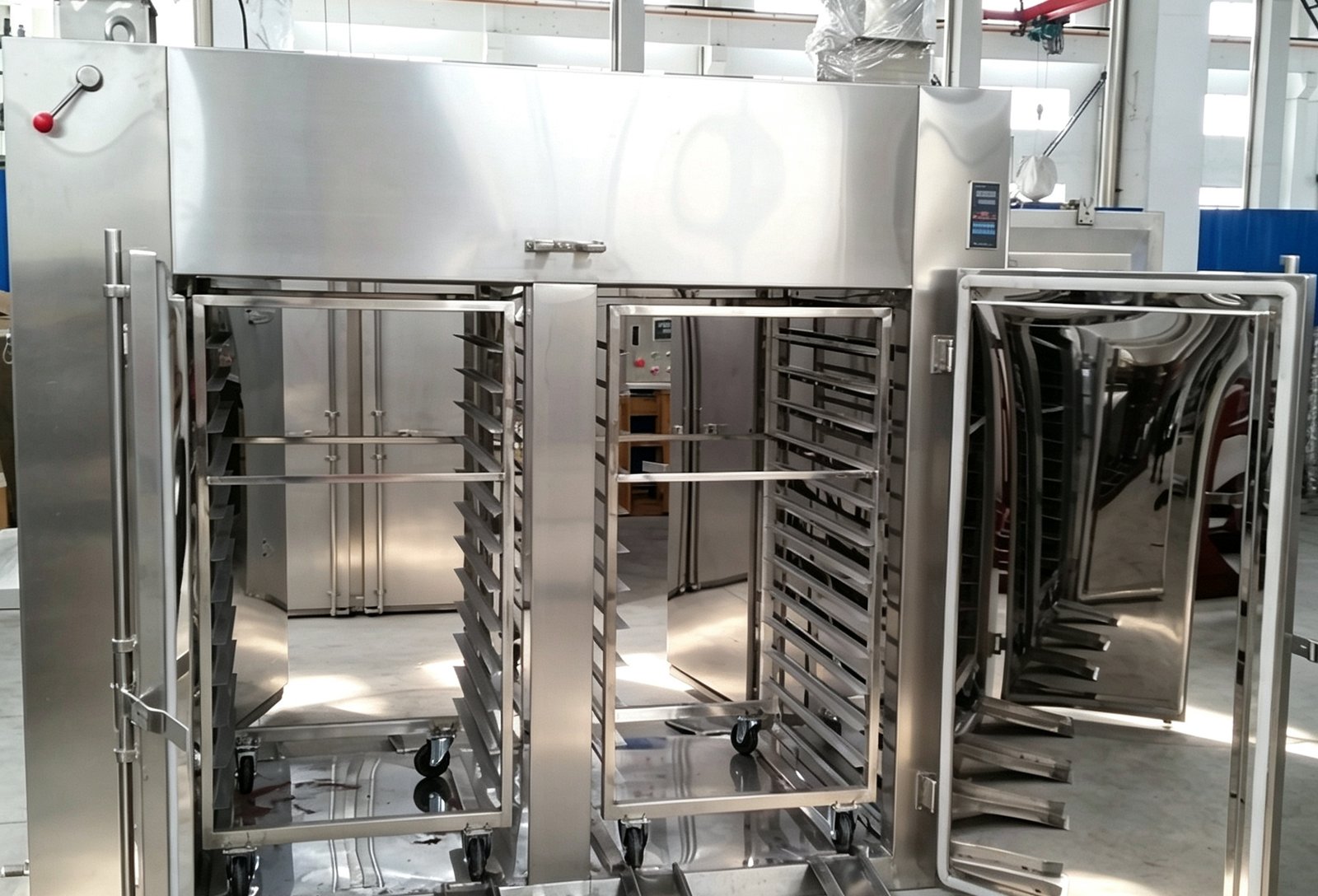
Hot-Air Tray Dryer
- Operating pressure Atmospheric
- Main heat-transfer Convection (Hot air)
- Drying atmosphere Circulating air
- Product temperature Higher (Matches air)
- Exposure to oxygen Continuous
- Solvent-vapor handling Typically exhausted
- Material sensitivity Stable materials
- Equipment complexity Lower (Simpler fan/heater)
Choose when: The material is stable in air at the required temperature, solvent containment is not required and simpler atmospheric drying is technically acceptable.
Is a Vacuum Tray Dryer the Right Vacuum Dryer?
Static tray drying is gentle but manual. Agitated vacuum dryers offer
Vacuum Tray Dryer
Static drying, simple product containment in removable trays, suitable when agitation is undesirable; requires manual tray loading and unloading.
- Action: Static
- Feed: Powder, crystal, paste
- Handling: Manual trays
Double Cone Vacuum Dryer
Gentle tumbling without an internal agitator, suitable when mixing and easier bulk discharge are required.
- Action: Tumbling
- Feed: Free-flowing powder/granule
- Handling: Bulk charge/discharge
Vertical Conical Vacuum Dryer
Agitated vacuum drying and mixing in a compact vertical vessel, suitable for projects requiring enclosed charging and discharge.
- Action: Ribbon/Screw Agitation
- Feed: Powder, paste
- Handling: Enclosed bulk
Vacuum Rake / Paddle Dryer
Agitation assists heat transfer and can break soft agglomerates; suitable for sticky or higher-resistance materials when static drying is too slow.
- Action: Horizontal Agitation
- Feed: Sticky paste, slurry
- Handling: Bulk discharge
How to Choose a Vacuum Tray Dryer
Follow these six steps to gather the information required for
Define the wet batch quantity
State the required kilograms per batch and batches per day.
Provide material properties
Include physical form, bulk density, viscosity or stickiness, particle size and corrosiveness.
Define moisture removal
Provide initial moisture, final moisture and whether the liquid is water or a solvent.
Establish temperature limits
Confirm the maximum allowable product temperature and any degradation risk.
Confirm utilities and conditions
Provide steam pressure, hot-water conditions, thermal oil, electricity, cooling water, available floor space and electrical standard.
Select product-contact & safety
Confirm SS304 or SS316L, solvent recovery, inert gas, vacuum pump type, instrumentation and any hygienic or explosion-risk requirements.
For unfamiliar materials, JEXDRY recommends material testing or reviewing representative drying data before finalizing tray area, vacuum system and heating configuration.
Submit Your Material for Evaluation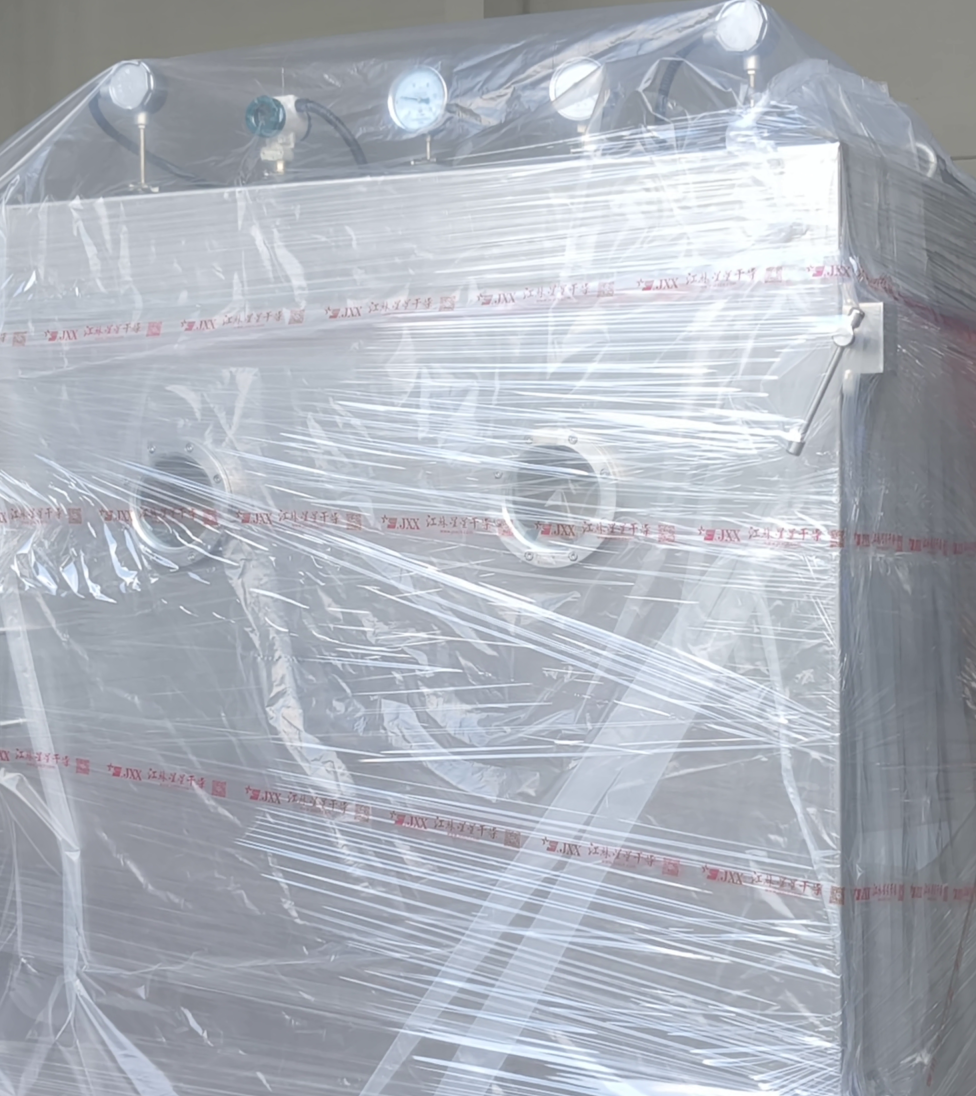
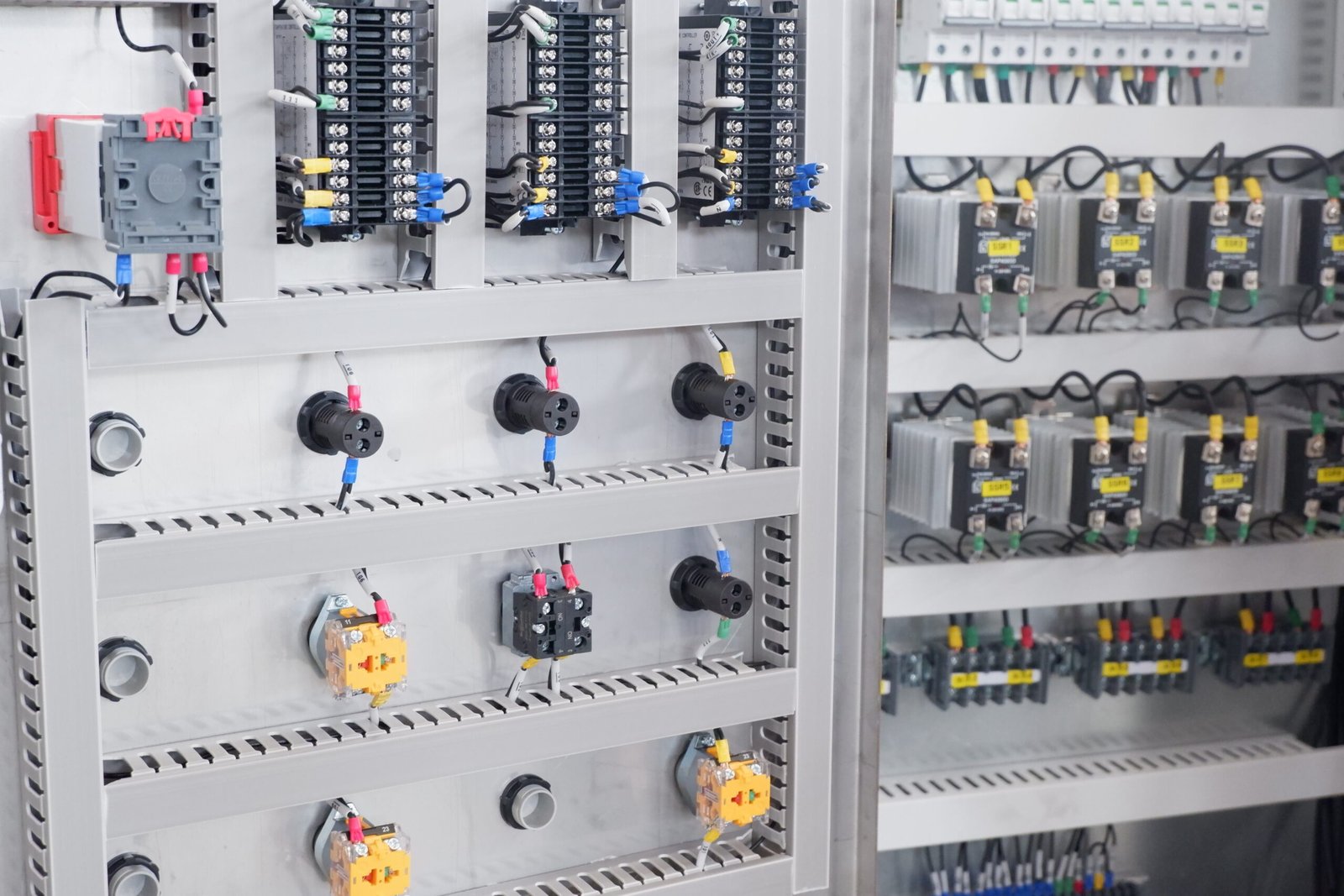
GZF-48 Vacuum Tray Dryers with Shared Controls
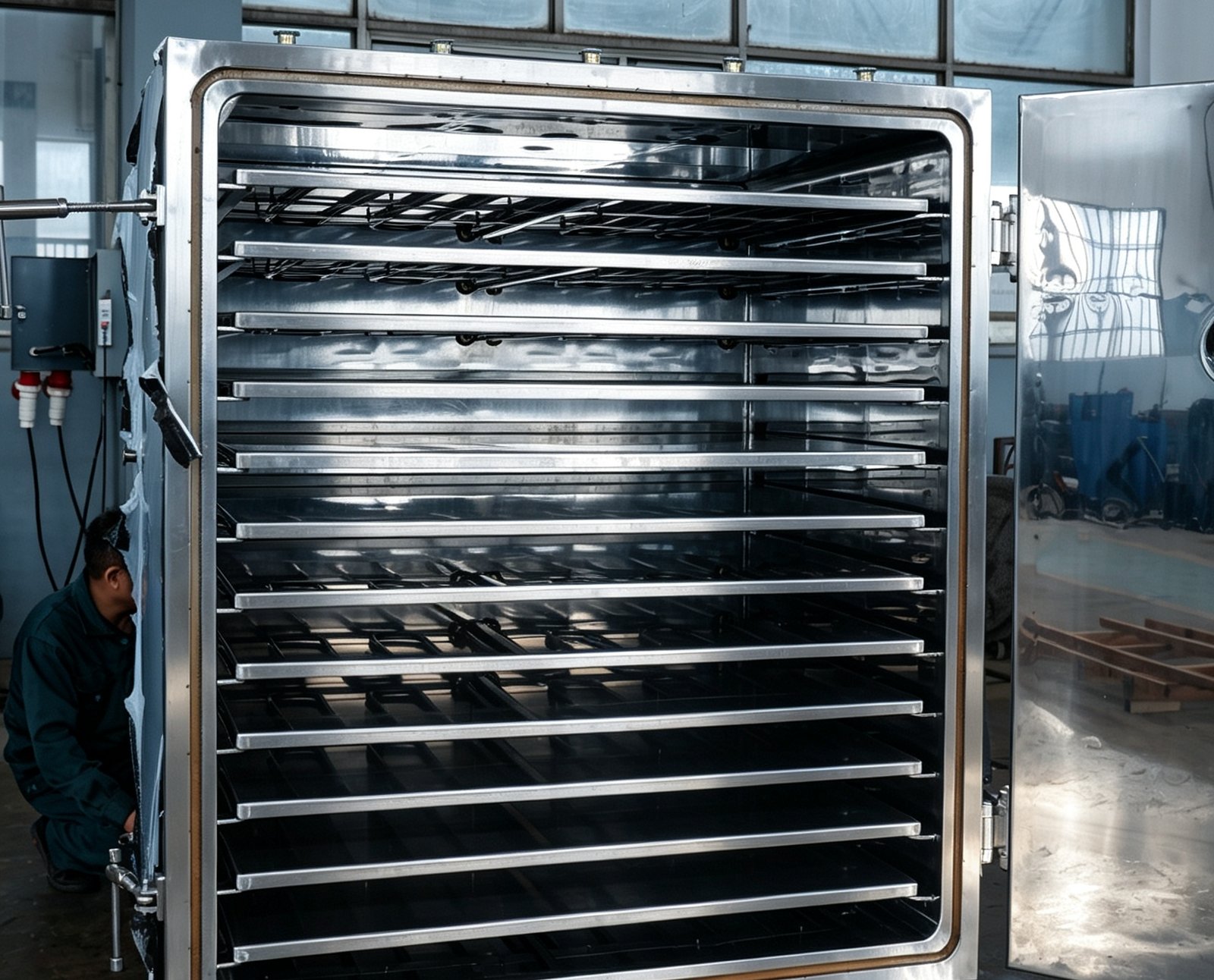
This GZF-48 configuration specifies three hot-water-heated vacuum tray dryers, with temperature control and vacuum readings brought together in one numbered control cabinet. Each dryer accommodates 48 removable trays across eight heated shelves.
Design Details for Daily Operation
-
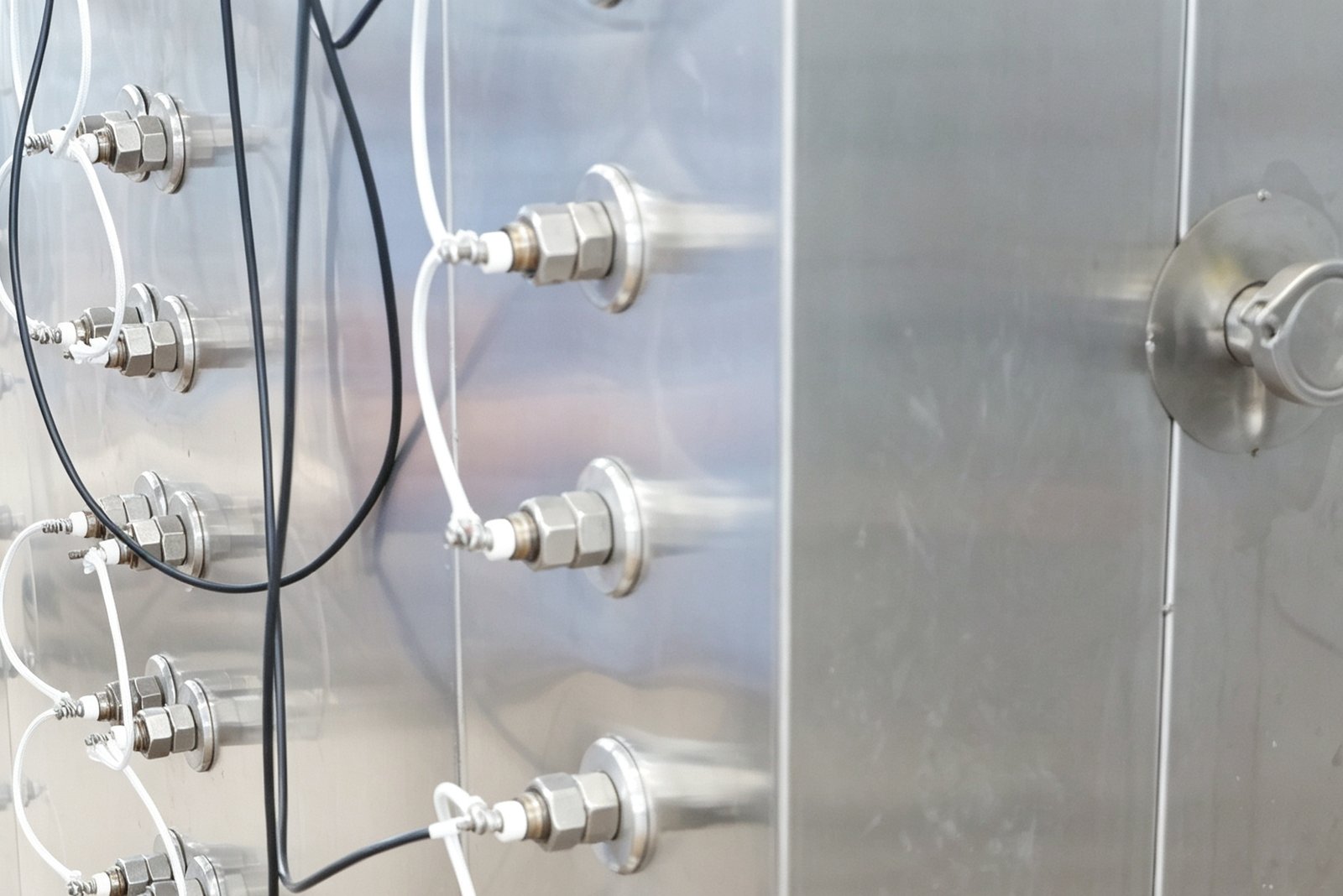
External Hot-Water Connections
The shelf-water connections are positioned outside the chamber to reduce the risk of product contamination from connection leaks.
-
Heated Shelves and Four-Side Jackets
Hot water heats the shelves and the chamber jackets on the top, bottom and both sides. The revised water routing is intended to improve heat distribution.
-
Access for Loading and Cleaning
A single-opening door provides access to the removable SUS304 trays. Rounded internal corners make the chamber easier to clean between batches.
-
Nitrogen Admission with a Baffle
The configuration includes nitrogen pulse admission. A baffle at the internal inlet disperses the gas to limit disturbance of material in the trays.
The shared cabinet brings temperature control and vacuum readings for all three dryers to one location, with numbered displays for equipment identification.
Tell us your material, batch size and available heating source.
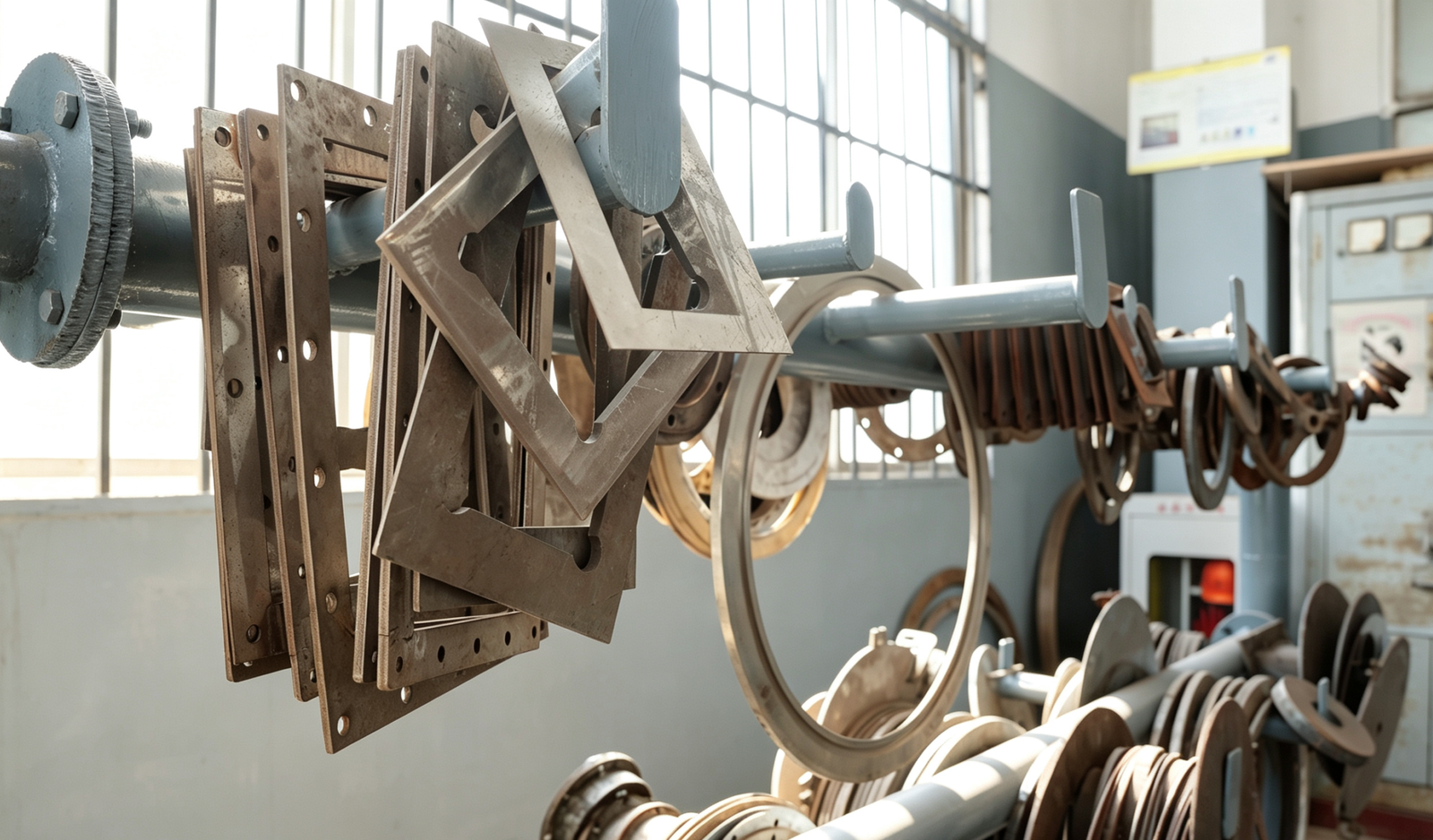
Built and Tested for the Confirmed Process Configuration
From stainless-steel fabrication to pre-shipment vacuum holding tests.
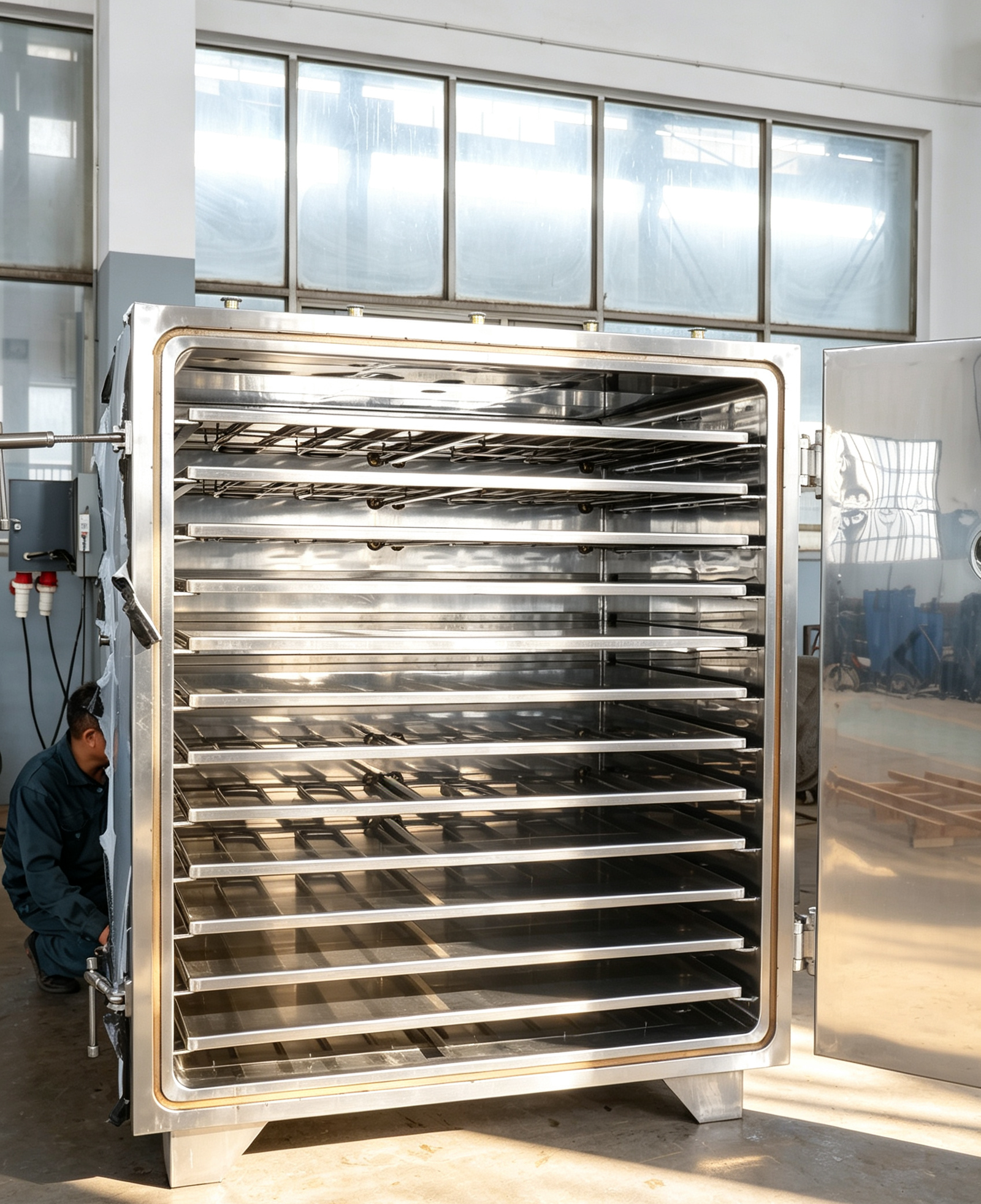
Vacuum Tray Dryer Packing & Shipment to Germany
This video shows the full packing and overseas shipping process of JEXDRY's industrial vacuum dryer, which is ready for delivery to Germany. We follow strict international export standards to ensure the equipment arrives in Germany in perfect condition.
Why Work with JEXDRY on a Vacuum Drying Project?
Manufacturing experience since 1998
Jiangsu Xingxing Drying Equipment Co., Ltd. manufactures industrial drying equipment in Changzhou, China.
Direct engineer involvement
Material and process information can be reviewed by people familiar with equipment selection and system design.
Equipment & system capability
The dryer can be configured with heating circulation, condensation, vacuum and control equipment according to the project boundary.
FAT and English technical support
The project can include pre-shipment inspection, FAT records and English technical documentation according to the agreed scope.
Available company and product documentation can be provided for project review. Applicable certification scope should be confirmed for the selected equipment.
Review Your Project with JEXDRY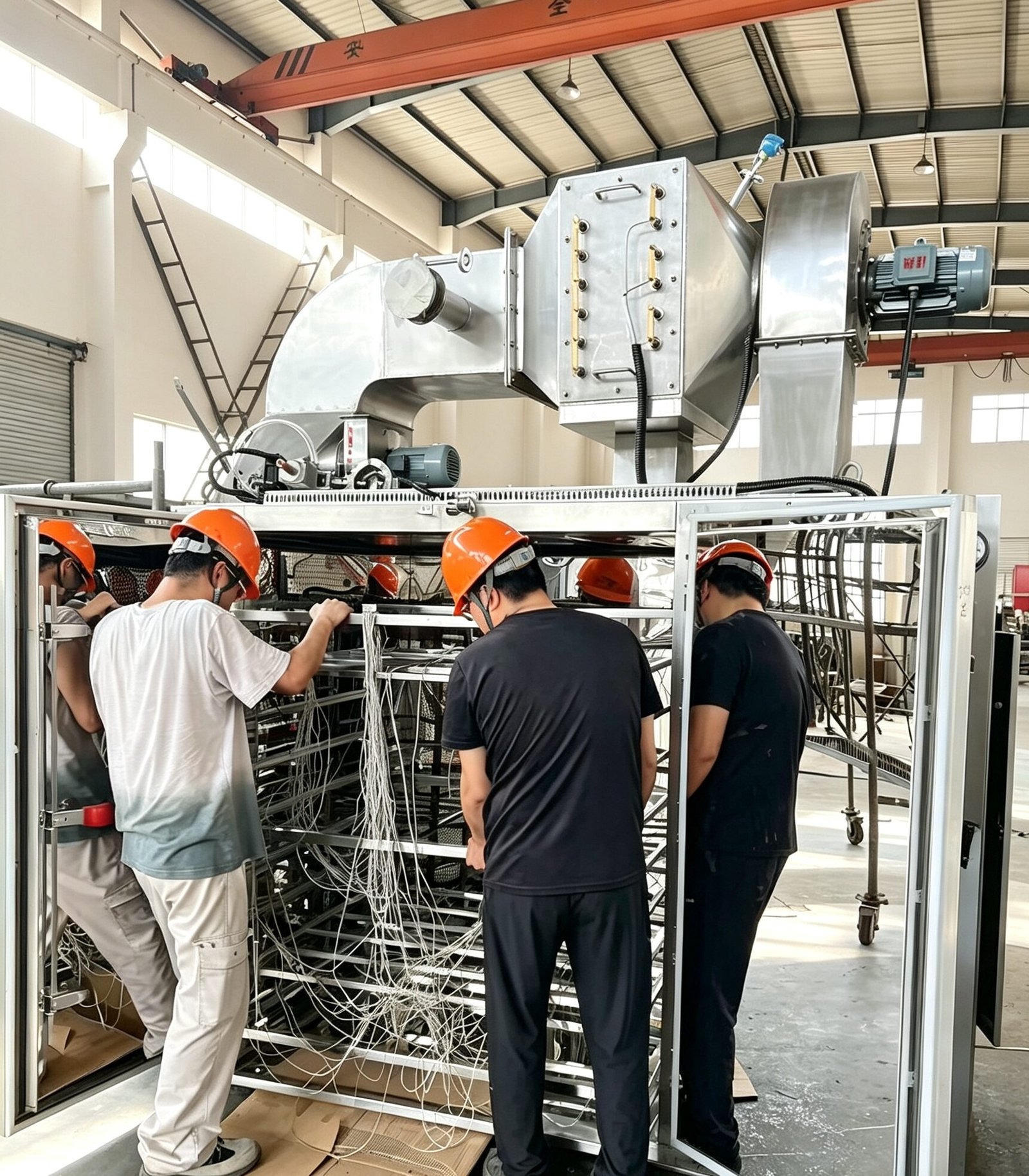
Verify the Drying Route Before Final Selection
If no suitable verified case is available, JEXDRY utilizes material testing to establish the correct loading thickness and drying curve.
What to Provide for Evaluation
- Representative material sample
- Safety data sheet (SDS)
- Initial and target moisture
- Maximum allowable temperature
- Solvent information
- Required batch capacity
Vacuum Tray Dryer FAQs
Direct answers to common technical and selection questions.
What is a vacuum tray dryer?
How does a vacuum tray dryer work?
What is the difference between a vacuum tray dryer and a tray dryer?
How is vacuum tray dryer capacity calculated?
Can a vacuum tray dryer recover solvents?
How long does one drying batch take?
Request a Preliminary Vacuum Tray Dryer Selection
Send us your material and batch requirements. JEXDRY will review the required tray area, heating source, vacuum configuration and optional condensation system