Bin Blender for Powder and Granule Mixing
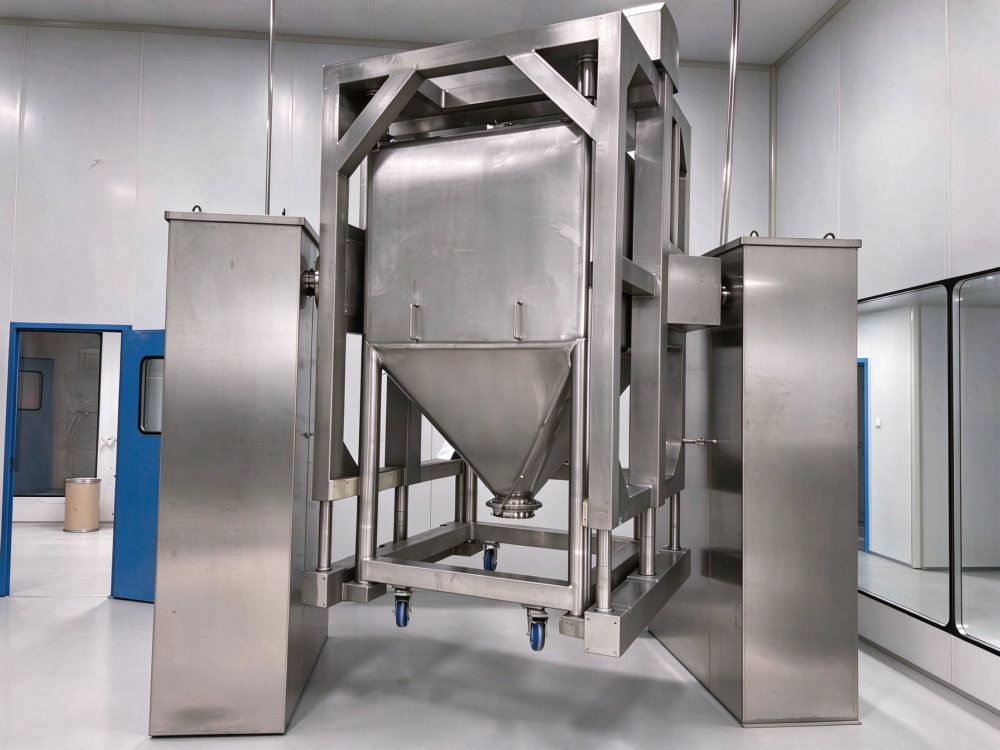
Engineered by JEXDRY for dry solid blending in pharmaceutical, nutraceutical, and specialty chemical processes. This IBC blending system utilizes tumbling action to achieve uniform batch mixtures. Evaluate your material characteristics to select the appropriate lifting, clamping, and container configuration.
Quick Engineering Overview: What to Verify Before Quoting
1. Material State
Suitable for dry powders and granules. Specify bulk density and flowability to determine mixing feasibility.
2. Batch Parameters
Provide required batch mass (kg) and known bulk density (kg/L) to calculate the necessary nominal bin volume.
3. Installation Constraints
Verify available ceiling height for lifting, floor loading capacity, and the 360-degree rotation clearance envelope.
4. Cleaning & Safety
Specify if offline bin washing is planned, required contact surface finish (Ra), and any hazardous area classifications.
Bin Blender Types for Different Production Needs
Select the structural configuration based on your factory layout, batch changeover frequency, and material handling workflow. Note: "Stationary machine" refers to the base installation, while "fixed blending vessel" means the bin
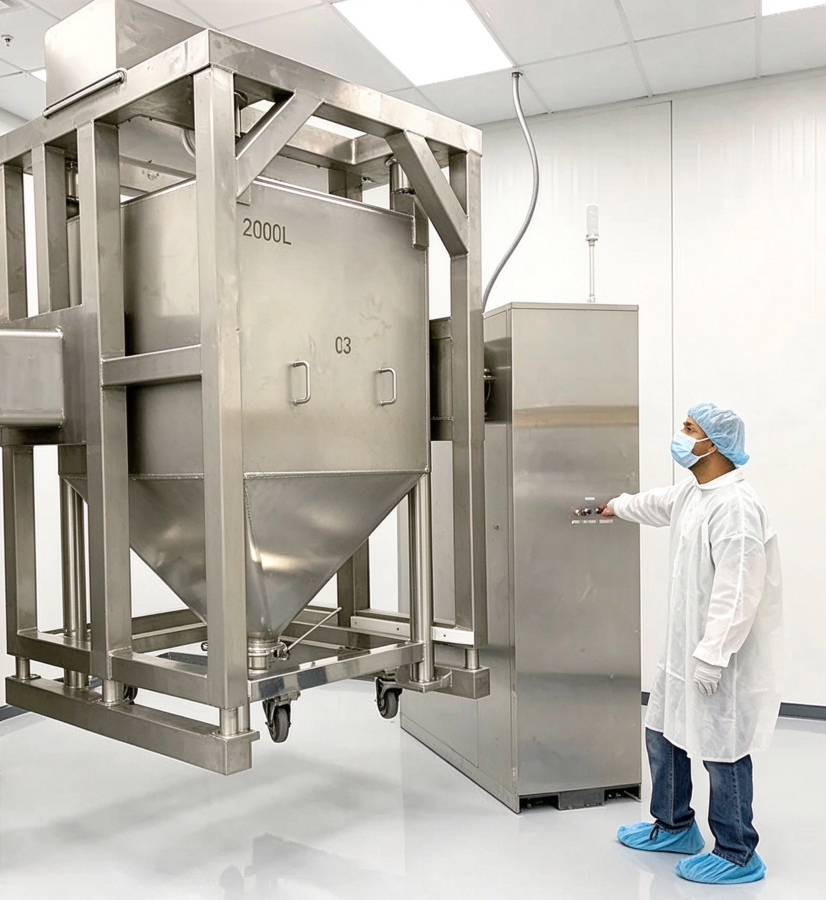
Automatic Lifting Bin Blender
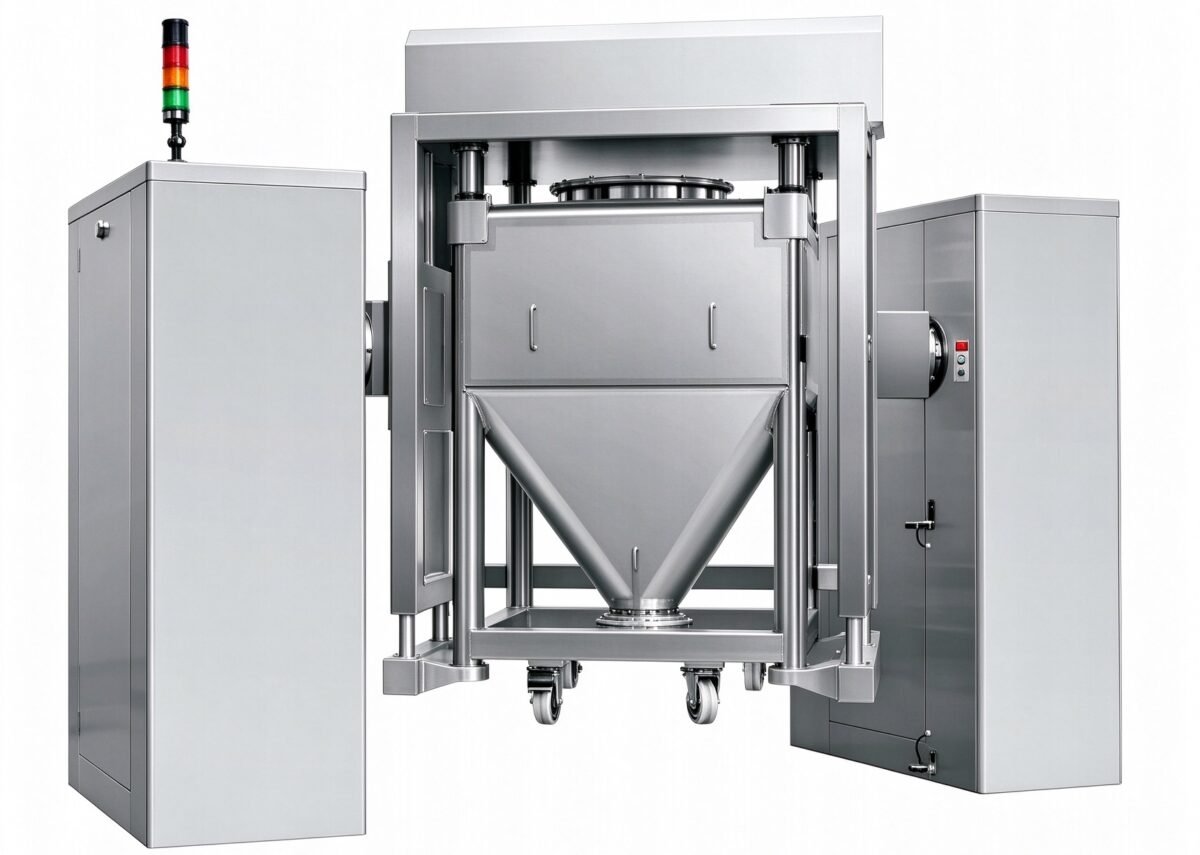
Structure: Features hydraulic or mechanical lifting columns to elevate the bin before rotation, facilitating direct discharge into downstream equipment.
Best For: Multi-floor gravity-fed lines or feeding tablet presses/capsule fillers directly without secondary transfers.
Considerations: Requires significant ceiling height and structural support for dynamic lifting loads.
Next Step: Confirm required discharge height and room clearance.
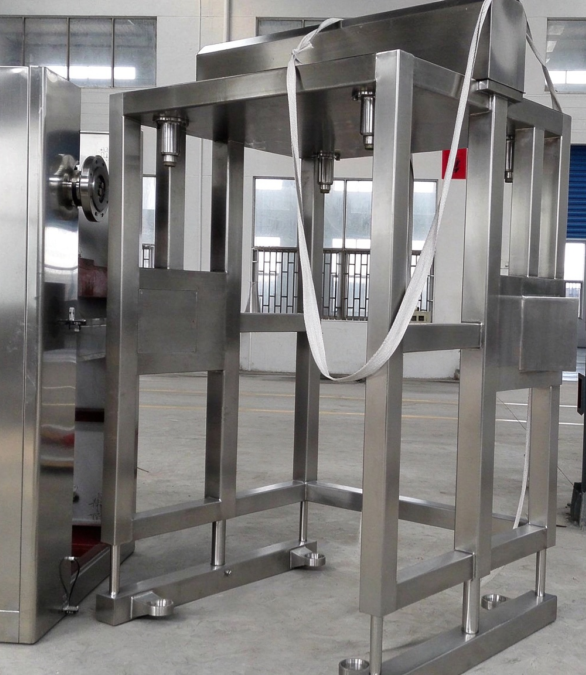
Post Bin Blender
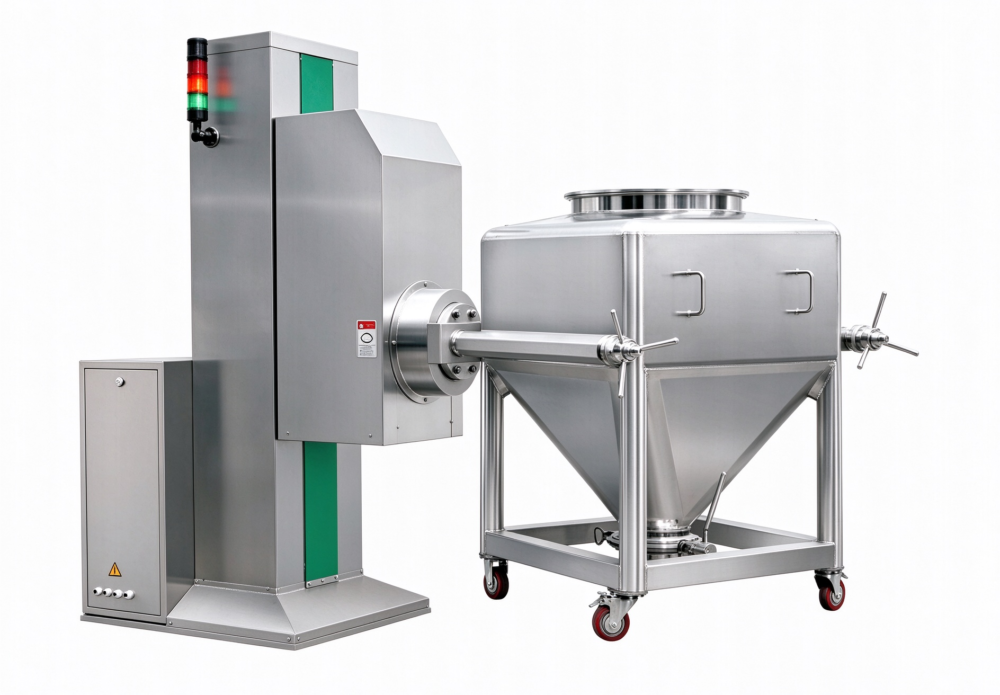
Structure: Mounted on a single robust pedestal. Utilizes exchangeable IBCs that are clamped, lifted slightly for clearance, and rotated.
Best For: High-frequency product changeovers where offline bin cleaning and preparation maximize blender uptime.
Considerations: Bin compatibility must be verified; lifting arm geometry limits the maximum bin size variance on a single machine.
Next Step: Verify existing IBC dimensions if retrofitting.
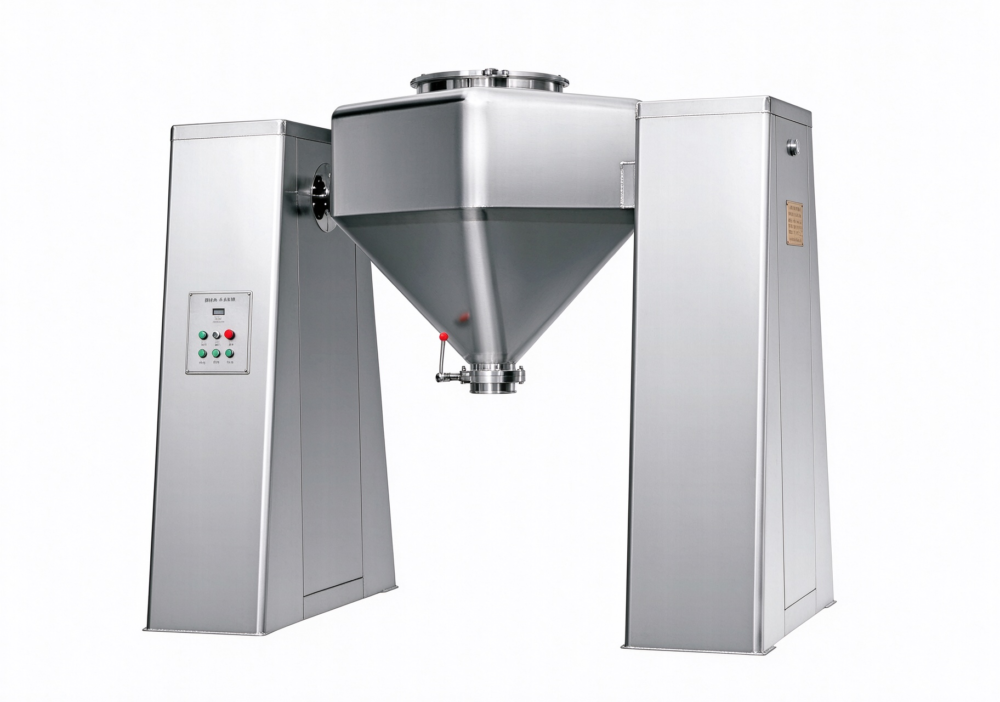
Fixed Bin Blender
Structure: The mixing vessel is permanently attached to the rotating trunnions. Materials are charged and discharged in place.
Best For: Dedicated product lines with infrequent changeovers, or processes where automated vacuum loading/discharging is preferred.
Considerations: Cleaning must occur in place (WIP/CIP), which requires planned downtime between different batches.
Next Step: Confirm cleaning validation protocols.
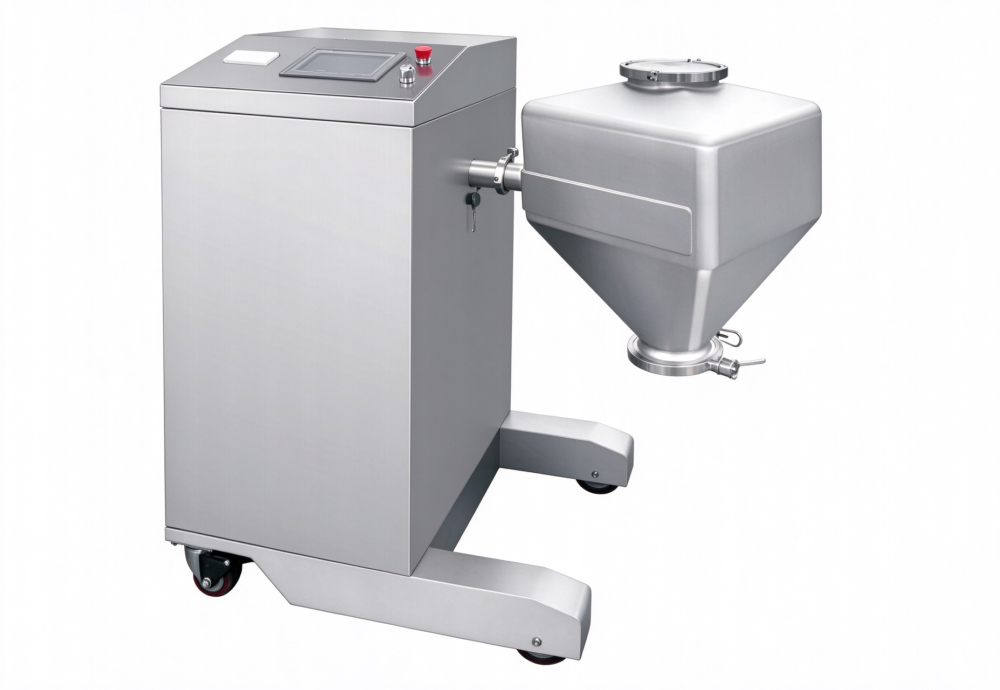
Laboratory Bin Blender
Structure: Compact benchtop or small-footprint floor model with quick-release connections for accommodating various small-volume bins.
Best For: R&D material testing, formulation development, and small clinical trial batches.
Considerations: Scale-up parameters (Froude number, fill depth) must be carefully calculated when moving to production scale.
Next Step: Specify range of interchangeable lab bins needed.
Engineering Specifications & Configuration Requirements
To provide an accurate quotation, specific mechanical and process parameters must be defined. The table below outlines the critical engineering requirements needed for selection, alongside reference ranges from historical DHC design standards.
| Specification Parameter | Buyer Must Provide | Impact on Selection |
|---|---|---|
| Nominal Bin Volume (L) | Target batch mass & bulk density | Determines physical machine size. Recommended working volume is typically 50-70% of nominal. |
| Maximum Product Load (kg) | Heaviest expected batch weight | Dictates drive motor power (kW), gear reducer sizing, and structural frame thickness. |
| Mixing Speed (rpm) | Material shear sensitivity | Requires Variable Frequency Drive (VFD) sizing. Typically ranges from 3 to 15 rpm depending on scale. |
| Surface Finish (Ra) | Sanitary requirements (e.g., GMP) | Product-contact parts typically require Ra ≤ 0.4µm (mirror or fine polish) to prevent material retention. |
| Rotation Clearance | Available room dimensions | Safety fencing and light curtains must be positioned outside the maximum swing radius of the largest bin. |
| Control & Data | Validation needs (e.g., 21 CFR Part 11) | Determines PLC/HMI complexity, audit trail software requirements, and batch report printing capabilities. |
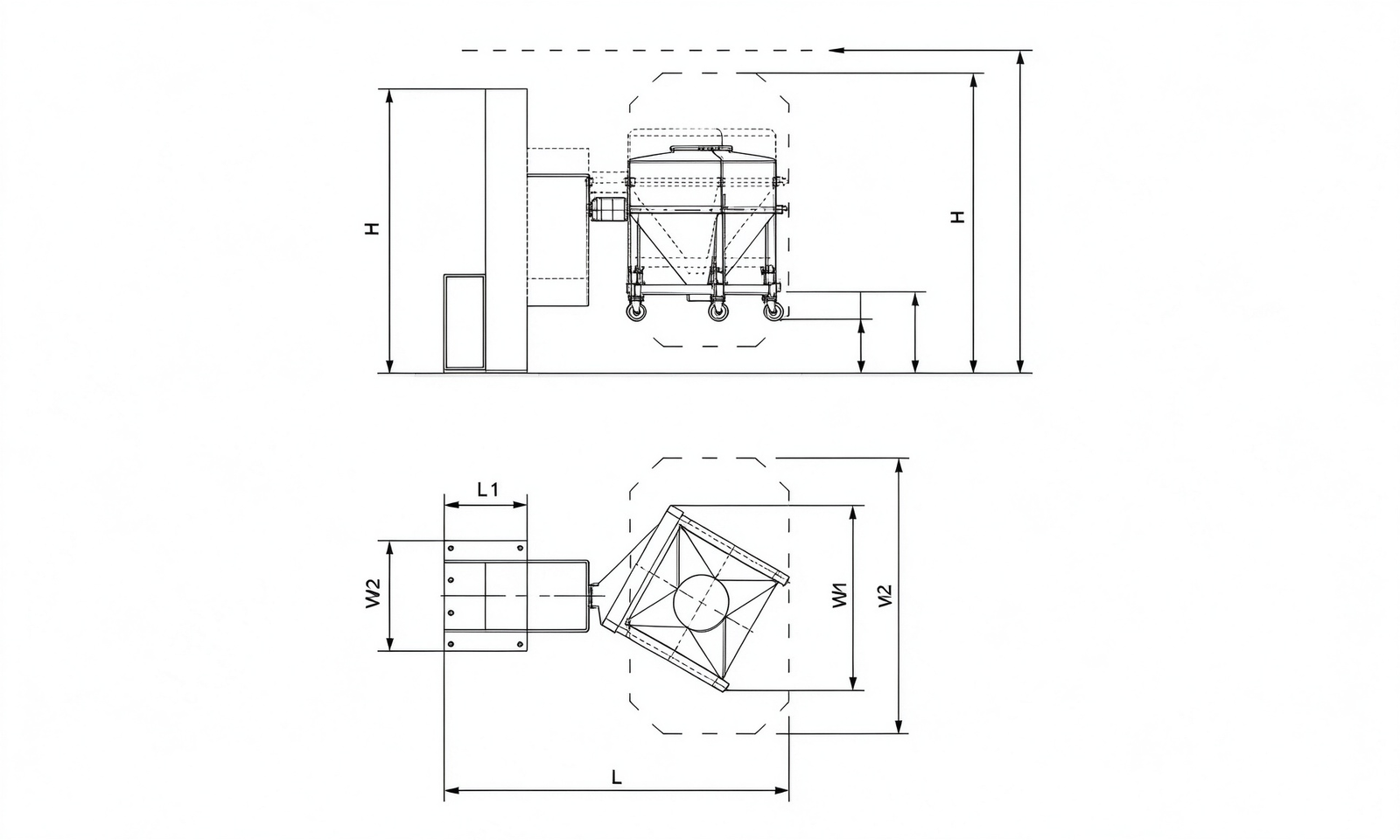
Need a Dimensional Drawing?
Space constraints are the most common installation barrier. Provide your required volume, and our engineers will generate a preliminary footprint layout.
Get a Configuration for Your BatchWhat Is a Bin Blender and How Does It Work?
A Bin Blender (or IBC Blender) is an industrial mixing system that rotates an Intermediate Bulk Container (IBC) on an asymmetrical axis. It relies on tumbling action and gravity to continuously split and recombine dry powders or granules, achieving a homogenous blend without internal agitator blades. Mixing efficiency depends on material flowability, fill volume, rotation speed, and time.
Typical Workflow for an Exchangeable Bin System
Load
Material is charged into the IBC in a separate dispensing room.
Dock & Secure
The IBC is positioned and hydraulically/mechanically clamped to the blender arm.
Lift (If Required)
The clamping arm elevates the bin to provide clearance for rotation.
Blend
Bin rotates at set RPM/time. Asymmetrical axis ensures 3D powder movement.
Return
Blender stops automatically at the vertical position and lowers the bin.
Transfer
Bin is released and moved to downstream equipment. Empty bin goes to wash.
Solve the Bottlenecks Around Your Blending Process
Addressing common production inefficiencies through proper structural selection and process integration.
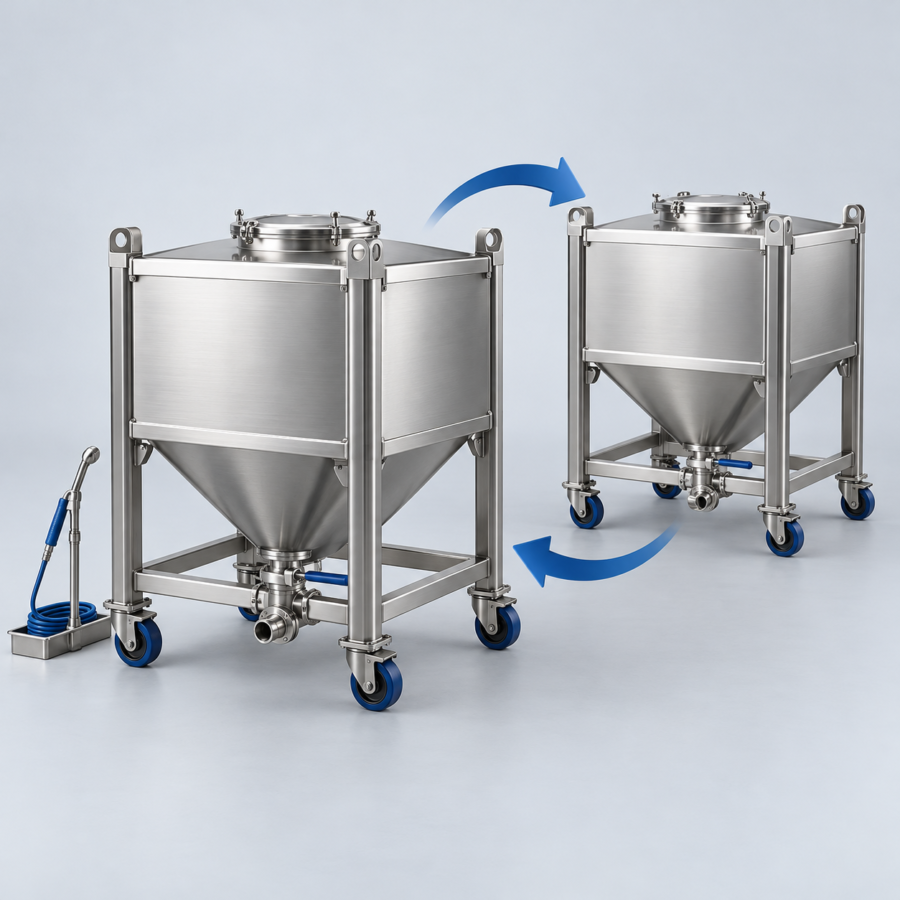
1. Idle Time During Cleaning
Constraint: Cleaning fixed-vessel blenders in place causes hours of machine downtime between different product batches.
Design Solution: Exchangeable IBC systems allow dirty bins to be removed immediately. The blender can resume operation with a pre-loaded, clean bin.
Verification Needed: Must establish validated offline bin washing procedures (WIP/CIP stations) to realize these uptime gains.
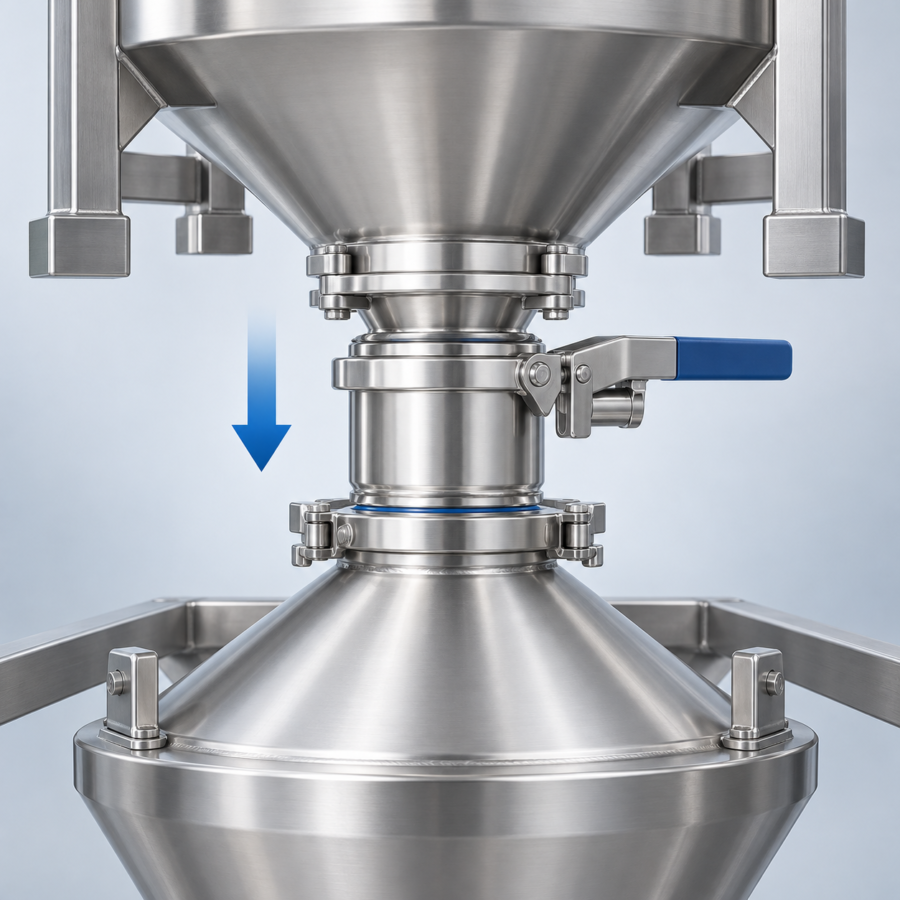
2. Transfer Exposure & Product Loss
Constraint: Scooping or open-pouring powders between mixers and hoppers generates dust, risking operator exposure and cross-contamination.
Design Solution: The IBC acts as both the blending vessel and the transfer container. Utilizing sanitary butterfly valves and docking stations maintains a closed system.
Verification Needed: Confirm mating valve types (e.g., split butterfly valves for high containment) and interface compatibility with downstream presses.
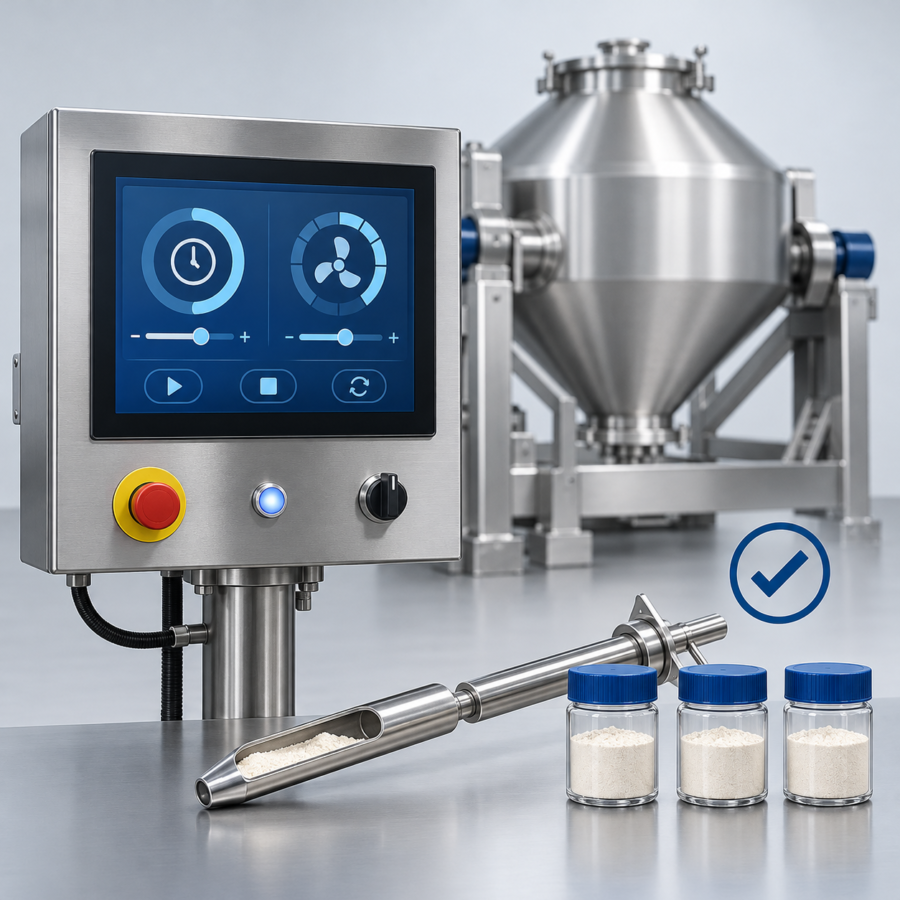
3. Batch Consistency Verification
Constraint: Manual timing or inconsistent rotation speeds lead to under-mixed or over-mixed (segregated) batches.
Design Solution: PLC/HMI controls enforce precise VFD speed regulation and automated timers, ensuring repeatable energy input per batch.
Verification Needed: Hardware controls alone do not guarantee uniformity. Blend times must be validated via representative sampling and material testing.
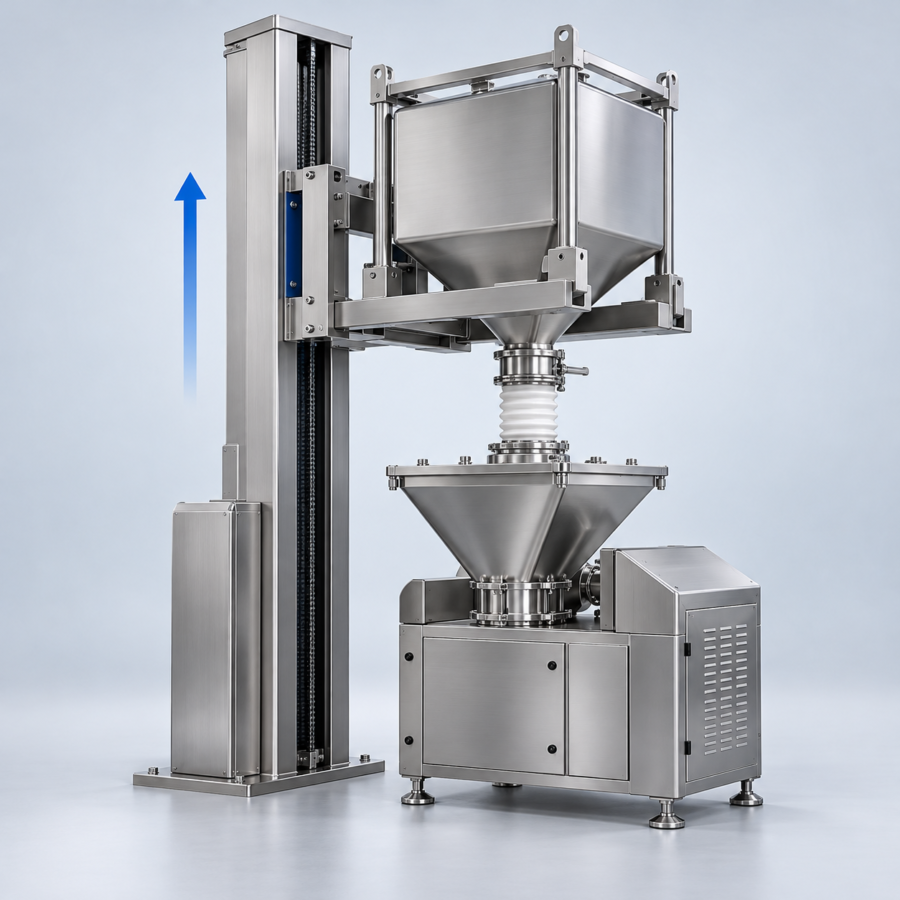
4. Constrained Downstream Feeding
Constraint: Moving blended powder from floor level up into tall tablet press hoppers requires complex vacuum conveying or manual lifting.
Design Solution: Automatic lifting blenders (like the HZD series structure) elevate the bin to the required discharge height directly over the receiving equipment.
Verification Needed: Coordinate required discharge height against factory ceiling limits and maintenance access requirements.
Engineering Details That Matter
Durable mechanical design and sanitary construction are critical for pharmaceutical and high-value chemical applications. Review these key inspection points.
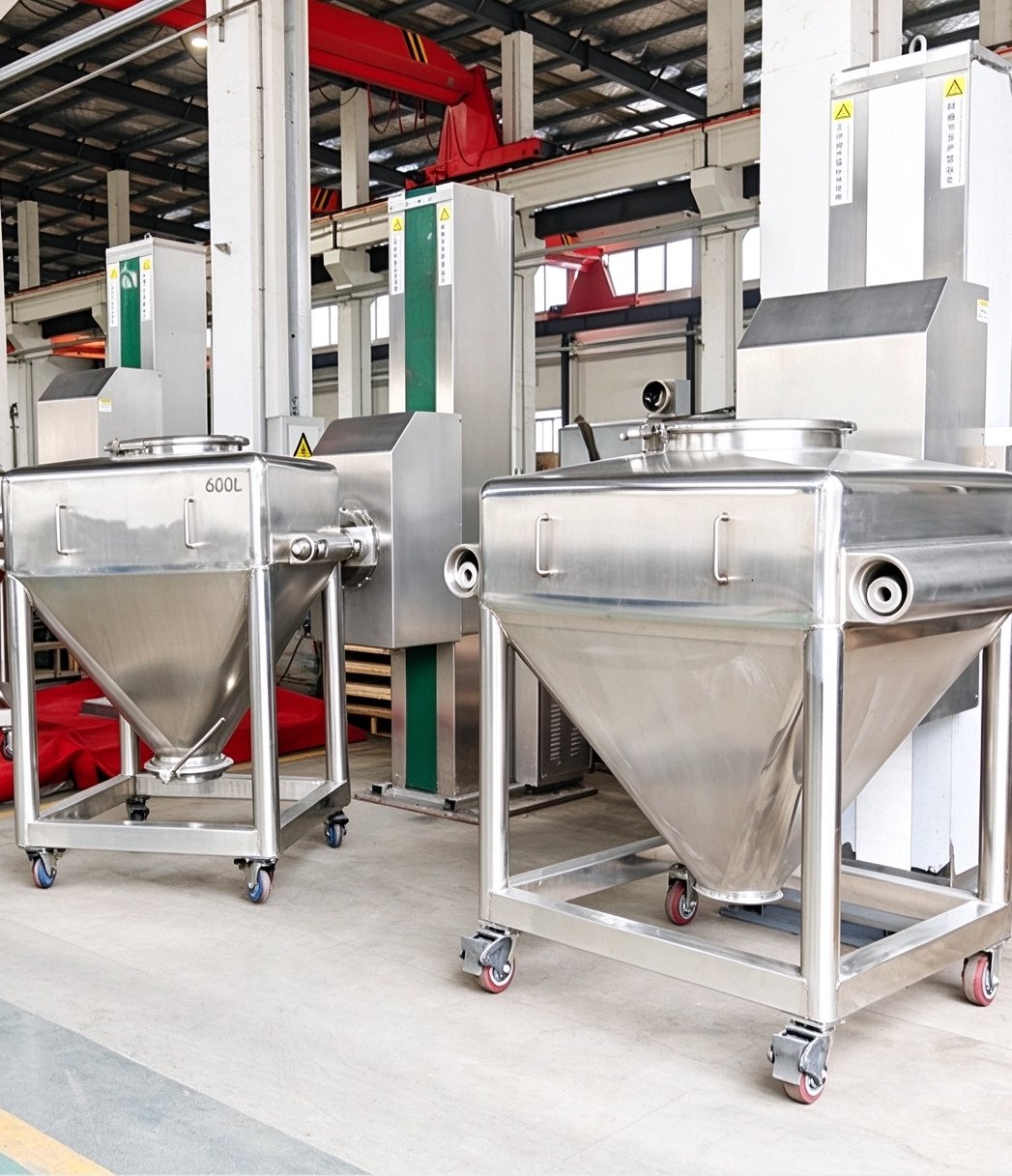
Clamping & Securing Mechanism
Verified FeatureWhy it matters: Ensures the heavy IBC cannot detach during dynamic rotation.
How to check: Inspect hydraulic pressure sensors or mechanical locking pins that interlock with the drive motor, preventing rotation if clamping is incomplete.
Product Contact Surfaces
Project OptionalWhy it matters: Rough welds trap powder, causing cross-contamination and failing cleaning validation.
How to check: Specify 316L stainless steel for contact parts. Request surface roughness (Ra) certificates for internal welds (typically ground smooth and polished to Ra ≤ 0.4µm).
Discharge Valve Design
Needs ConfirmationWhy it matters: The valve is the most common point of leakage and difficult cleaning.
How to check: Ensure the sanitary butterfly valve features a quick-release, tool-less teardown design with FDA-compliant silicone or EPDM seals.
Safety & Interlocks
Verified FeatureWhy it matters: Rotating heavy bins present severe crushing hazards to operators.
How to check: Verify the inclusion of infrared light curtains or physical safety fences wired to the machine's emergency stop logic.
Applications and Process Integration
Bin blenders are central to solid dosage manufacturing, effectively linking upstream material preparation with downstream processing.
Weighing, Dispensing, Granulation, Drying
Lubricant addition, Final homogeneous mix
Dust-free docking, Gravity feed
Tablet Pressing, Capsule Filling, Sachet Packing
Pharmaceutical Solid Dose
- Task: Blending APIs with excipients and lubricants (e.g., magnesium stearate).
- Requirement: High containment, strict Ra ≤ 0.4µm finish, accurate audit trails.
- Risk: Over-mixing sensitive lubricants can reduce tablet hardness.
Nutraceuticals
- Task: Vitamin premixes, protein powder blends, herbal extracts.
- Requirement: Handling variable bulk densities, frequent flavor changeovers.
- Risk: Cross-contamination between allergen-containing batches requires rigorous offline bin cleaning.
Specialty Chemicals & Food
- Task: Spice blends, battery materials, ceramic powders.
- Requirement: Heavy-duty drive systems for high-density materials.
- Risk: Abrasive materials may require special wear-resistant coatings or thicker bin walls.
Manufacturing, Inspection & Documentation
Industrial equipment procurement requires verifiable quality control. The following documentation packages should be negotiated and confirmed during your project discussion.
-
Material Traceability Mill test certificates for 316L/304 stainless steel product-contact parts.
-
Factory Acceptance Testing (FAT) Pre-shipment functional testing of clamping, rotation, interlocks, and control logic.
-
Validation Support (IQ/OQ) Installation and Operational Qualification protocols available upon request for regulated industries.
How to Choose the Right Bin Blender
Follow these engineering steps to size and configure your blending system correctly.
Define Mass & Density
Determine your target batch mass (kg) and the bulk density (kg/L) of your mixed powder.
Assess Material Properties
Evaluate flowability, particle size, density differences, and risks of agglomeration or segregation.
Calculate Required Volume
Use the formula below to find the nominal volume based on a recommended working fill fraction.
Fixed vs. Exchangeable
Compare fixed bin configurations (lower upfront cost) against exchangeable IBCs (higher throughput).
Verify Facility Space
Confirm room height, floor loading, rotation clearance, and lifting height for downstream interfaces.
Confirm Compliance
Specify cleaning methods (WIP/CIP), safety fencing, control systems, and validation (IQ/OQ) needs.
Volume Calculation Formula
Example Calculation:
Targeting a 200 kg batch of powder with a bulk density of 0.5 kg/L, assuming a 60% fill rate:
200 kg ÷ 0.5 kg/L ÷ 0.60 ≈ 667 L (Select a 600L or 800L standard bin depending on actual material tests).
* Note: 60% is an estimation assumption. Actual recommended fill rates vary (typically 50-70%) based on material flow and bin geometry. Always verify mechanical load limits.
Equipment Comparison
Understand how Bin Blenders compare to other common industrial mixers to ensure you choose the right technology for your powder.
| Feature | Bin Blender (IBC) | V-Blender | Ribbon Blender |
|---|---|---|---|
| Primary Mixing Action | Tumbling (Asymmetrical rotation) | Tumbling (Splitting/recombining) | Convective (Internal agitator blades) |
| Vessel Separation | Typically detachable (Exchangeable bins) | Fixed vessel | Fixed vessel |
| Changeover & Cleaning | Fast (Swap bins; wash offline) | Slower (Wash in place) | Slowest (Complex internal shaft/blades) |
| Shear Sensitivity | Low shear (Gentle on granules) | Low shear (Unless intensifier bar added) | Medium to High shear (Can degrade fragile particles) |
| De-agglomeration | Poor (Not designed for breaking lumps) | Fair (If equipped with intensifier bar) | Good (Blades provide mechanical force) |
Frequently Asked Questions
Common engineering and procurement questions regarding bin blender selection and operation.
Is a bin blender the same as an IBC blender?
What powders and granules are suitable for bin blending?
Can one blender handle different bin sizes?
What determines the mixing time?
How is blend uniformity evaluated?
How are the bin and discharge valve cleaned?
Related Equipment
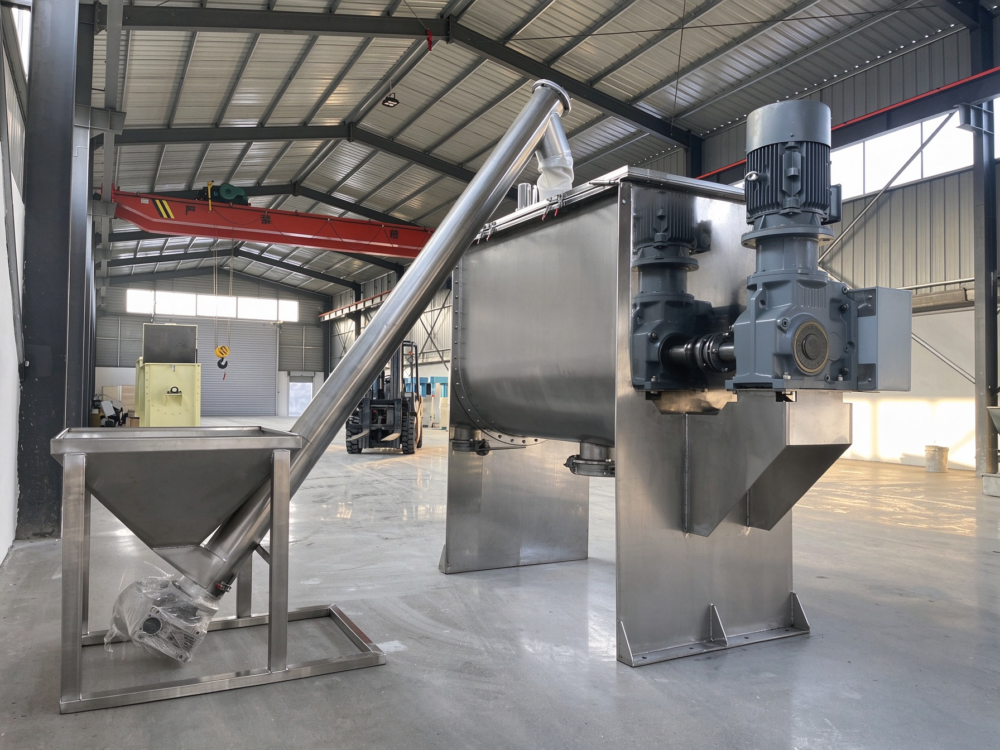
Ribbon Blender
Highly efficient blending equipment for dry powders, granules, and cohesive materials.
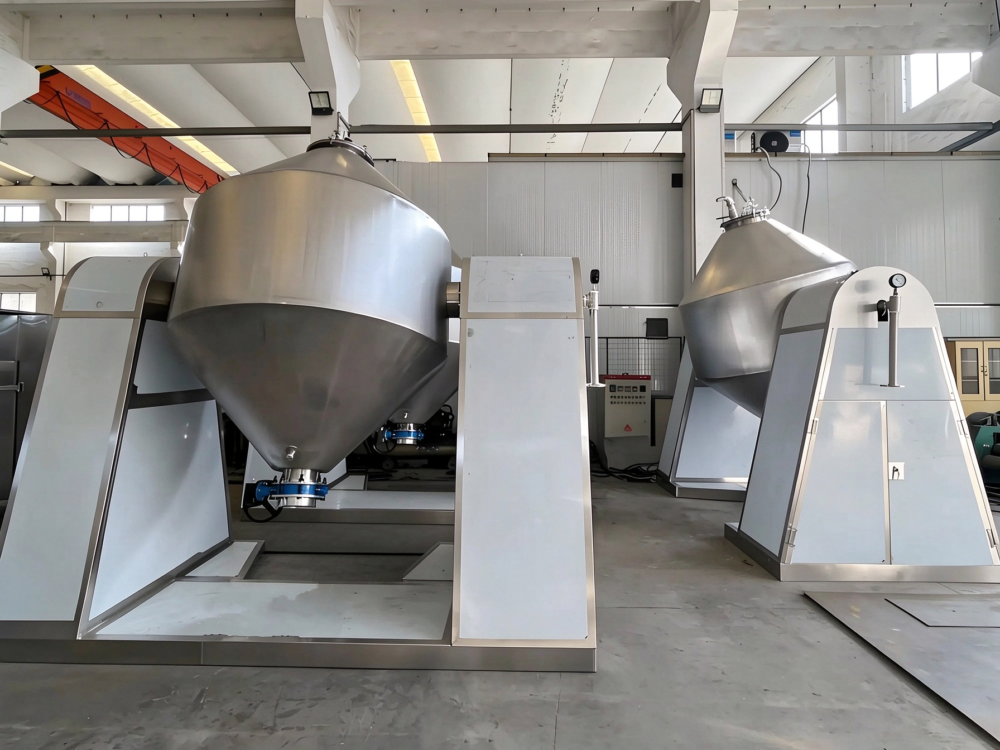
Double Cone Vacuum Dryer
Gentle and efficient vacuum drying system ideal for heat-sensitive and easily oxidizable materials.
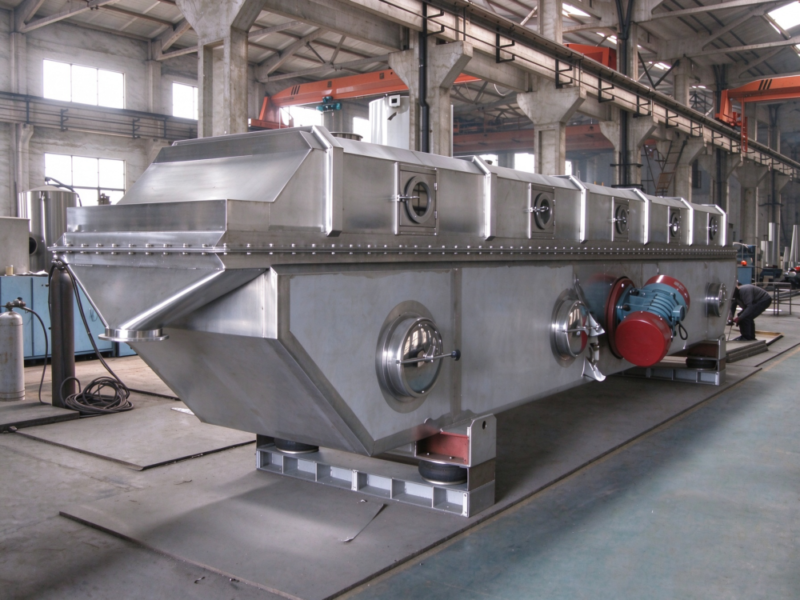
Vibrating Fluid Bed Dryer
Continuous drying and cooling equipment ensuring uniform particle processing and high thermal efficiency.
Find the Right Bin Blender for Your Material and Batch
Provide your basic batch requirements, and our engineering team will suggest the appropriate structural configuration, sizing, and preliminary footprint.