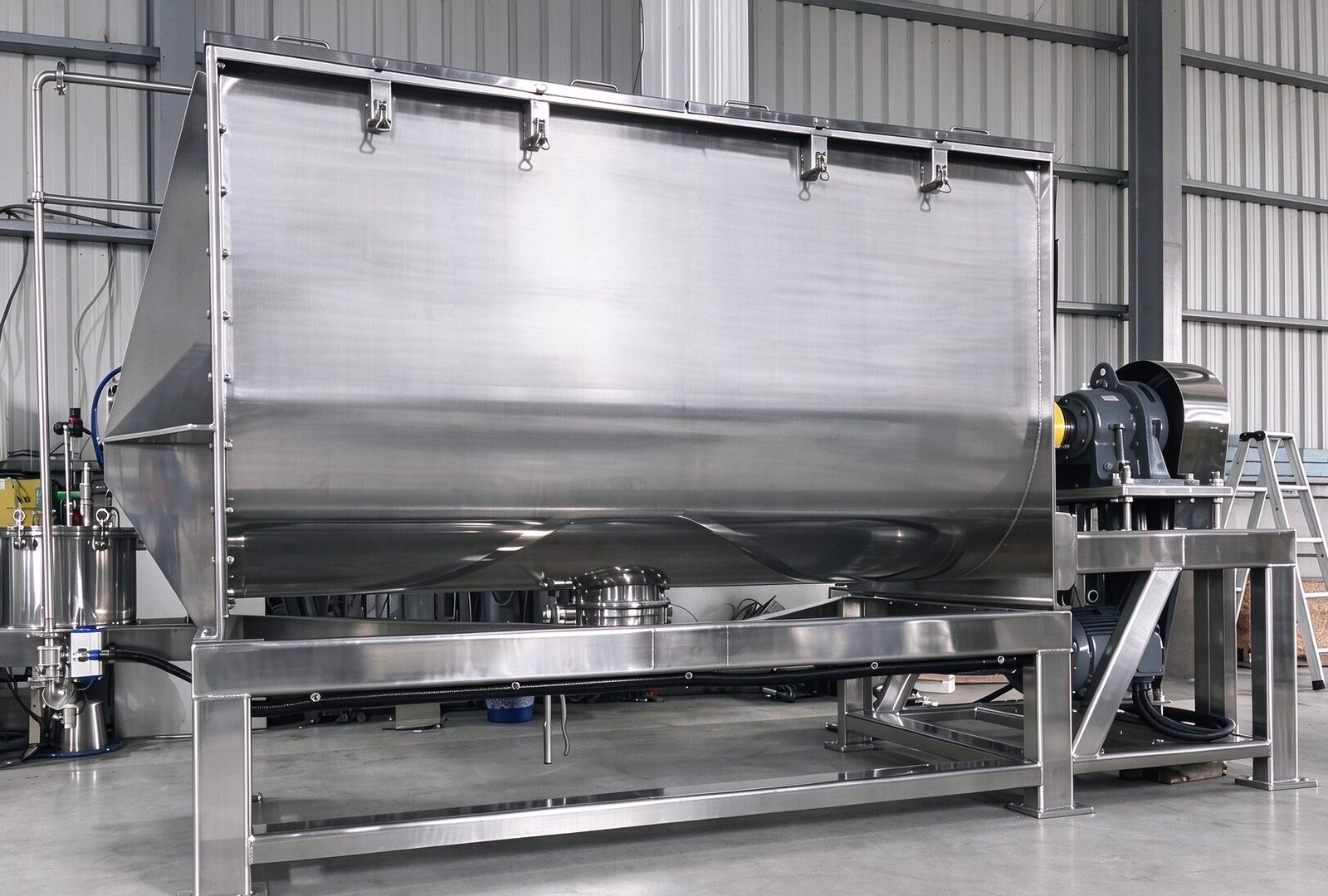
Ribbon Blender for Industrial Powder Mixing
A horizontal U-shaped powder mixer with inner and outer ribbons that move material in opposing axial directions. Configure the blender around your material, bulk density, batch size, cleanability and production requirements.
Documented Reference Specification Highlights
- 200 L reference full volume
- SS316L product-contact interior
- 3 kW inverter-driven unit
- 30–40 rpm reference speed
Quick Application Check
Review these key factors before sizing a horizontal ribbon mixer for your production line.
Material behavior
Is the powder free-flowing, cohesive, or fragile? Ribbon blenders are best suited for powders with sufficient flowability and moderate shear tolerance.
Batch volume and bulk density
What is the material’s bulk density? Batch weight in kilograms alone is not enough to size a ribbon blender; volume must be calculated.
Cleaning and changeover
How often do you change recipes? Consider the internal finish and access required to prevent cross-contamination between batches.
Discharge and downstream connection
How will the mixed powder exit the machine? The discharge valve height and type must match your downstream packaging or conveying system.
What Is a Ribbon Blender?
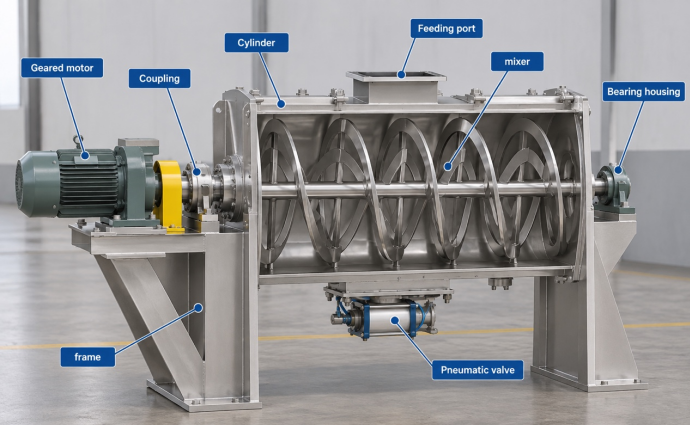
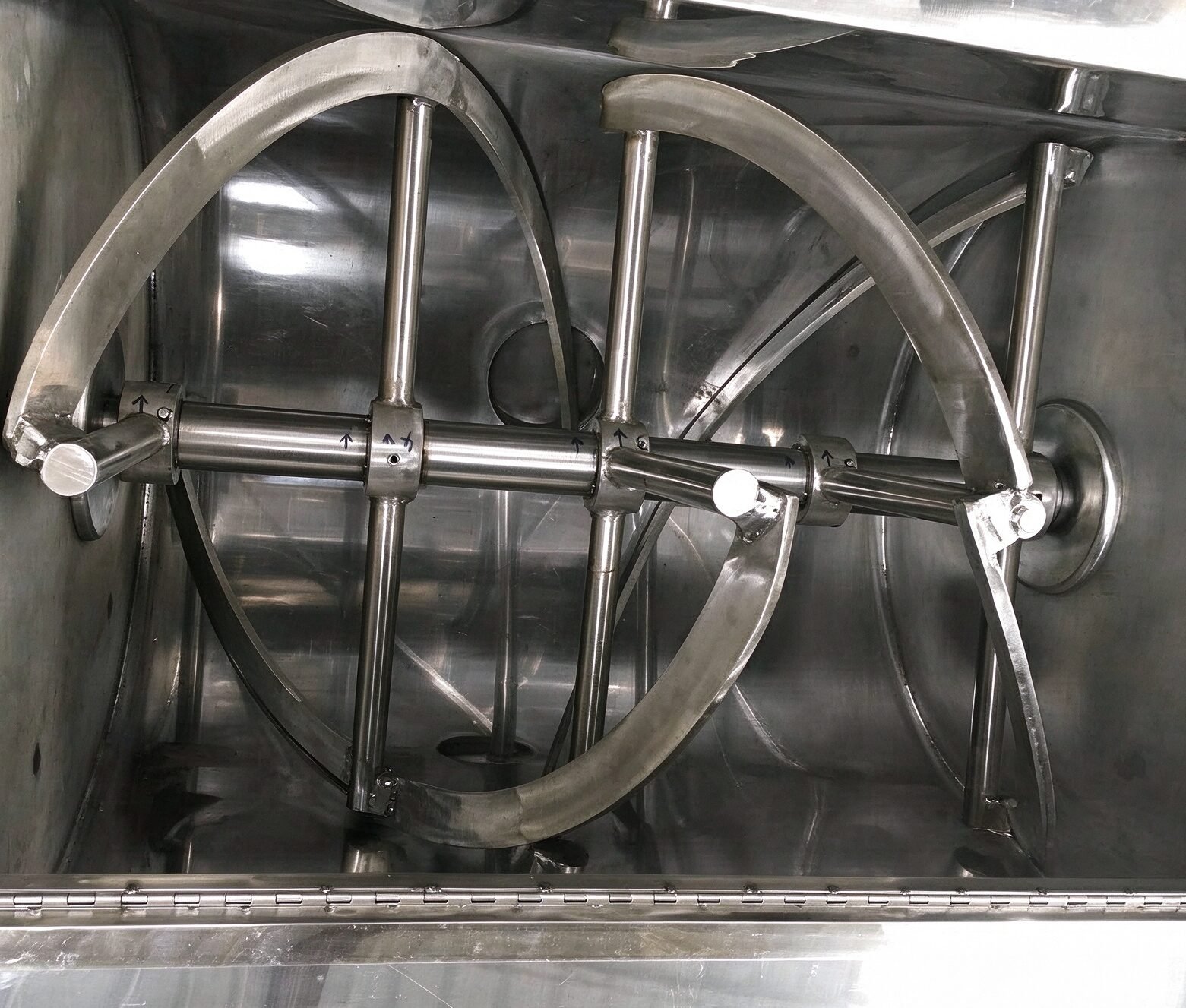
A Ribbon Blender is an industrial horizontal batch mixing machine. It is primarily constructed with a U-shaped trough, a horizontal agitator shaft equipped with inner and outer helical ribbons, a drive system, shaft end seals, and a bottom discharge assembly.
This equipment is designed to blend dry powders and granules that possess sufficient flowability. The opposing ribbons create a convective motion, ensuring materials are continuously moved throughout the vessel.
While highly versatile, applications involving minor liquid additions, sticky materials, or specialized formulations must be evaluated based on the actual recipe to ensure the blender can achieve the desired homogeneity without agglomeration.
Explore our powder mixing equipmentHow Does a Ribbon Blender Work?
The mixing principle relies on the convective circulation of materials driven
Loading
Material is loaded into the U-shaped trough from the top cover. The batch volume must allow enough headspace for the material to expand and circulate.
Convective Mixing
The outer and inner ribbons move material in opposite axial directions while also circulating it radially. Typically, outer ribbons push material toward the center, while inner ribbons push it toward the ends.
Discharging
After the required mixing cycle, material is discharged through the bottom valve. The actual flow pattern during mixing is influenced by ribbon design, speed, fill level, and powder properties.
Watch the Process Flow
Observe how the dual-ribbon agitator creates a continuous, dynamic exchange of particles. The video demonstrates the loading phase, the opposing axial movements of the powder bed, and the central discharge operation.
Design Details That Matter in Daily Production
Engineered to address common operator challenges regarding cleanability,
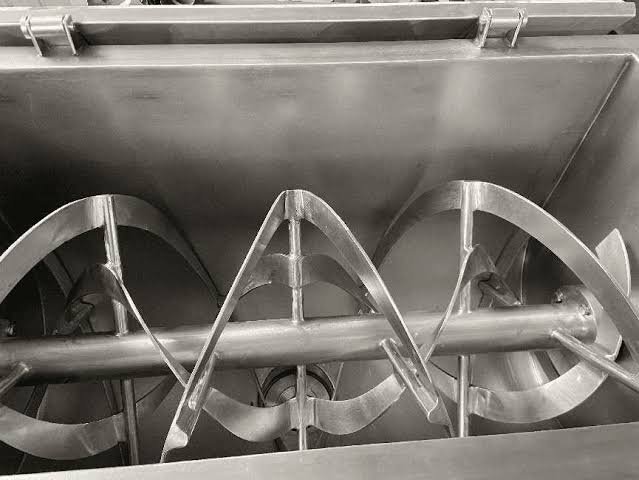
Counter-Directional Double Ribbons
For formulations requiring thorough blending, gravity alone is insufficient. The inner and outer ribbons form active axial and radial material circulation to ensure particle exchange.
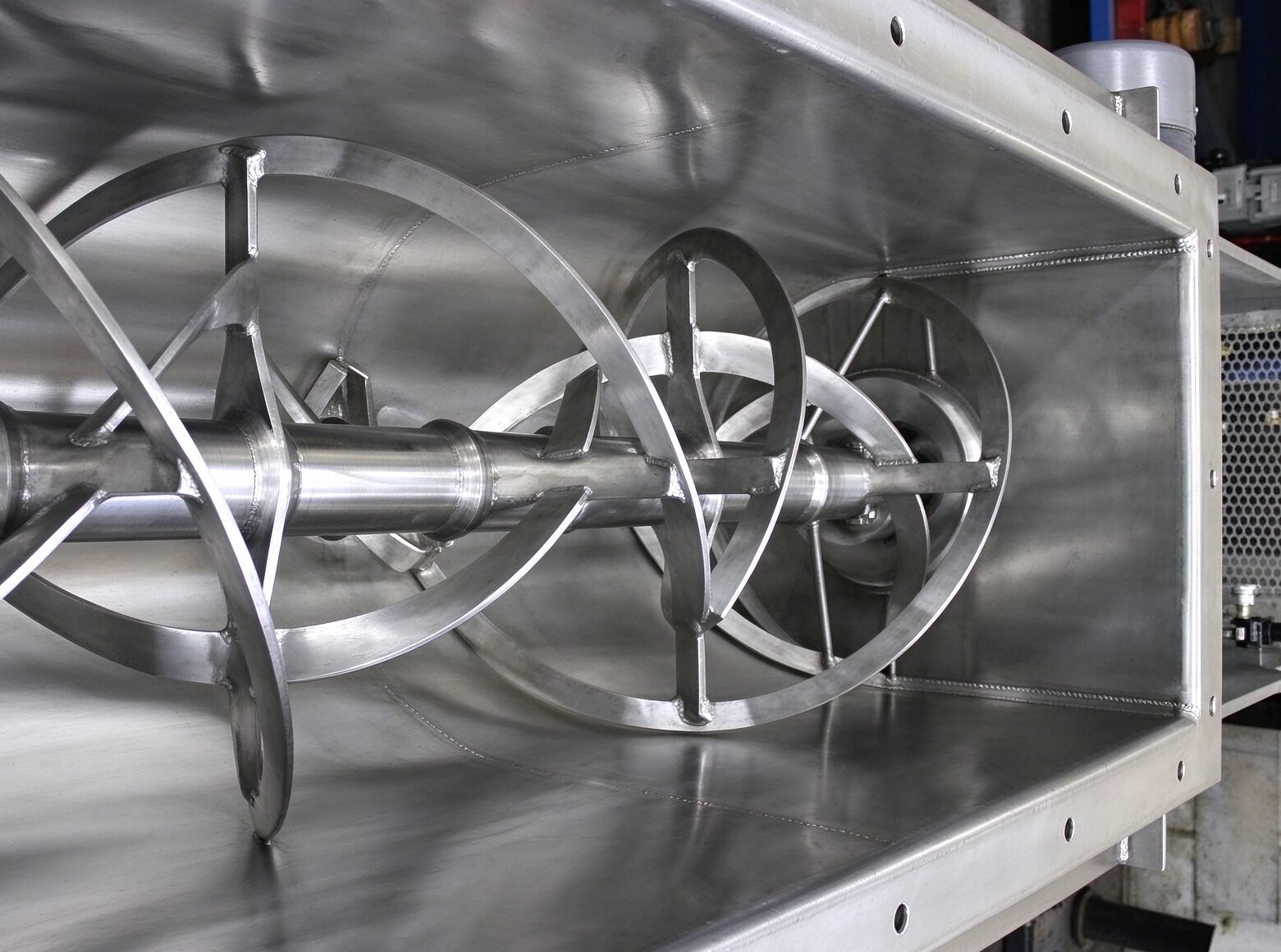
SS316L Product-Contact Interior
When processing corrosive or high-hygiene materials, standard steel degrades. The 200 L reference configuration utilizes SS316L for all internal wetted parts to maintain material integrity.
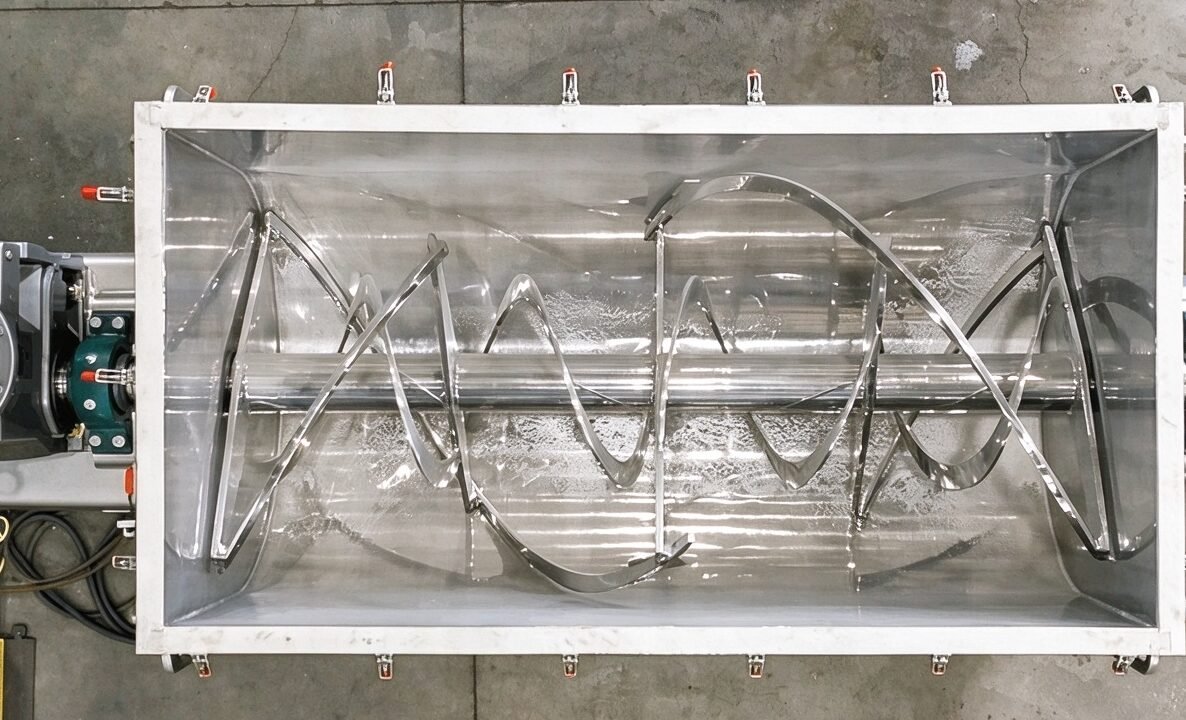
Polished Internal Surfaces
Manual wiping of rough surfaces extends downtime. The Ra ≤ 0.6 μm verified polish on internal surfaces reduces material adhesion, offering practical value for cleaning and residue control.
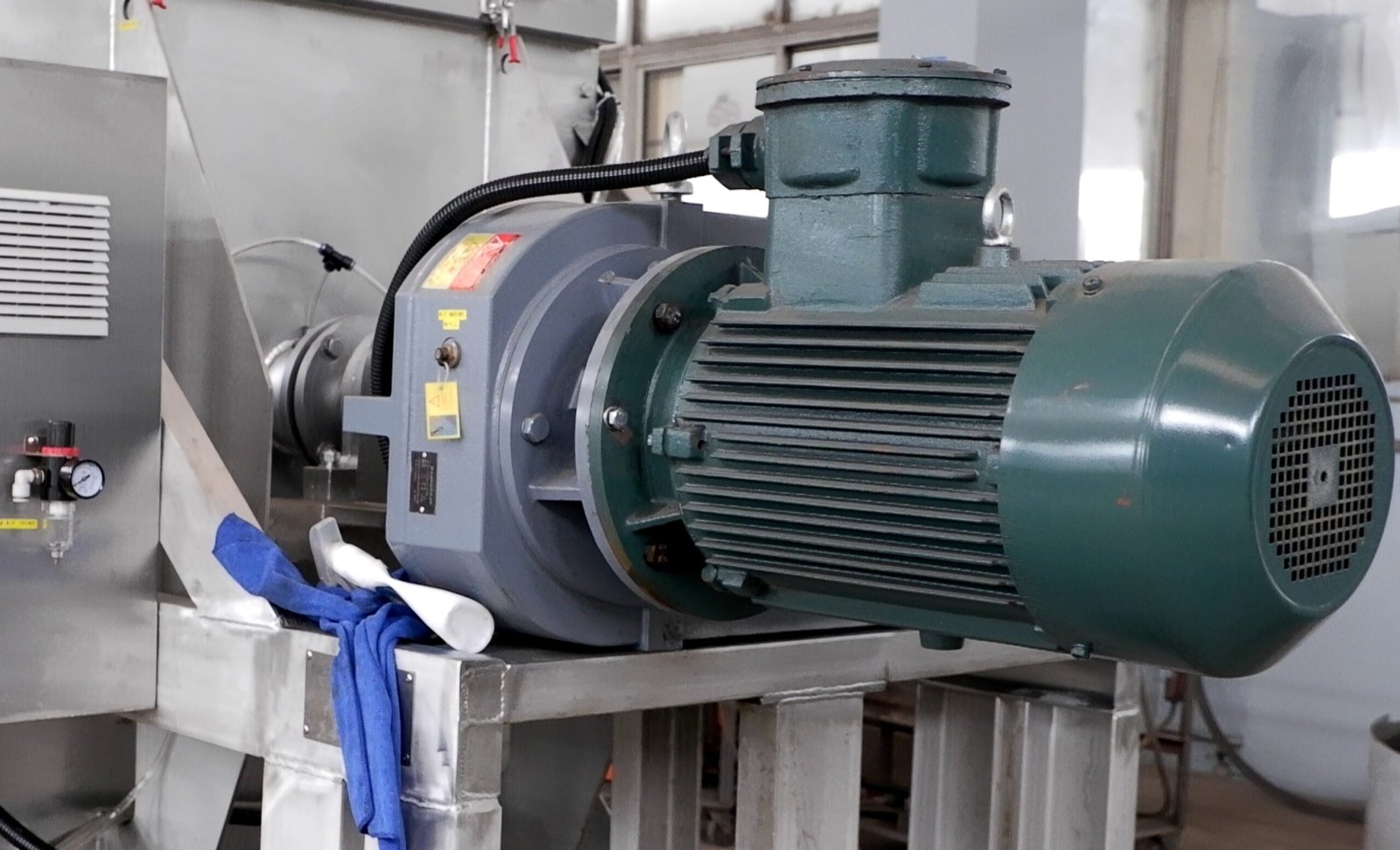
Variable-Speed Drive
Different bulk densities require different shear inputs. The reference 3 kW inverter-driven motor allows adjustment within the 30–40 rpm range to suit specific powder characteristics.
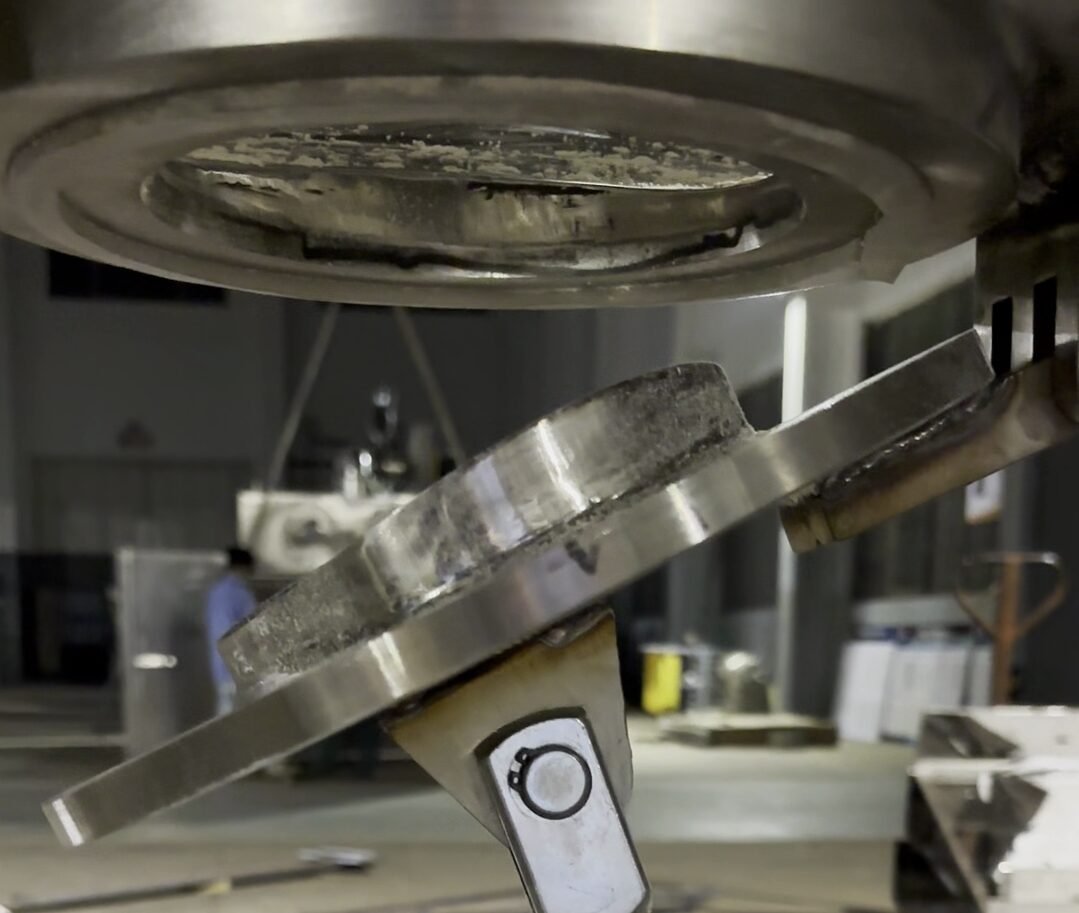
Pneumatic Bottom Discharge
Manual valves slow down batch cycles. The pneumatic discharge facilitates rapid material exit and simplifies connection to downstream hoppers, conveyors, or packaging lines.
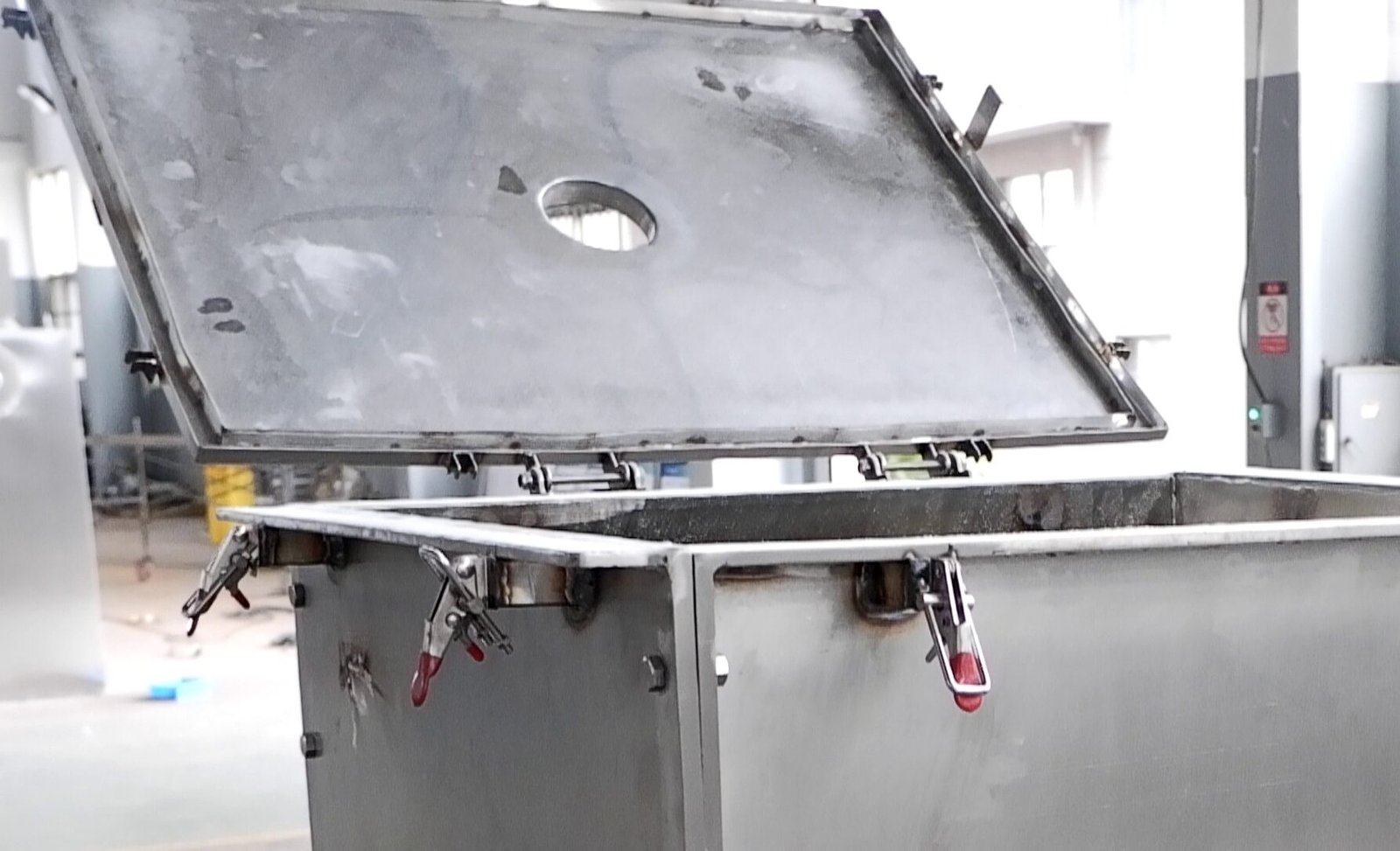
Cover Safety Interlock
Operator safety during inspection is critical. A proximity switch is integrated to automatically stop the agitator rotation whenever the main cover is opened.
Packing and PTFE Shaft Sealing
Powder leakage at the shaft ends causes waste and bearing damage. The reference configuration employs a combination of packing seal and PTFE to secure the shaft ends during operation.
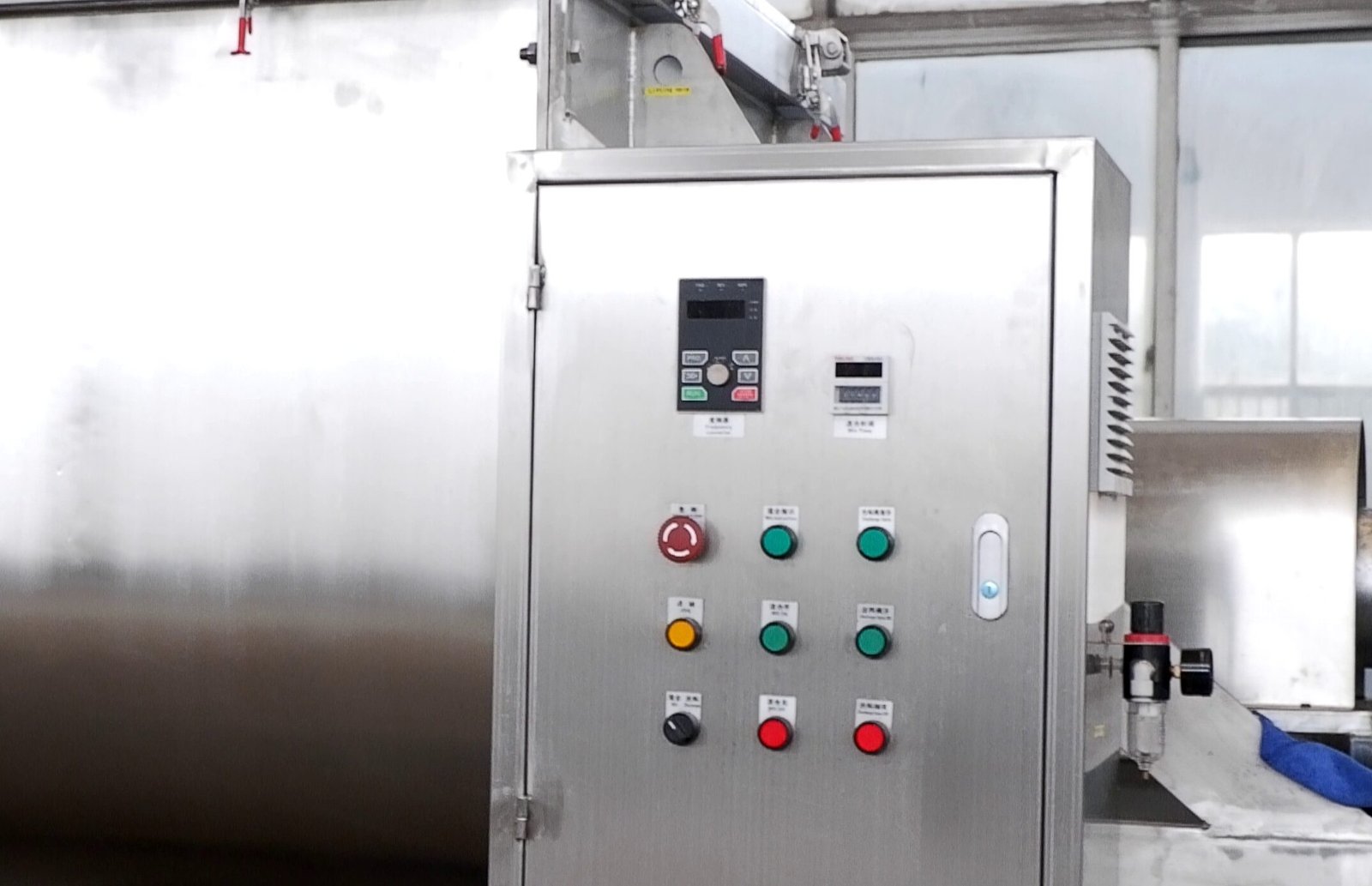
IP65 Control Cabinet
Dusty environments threaten electrical reliability. The individual push-button cabinet is rated IP65 and utilizes verified Schneider Electric components for stable daily control.
200 L Ribbon Blender Reference Specifications
Note: The values below describe one documented 200 L configuration. Final specifications are selected according to the material, required batch volume, site utilities, and safety requirements.
| Specification | Verified Reference Value |
|---|---|
| Equipment type | Horizontal double ribbon blender |
| Vessel construction | U-shaped horizontal trough |
| Full vessel volume | 200 L (Not guaranteed working volume) |
| Reference batch | Approx. 50 kg for a flour-like material |
| Reference bulk density | 0.4–0.6 kg/L |
| Internal product-contact | SS316L in this reference configuration |
| Internal surface finish | Mirror polished, Ra ≤ 0.6 μm |
| Main motor & Inverter | 3 kW / 3 kW |
| Reference speed | 30–40 rpm |
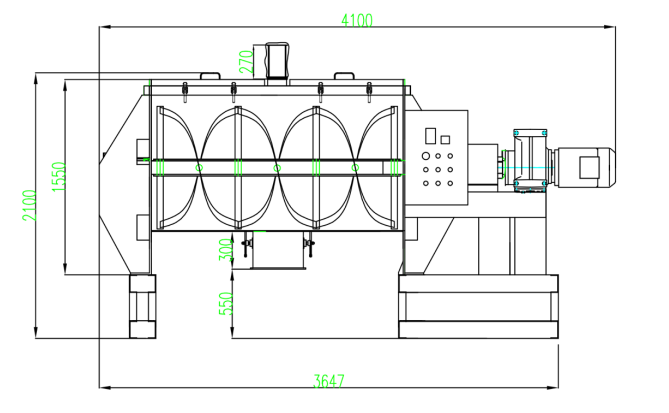
| Machine dimensions | Approx. 1,800 × 850 × 1,500 mm |
| Machine weight | Approx. 500 kg |
| Reference power supply | 400 V / 50 Hz / 3 phase (Others must be confirmed) |
| Discharge | Pneumatic discharge valve |
| Shaft sealing | Packing seal plus PTFE seal |
| Cover | Quick-opening cover assisted by pneumatic spring |
| Safety | Proximity switch stops mixer when cover is open |
| Control cabinet | Individual push-button cabinet, IP65 (Schneider components) |
| Powder area requirement | Reference project specified Zone 22; project compliance and certification must be confirmed separately. |
Volume Calculation Formula
Equipment capacity is sized by volume, not just weight. Batch weight depends heavily on bulk density.
Example Calculation:
This is a preliminary volume conversion. It cannot replace professional equipment sizing or actual material testing. Final capacity and motor power must be confirmed by JEXDRY engineering.
Configure the Ribbon Blender Around Your Process
We build the system based on your engineering data, rather than
Material-Contact Construction
Data needed from buyer: Material corrosiveness, abrasiveness, and hygiene standards.
- Reference: SS316L internal construction.
- To be confirmed: SS304 construction, special coatings.
Discuss this requirement with JEXDRY engineering.
Drive and Speed Control
Data needed from buyer: Bulk density, stickiness, start-under-load requirements, factory voltage.
- Reference: 3 kW motor with inverter, 400V/50Hz.
- To be confirmed: Explosion-protected motor and controls, different capacities.
Discuss this requirement with JEXDRY engineering.
Discharge & Downstream Connection
Data needed from buyer: Discharge height, connecting hopper dimensions, packaging line layout.
- Reference: Pneumatic central bottom valve.
- To be confirmed: Full-length drop-bottom discharge.
Discuss this requirement with JEXDRY engineering.
Process Add-ons & Safety
Data needed from buyer: Liquid addition percentage, heating/cooling needs, hazardous dust classification.
- Reference: Cover safety interlock, standard shaft seals.
- To be confirmed: Liquid spray system, heating/cooling jacket, high-speed chopper, load cells, vacuum operation, CIP system.
Discuss this requirement with JEXDRY engineering.
Materials Suitable for Ribbon Blender
Ribbon blenders are mainly used for mixing dry powders, granules and other free-flowing bulk materials. They are commonly applied in food, pharmaceutical,
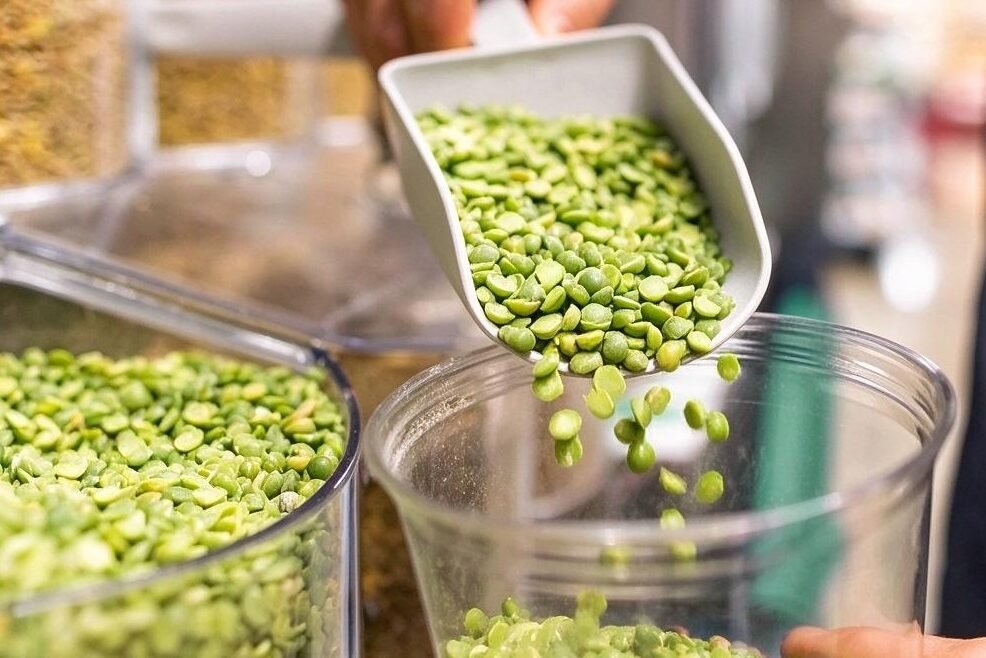
Food & Ingredients
- Flour
- Starch
- Sugar
- Spices & Seasonings
- Protein Powder
- Bakery Premixes
Suitable for blending dry food powders and ingredient premixes where consistent distribution of multiple components is required.
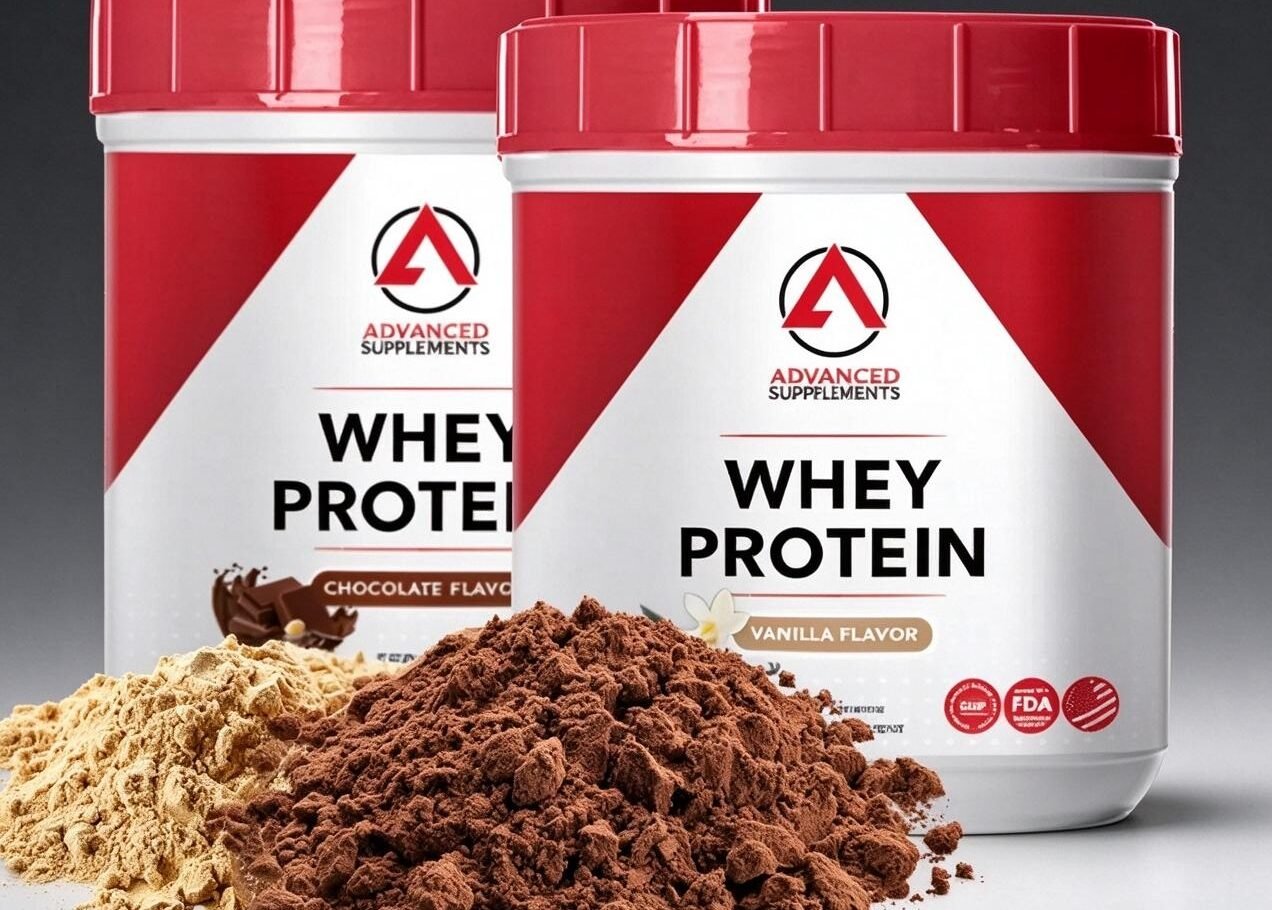
Pharmaceutical & Nutraceutical Powders
- Pharmaceutical Excipients
- Vitamin Premixes
- Mineral Premixes
- Herbal Powders
- Nutraceutical Powders
- Pharmaceutical Granules
Used for dry powder and granule blending where multiple ingredients need to be distributed throughout a batch.
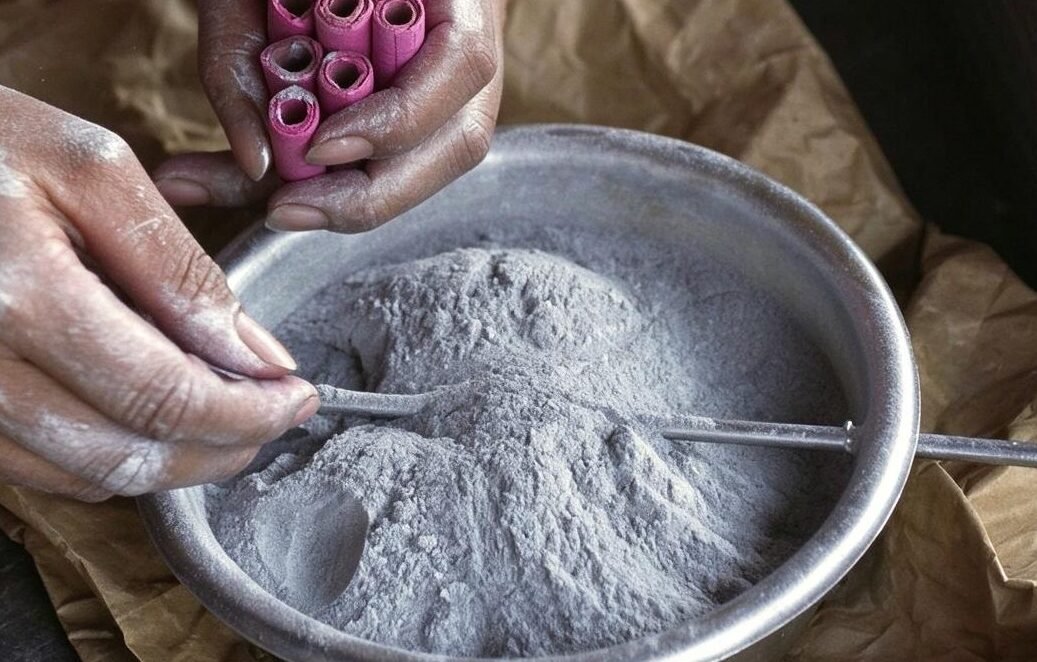
Chemical & Industrial Powders
- Pigments
- Fillers
- Detergent Powder
- Fertilizer Powder
- Polymer Powder
- Mineral Blends
Suitable for many dry chemical and industrial formulations, with mixer configuration selected according to bulk density, particle size and flowability.
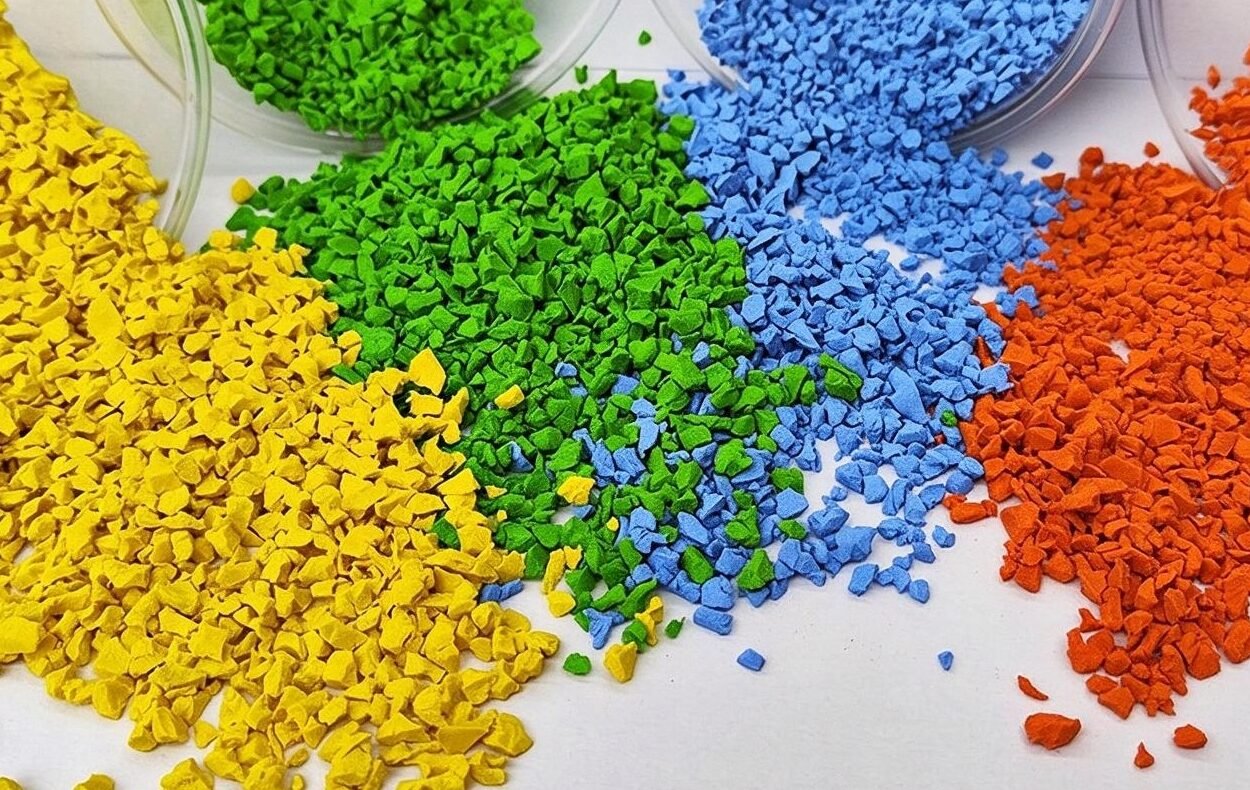
Granules & Free-Flowing Solids
- Fertilizer Granules
- Plastic Granules
- Feed Ingredients
- Food Granules
- Pharmaceutical Granules
- Dry Bulk Solids
Ribbon blenders can also handle many free-flowing granules and bulk solids when particle breakage and segregation are properly considered during mixer selection.
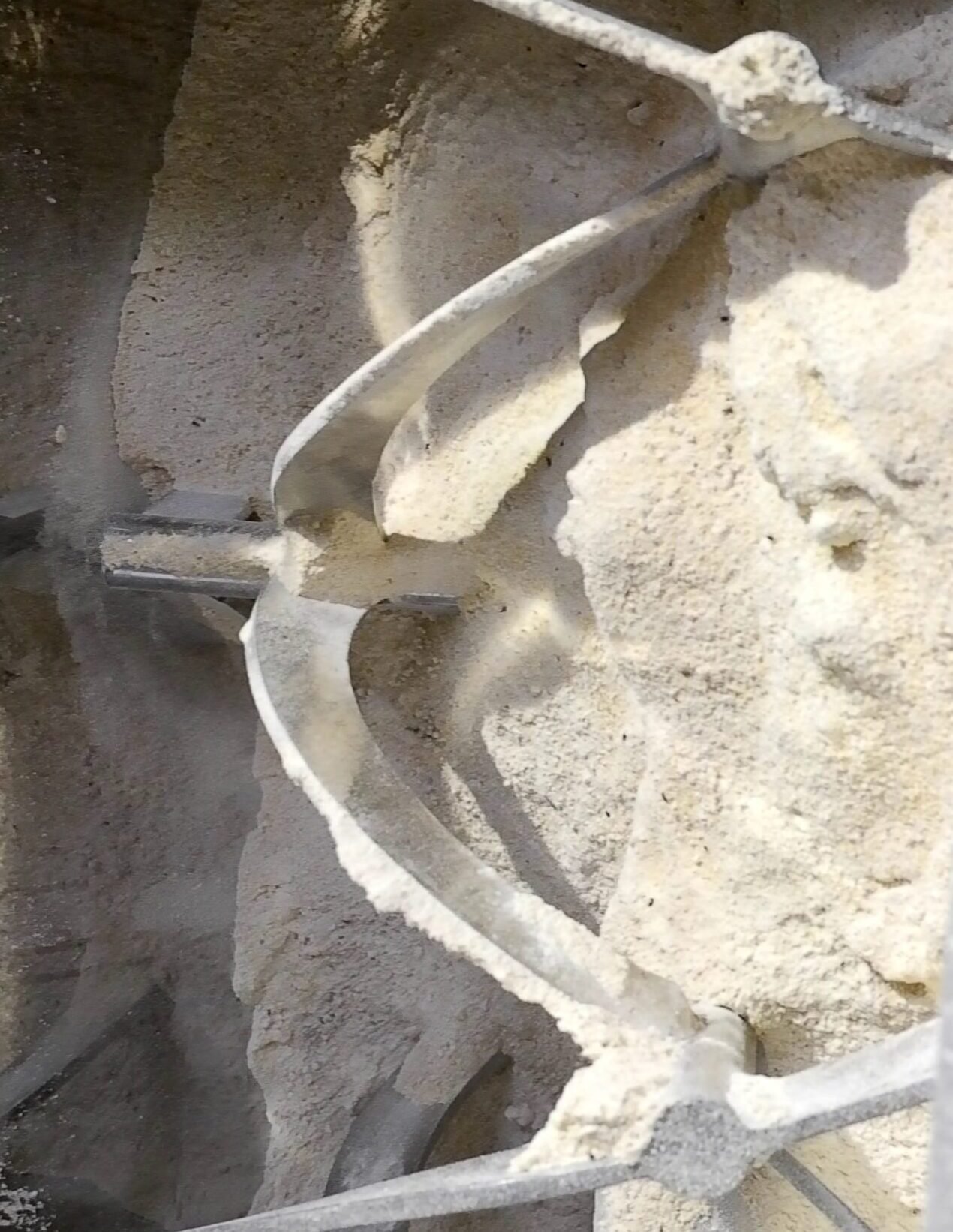
Is Your Material Suitable for a Ribbon Blender?
Ribbon blenders are typically selected for dry powders, granules and free-flowing bulk materials. For sticky, wet, highly cohesive or fragile materials, the mixer configuration should be evaluated according to the actual material properties.
For preliminary mixer selection, please provide: material name, bulk density, batch size and whether liquid addition is required.
Reference Configuration vs. Project-Specific Requirements
Documented 200 L Reference Configuration
- ▪ SS316L internal specification
- ▪ 3 kW motor and inverter
- ▪ 30–40 rpm
- ▪ Pneumatic discharge valve
- ▪ Packing plus PTFE sealing
- ▪ Safety proximity switch
- ▪ IP65 push-button control cabinet
- ▪ Schneider Electric components
- ▪ 400 V / 50 Hz / 3 phase
Requirements to Confirm for Each Project
- › Material and bulk density
- › Batch weight
- › Particle size
- › Minor ingredient percentage
- › Liquid addition
- › Abrasion or corrosion
- › Hygiene standard
- › Hazardous powder classification
- › Required voltage
- › Discharge height
- › Cleaning method
- › Downstream equipment
How to Choose the Right Ribbon Blender
Oversizing a blender can lead to poor mixing of small batches, while undersizing bottlenecks production. Follow this engineering path:
Define the material
Confirm bulk density & behavior
Determine flowability, stickiness, and particle fragility.
Convert batch weight to volume
Equipment capacity is selected by volume. Motor power is influenced by bulk density and starting conditions.
Set required production cycle
Total cycle includes loading, mixing, sampling, discharging, and cleaning.
Review cleaning & safety
Actual filling range must be confirmed by the manufacturer based on structure and material.
Match discharge to line
Ensure the valve height and type integrate with downstream equipment.
Prepare Your Material Data
Gather these parameters to get an accurate equipment proposal:
- Material name & state
- Bulk density (kg/L)
- Target batch weight (kg)
- Available voltage
Ribbon Blender vs Paddle Mixer, V Blender and Double Cone Blender
| Feature | Ribbon Blender | Paddle Mixer | V Blender | Double Cone Blender |
|---|---|---|---|---|
| Mixing principle | Convective (Agitator) | Convective (Paddles) | Tumble (Vessel rotation) | Tumble (Vessel rotation) |
| Typical material behavior | Powders & granules with some flowability | Cohesive or varying density powders | Free-flowing powders | Free-flowing powders |
| Particle sensitivity | Moderate shear; may degrade very fragile particles | Typically lower shear than ribbons | Very low shear | Very low shear |
| Batch-size flexibility | Requires a minimum fill level to engage ribbons | Often handles a wider fill range | Strict fill volume limits | Strict fill volume limits |
| Liquid addition | Possible; depends on material stickiness | Often better for higher liquid/sticky mixes | Intensifier bar may be needed | Limited |
Note: The comparisons above are general tendencies. Selection depends entirely on the specific material.
When a Ribbon Blender Is Not the Best Fit →Cleaning and Routine Maintenance
Proper cleaning procedures are essential to prevent cross-contamination and ensure operator safety.
-
1. Isolate power and air
Isolate power and compressed air according to the site lockout/tagout procedure.
-
2. Open and inspect
Open the cover and inspect the trough, ribbon-to-trough clearance, shaft ends, and discharge area.
-
3. Clean according to protocol
Clean according to the material and hygiene requirements. Pay special attention to shaft seals, end plates, and the discharge valve gasket.
-
4. Confirm readiness
Confirm that all parts are dry, correctly assembled, and safe before resuming operation.
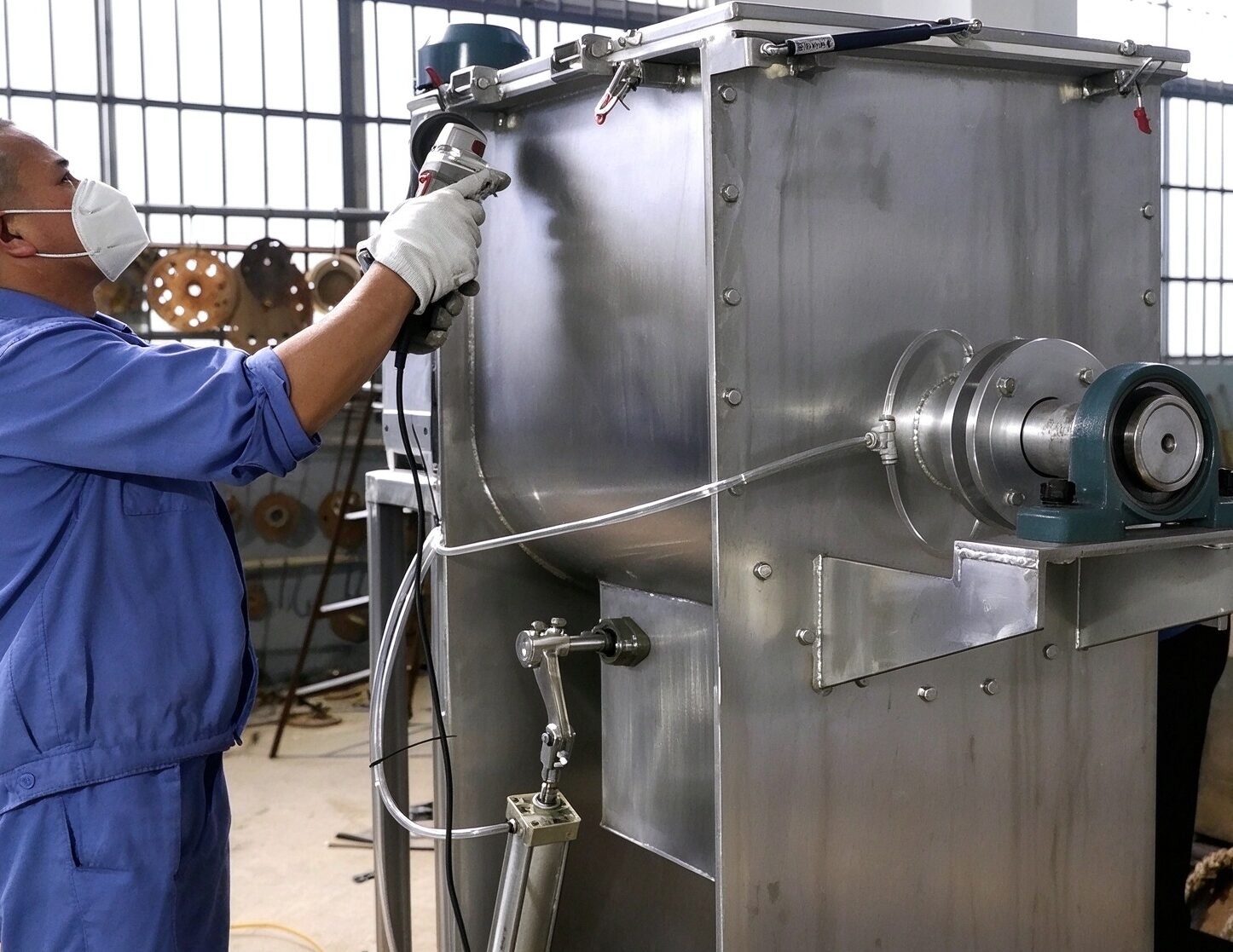
Built in Our Factory, From Ribbon to Complete Mixer
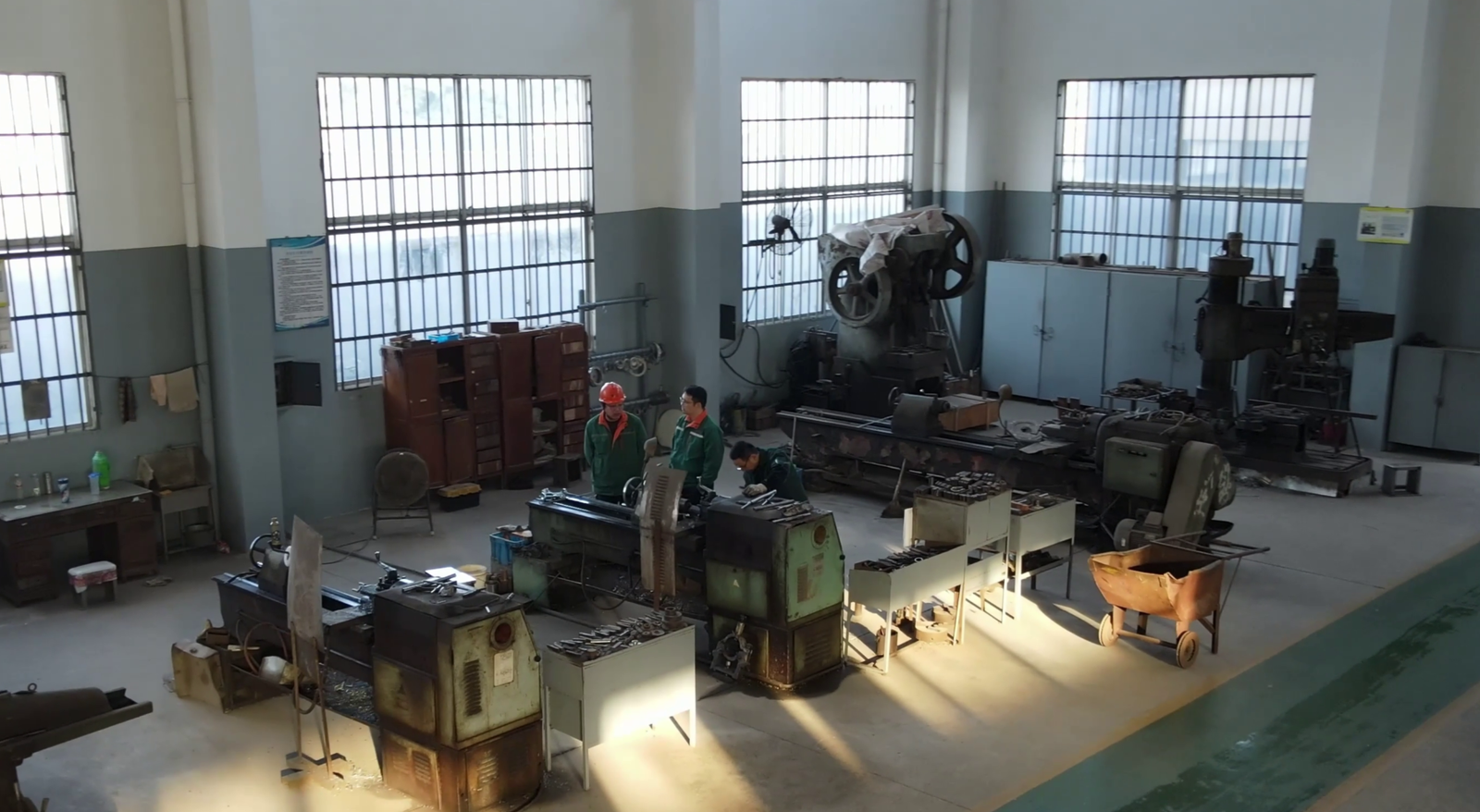
At JEXDRY, the ribbon agitator, mixing trough, shaft and drive assembly are manufactured and assembled in our own workshop. Real production photos show
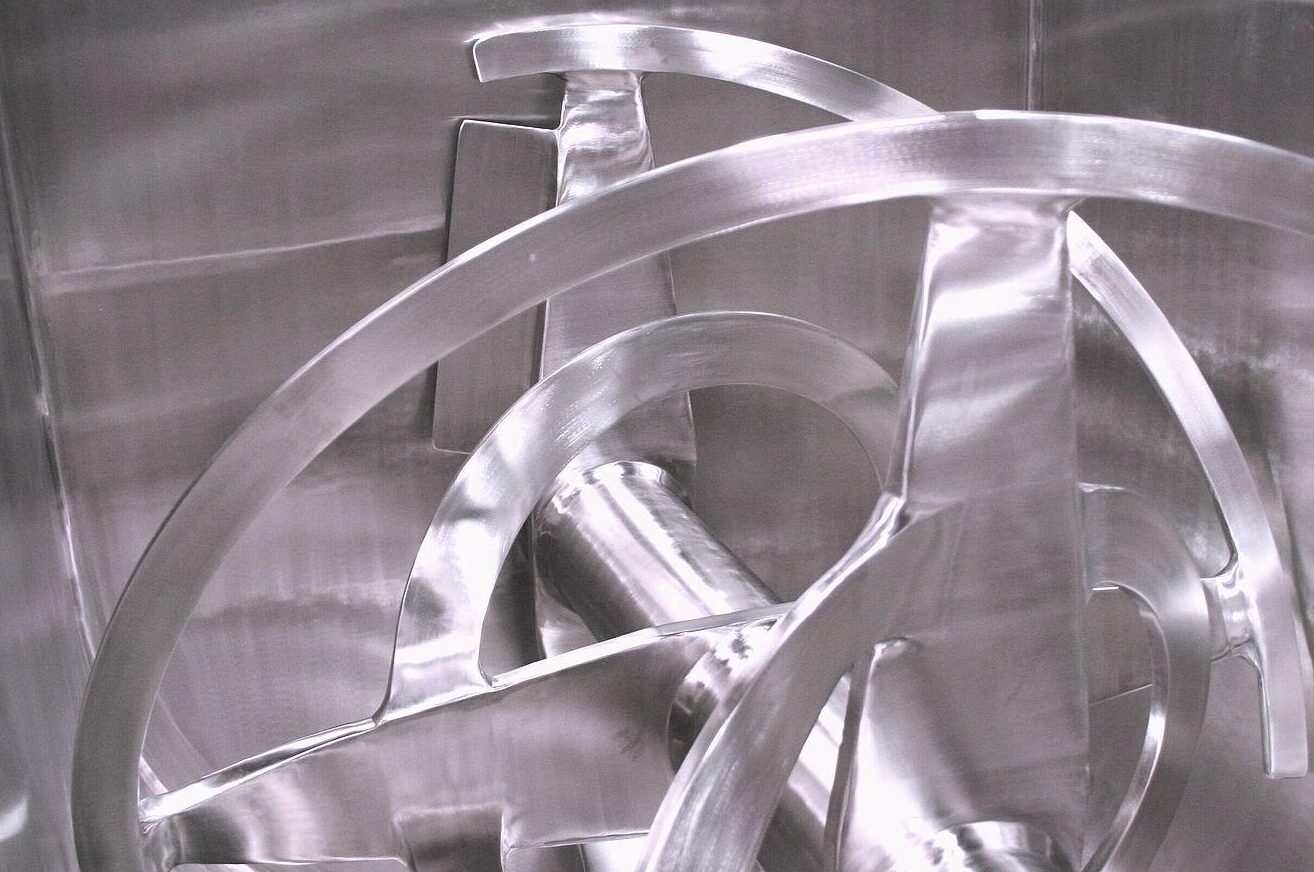
Ribbon Fabrication
The inner and outer ribbons are fabricated according to the mixer diameter, working volume and material characteristics.
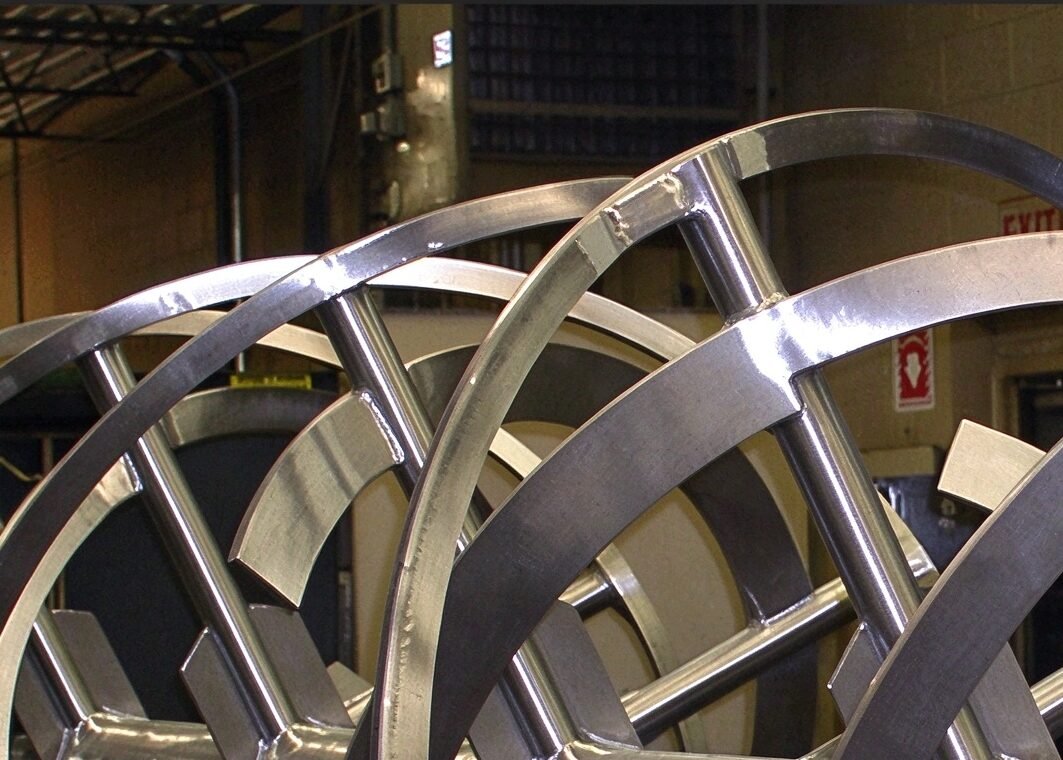
Ribbon & Shaft Assembly
Ribbon flights and support arms are positioned and welded to the main shaft before installation into the mixer.
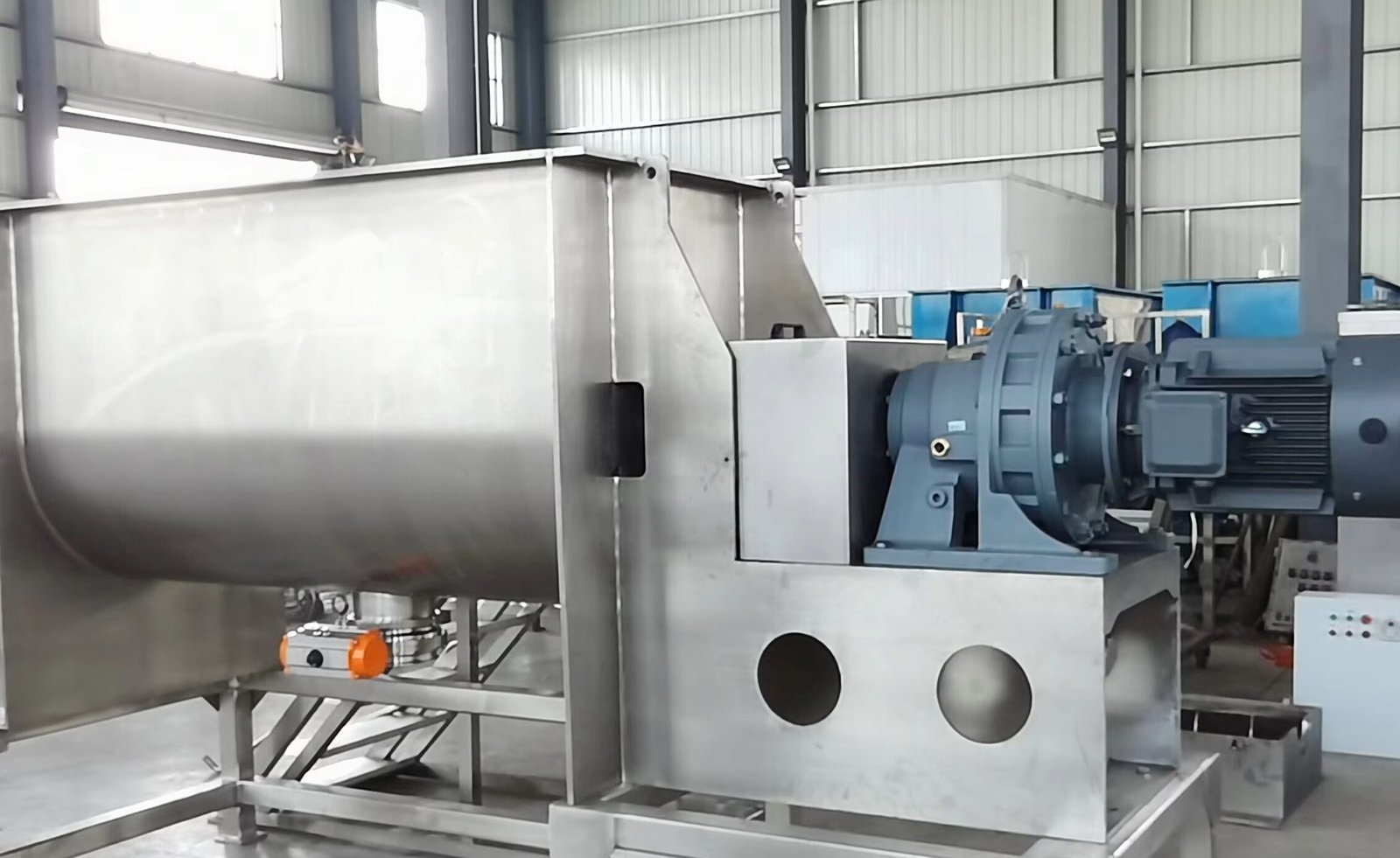
Mixer Body Fabrication
The mixing trough, end plates, bearing positions and discharge opening are fabricated to match the project-specific mixer configuration.
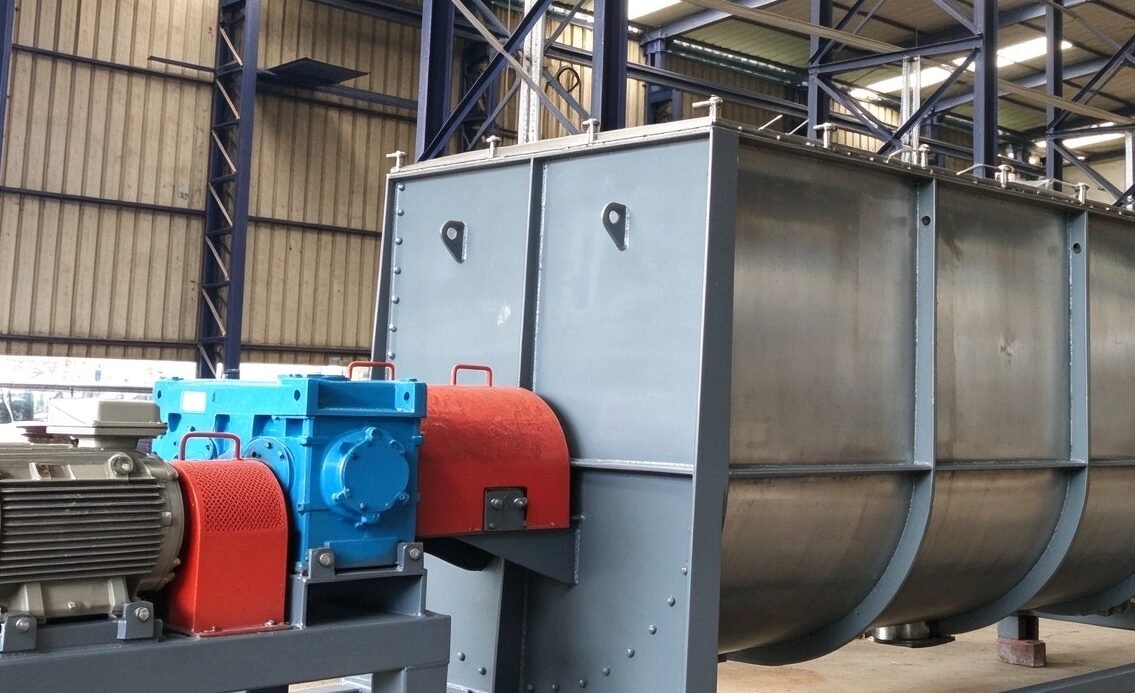
Assembly & Inspection
The ribbon agitator, bearings, drive unit and discharge system are assembled and checked before the mixer is prepared for shipment.
You can see the actual machine being built
For project orders, production photos, assembly progress and pre-shipment inspection records
Tell us your material, batch size and bulk density for preliminary mixer selection.
From Material Data to Equipment Proposal
1. Submit Info
Submit material and batch data.
2. Review Process
We review material behavior.
3. Confirm Configuration
Select drive, seals, and utilities.
4. Approve Proposal
Approve technical layout.
5. Manufacture
Manufacture, inspect & ship.
Tell Us What You Need to Mix
The more information you provide about the material and batch target, the more accurately the mixer can be configured.
Ribbon Blender FAQ
What is the difference between full volume and working volume?
How many kilograms can a 200 L ribbon blender process?
How long does ribbon blending take?
Can a ribbon blender add liquid to powder?
How is a ribbon blender cleaned?
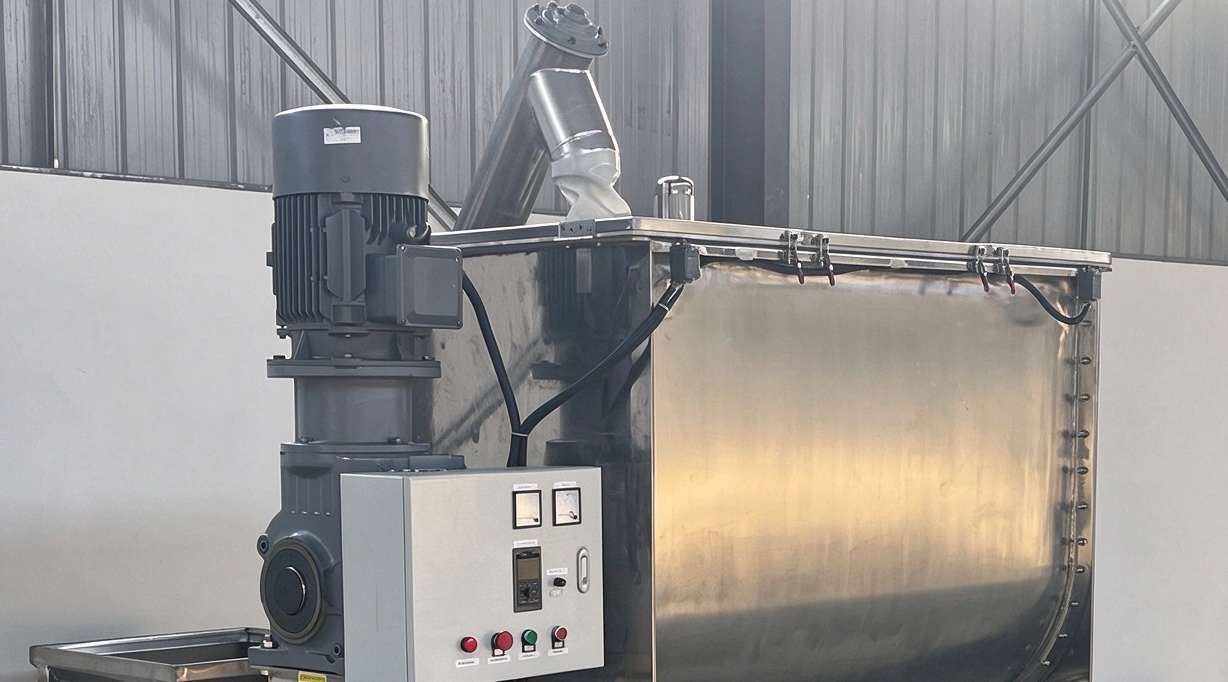
Configure a Ribbon Blender for Your Material
Send us your material, bulk density, batch target, cleaning requirements and site utilities. JEXDRY will use this information to prepare a more relevant technical proposal.