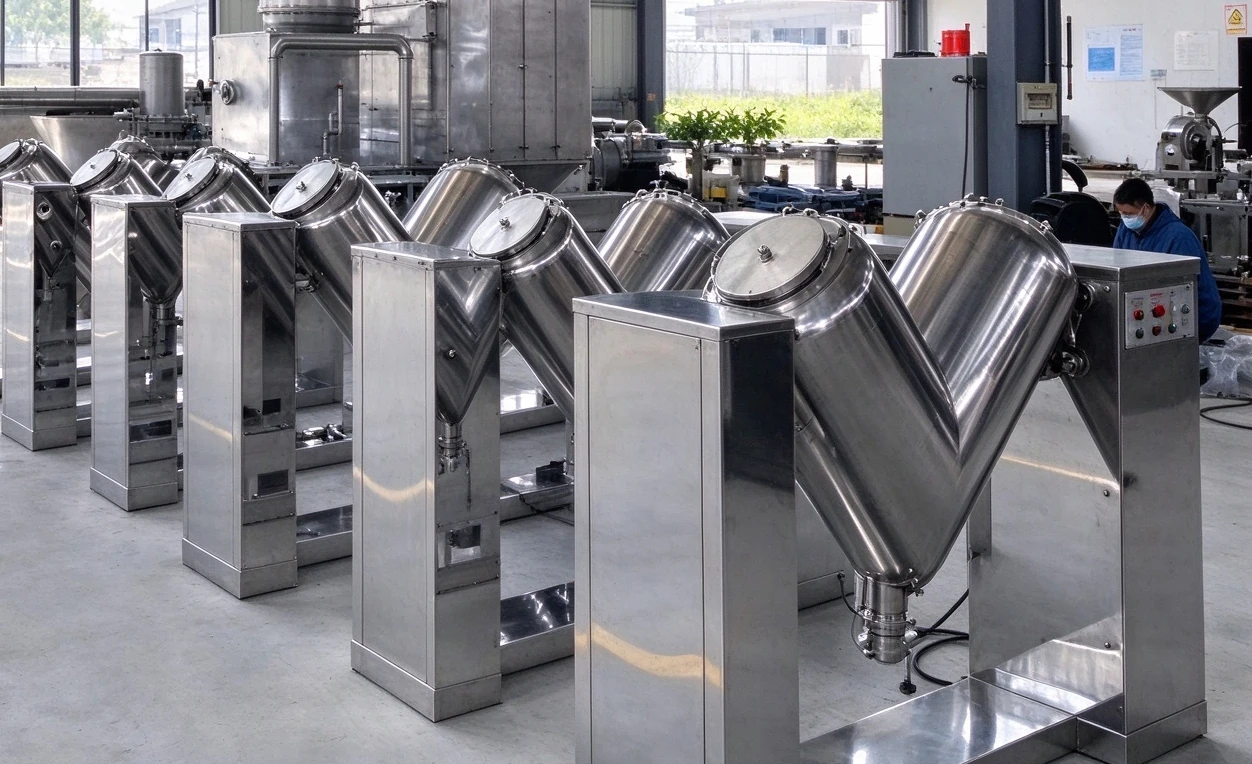
V Blender Manufacturer for Dry Powder and Granule Mixing
JEXDRY manufactures V-type mixers for batch blending of dry powders and granules. Choose a standard tumble configuration for free-flowing materials, or discuss an intensifier-bar option when your formulation needs additional agitation.
- Standard tumble blending
- Optional intensifier bar
- Vacuum-assisted loading option
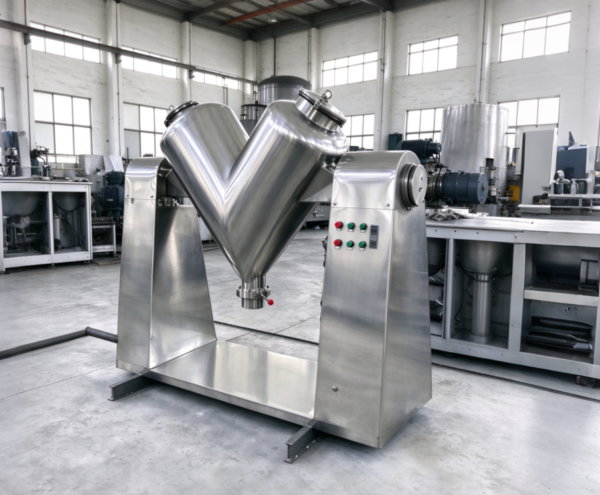
Choose Your V Blender Configuration
We review how your powder flows, whether it forms lumps, and how easily its particles break. Based on these properties, we help you decide whether standard tumble blending is sufficient or an intensifier bar is worth evaluating.
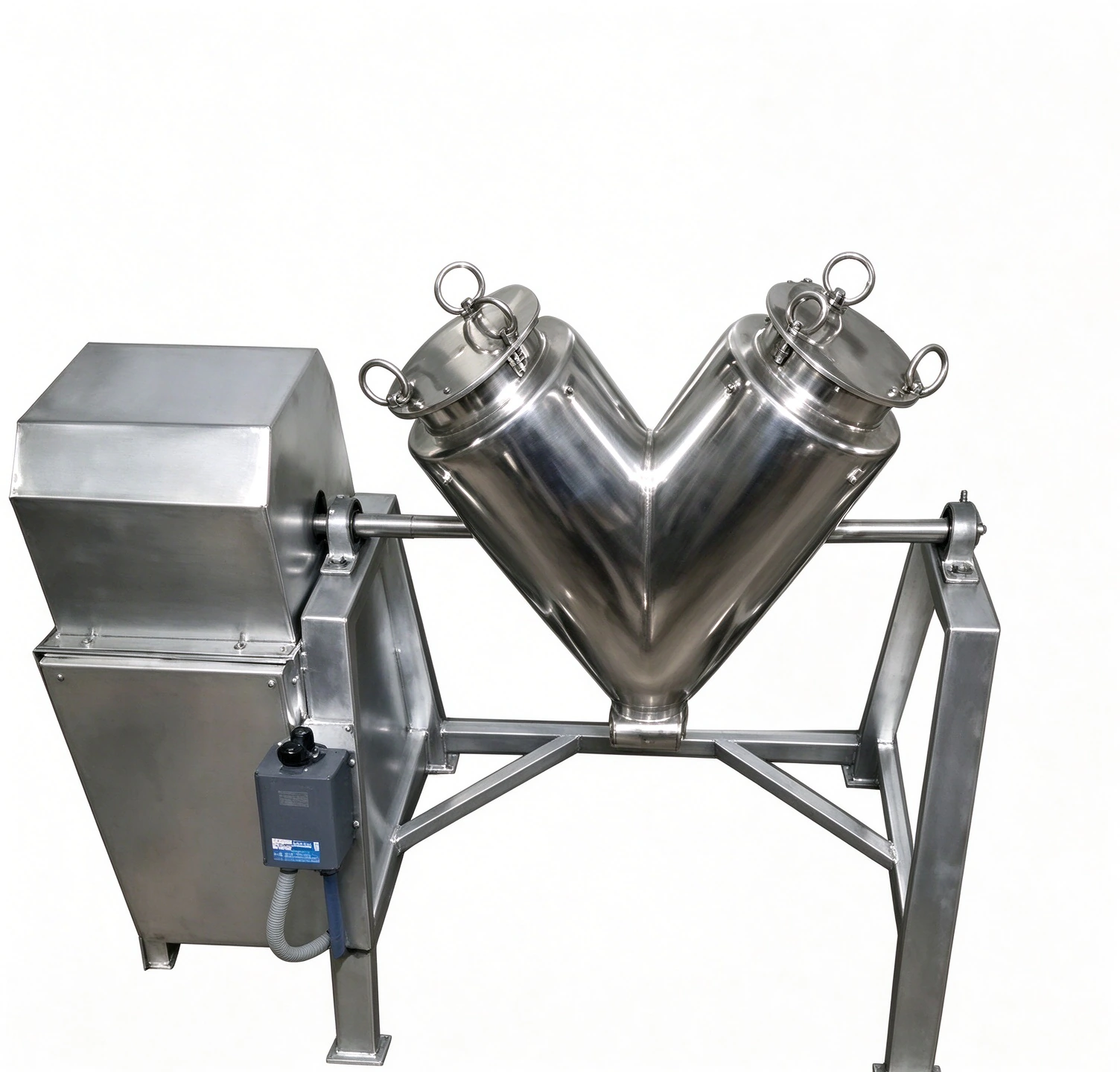
Standard V Blender
A rotating V-shaped vessel repeatedly divides and recombines the batch. The standard configuration has no internal mixing agitator and is intended for dry powders and granules with sufficient flowability.
💡 Evaluate this configuration when gentle tumble mixing is suitable and aggressive deagglomeration is not required.
Key Selection Factors
- Working batch volume
- Bulk density
- Particle fragility
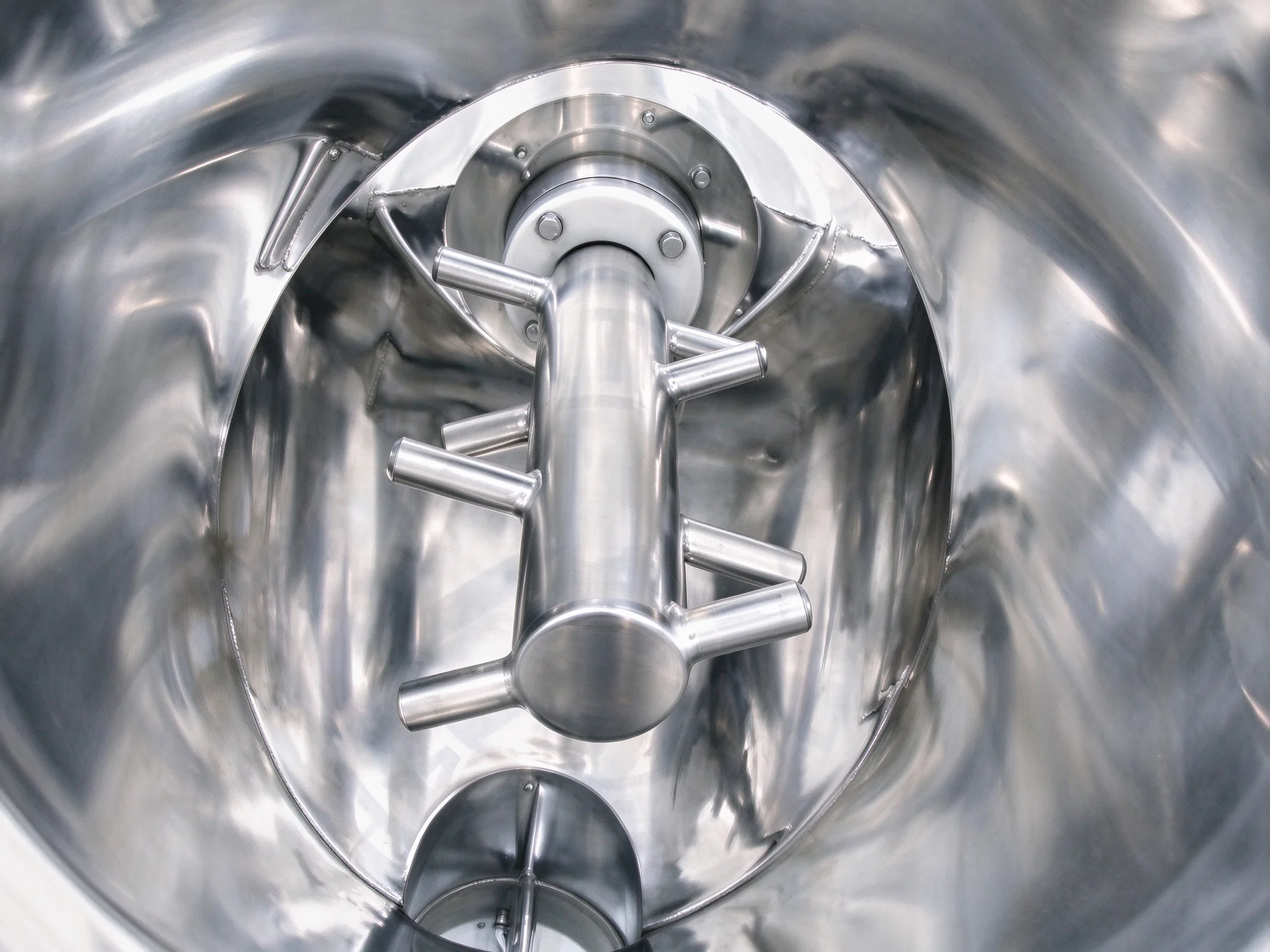
V Blender with Intensifier Bar
An optional internal agitator adds local mixing action alongside vessel rotation. This configuration can be evaluated for fine powders, soft agglomerates and formulations containing small proportions of additives.
💡 Assess the benefit against particle damage, heat generation, cleaning access and the actual behavior of your formulation.
Key Selection Factors
- Agglomeration behavior
- Shear tolerance
- Cleaning requirements
What Is a V Blender, and How Does It Work?
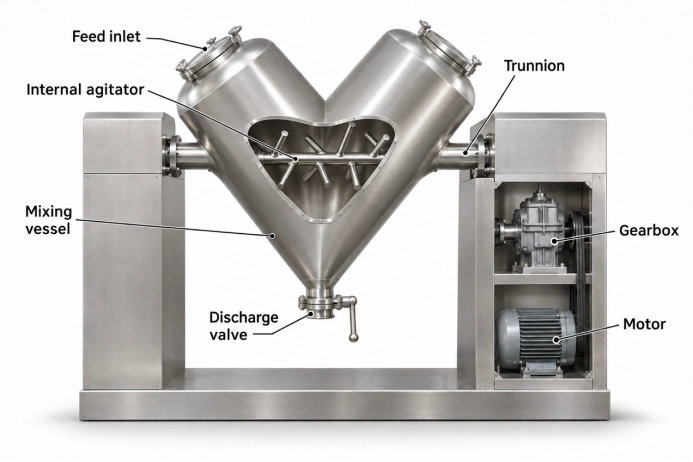
A V blender is a batch mixer with two cylindrical shells joined in a V shape. As the vessel rotates, gravity moves the material through the two arms and their junction, repeatedly splitting and recombining the powder bed.
Also called a V-shell or twin-shell blender, it is primarily used for solid–solid blending. The standard version relies on tumbling rather than an internal agitator.
Load
Charge the ingredients while retaining the free space needed for material movement.
Tumble
Rotate the vessel so particles redistribute through repeated division and recombination.
Discharge
Position the outlet above the receiving container and release the blended batch through the bottom valve.
Note: Vacuum-assisted loading transfers powder into the vessel. It does not, by itself, mean that blending takes place under vacuum or that the mixer performs vacuum drying.
V Blender Specifications and Capacity Selection
Start with working batch volume rather than vessel size alone. The reference HV-series configurations below distinguish total vessel volume from the listed loading volume.
HV-Series Reference Specifications
| Reference model | Total vessel volume (L) | Listed loading volume (L) | Vessel speed (rpm) | Motor power (kW) |
|---|---|---|---|---|
| HV-100 | 100 | 40 | 15 | 1.1 |
| HV-200 | 200 | 80 | 15 | 1.5 |
| HV-300 | 300 | 120 | 15 | 1.5 |
| HV-500 | 500 | 200 | 15 | 1.5 |
| HV-1000 | 1,000 | 400 | 12 | 3.0 |
| HV-1500 | 1,500 | 600 | 10 | 4.0 |
| HV-2000 | 2,000 | 800 | 10 | 5.5 |
| HV-2500 | 2,500 | 1,000 | 8 | 7.5 |
| HV-3000 | 3,000 | 1,200 | 6 | 7.5 |
Convert Batch Weight into Working Volume
Batch volume in litres equals batch mass in kilograms divided by loose bulk density in kilograms per litre. Required vessel volume then depends on the selected working fill fraction. The mechanical load limit must also be checked separately.
This is an illustrative sizing calculation, not a production guarantee. At 0.30 kg/L, the same 30 kg batch occupies 100 L and needs a different volume assessment.

Match the Mixer to the Powder, Not Just the Batch Weight
A correctly sized vessel still needs the right mixing mechanism, loading arrangement and discharge connection. These decisions affect how the batch moves and how the equipment fits into your line.
Powder stays in lumps
Tumble motion alone may not break cohesive agglomerates. We offer an optional internal agitator for evaluation where additional mixing action is needed.
Particles are easily damaged
For free-flowing, fragile granules, the standard configuration avoids an internal mixing agitator. Appropriate speed and cycle duration still need to be established for the product.
The batch fits by weight but overfills the vessel
Calculate powder volume from bulk density and retain space for tumbling. Check both working volume and the mechanical load limit.
Loading and discharge do not match the line
Vacuum-assisted loading can be discussed as an option. Outlet height, receiving-container clearance and the vessel’s rotating envelope also need to fit the installation.
Practical Features for Batch Powder Mixing

Gentle mixing without an internal agitator
The standard vessel blends through rotation and gravity, providing a tumble-mixing route for suitable powders and granules.
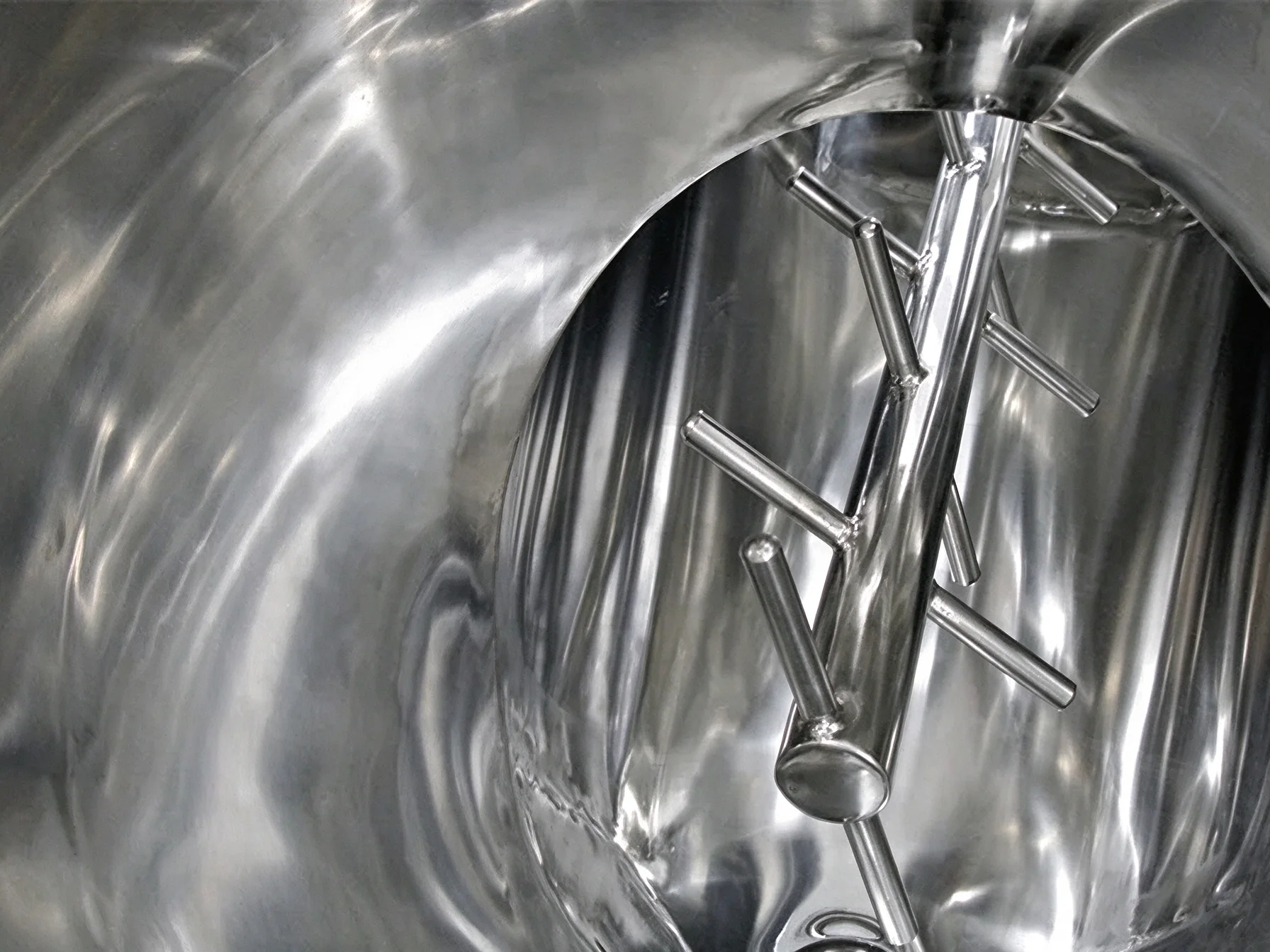
A separate option for additional agitation
The intensifier-bar configuration provides another route when the formulation needs more than tumble motion alone. It is selected around the material rather than treated as a default upgrade.
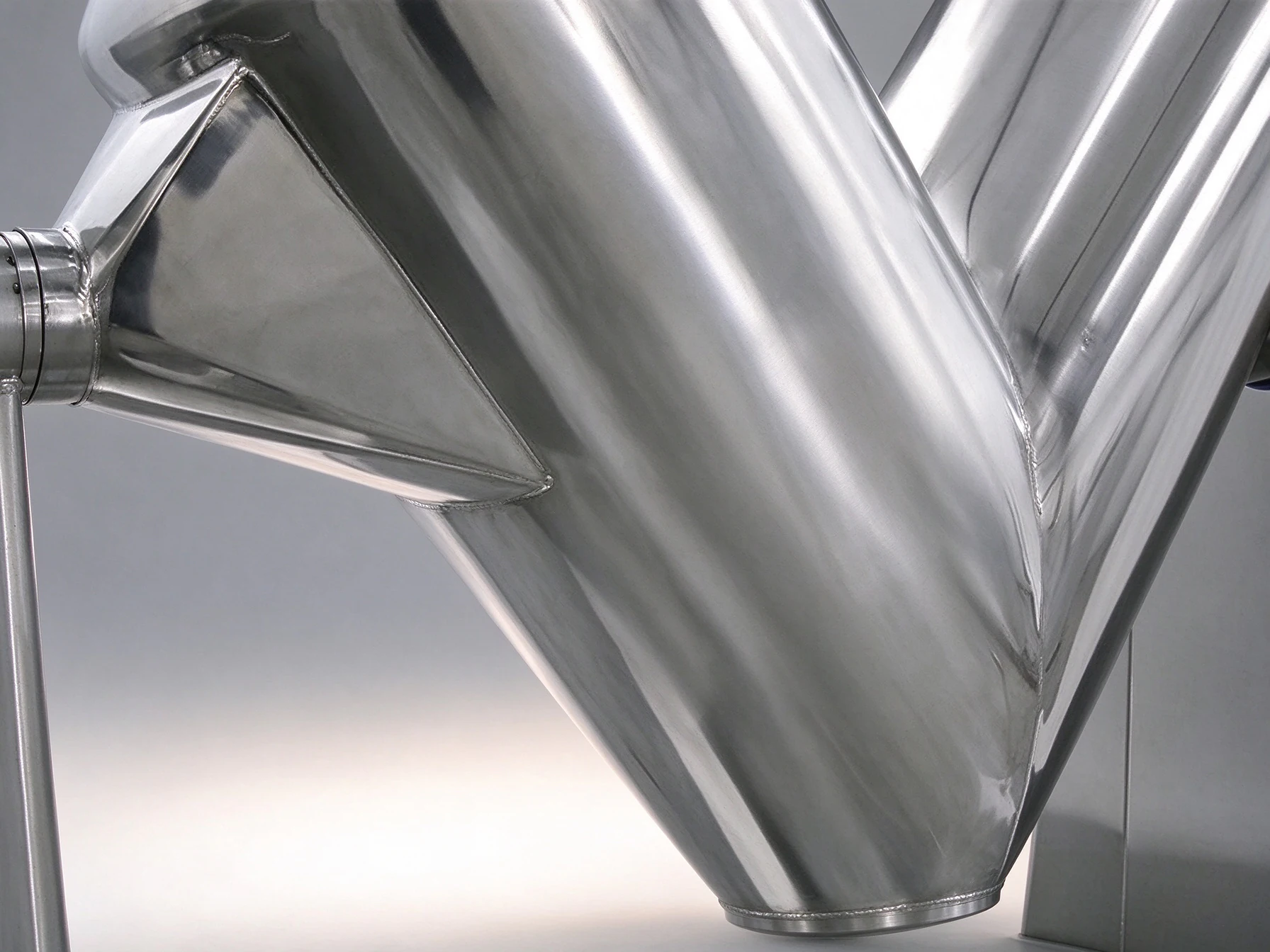
Polished stainless steel vessel surfaces
Our V-type mixer designs use polished stainless steel vessel surfaces. Product-contact materials, seals and cleaning access are specified for the application; support structures and other non-contact parts are defined separately.
Where a V Blender Fits
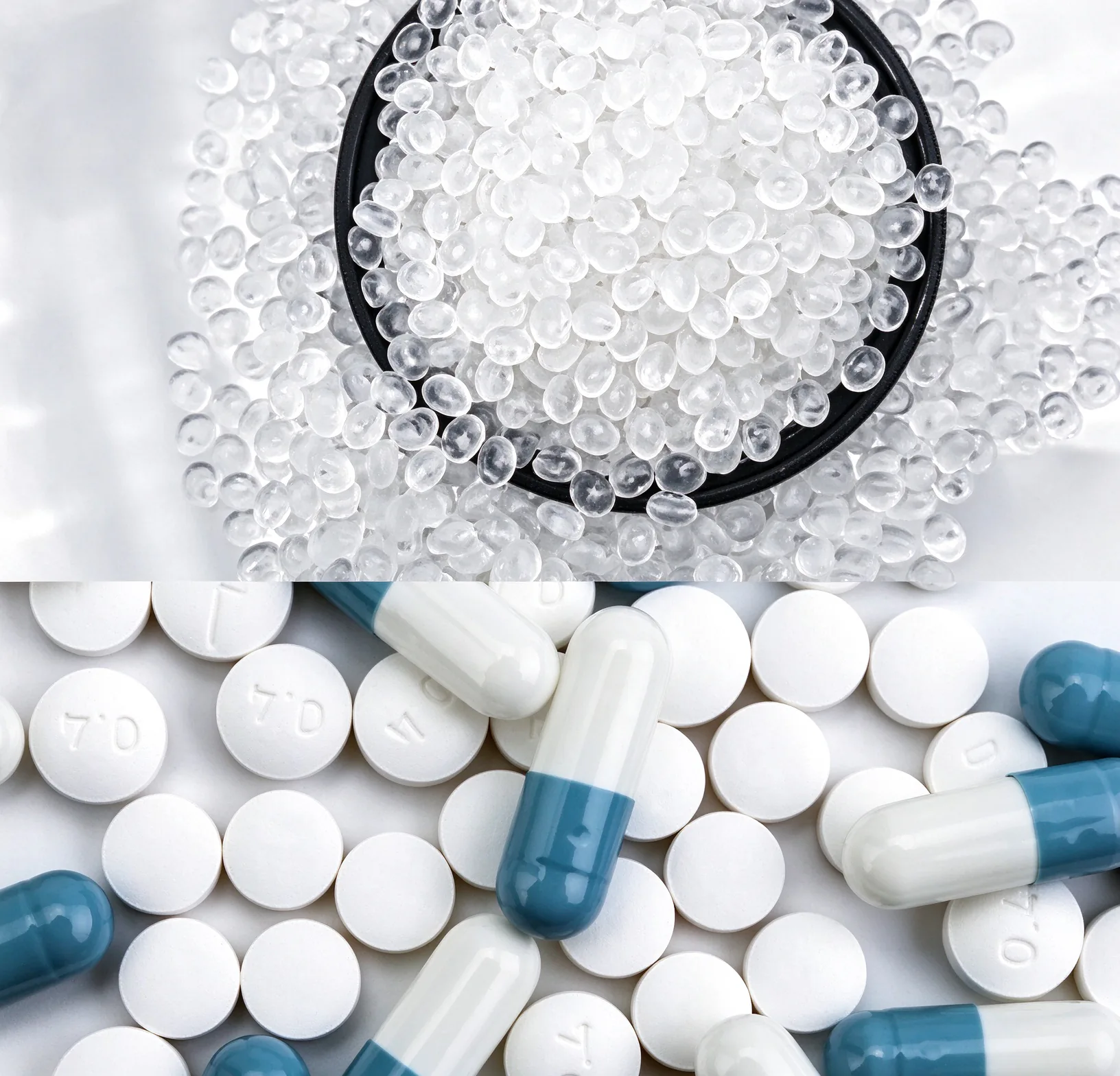
V-type mixers are used to evaluate dry powder and granule blending in food, pharmaceutical and chemical processing. Suitability depends on powder behavior, formulation and the required cleaning and validation procedures.
| Material or process condition | Selection direction | Main consideration |
|---|---|---|
| Free-flowing dry powders and granules Examples: granulated sugar, free-flowing polymer granules | Start with a standard V blender. | Check working fill level and whether differences in particle size or density could cause segregation. |
| Fragile granules Examples: instant coffee granules, porous instant milk powder granules | Start with gentle tumble mixing in a standard V blender. | Check how much the granules break down at the selected speed and mixing time. |
| Fine powders that form soft lumps Examples: cocoa powder or fine seasoning powders that clump during blending | Evaluate an intensifier bar if lumps remain after standard tumble mixing. | Check whether the added agitation breaks up lumps without damaging the product. |
| Low-dose additives in dry blends Examples: vitamin premixes, powdered food colorants | Review premixing and loading order first. Evaluate an intensifier bar if soft lumps remain. | Use representative samples to check whether the additive is evenly distributed. |
| Sticky, wet or strongly cohesive materials Examples requiring separate evaluation: wet starch filter cake, dough | Assess material behavior and mixer type before sizing. | Check for wall buildup, poor material movement and incomplete discharge. |
Share your material, batch size and any clumping or particle breakage you’ve observed. We’ll help you decide whether standard tumble blending is sufficient or an intensifier bar is worth evaluating.
HV-150 Application Example: Matcha Latte Powder in Japan
A beverage powder producer in Japan plans to blend matcha powder, milk powder and powdered sugar in 25 kg batches. The team wants to know whether the HV-150 can handle the batch and whether it needs an intensifier bar to break up visible green clumps.
The Buyer’s Questions
Will a 25 kg batch fit in the HV-150? The buyer needs to check how much space the powder takes up as well as how much it weighs.
Do we need an intensifier bar? Dark green specks could be soft matcha clumps or a sign that the matcha has not dispersed evenly. The cause affects which configuration we recommend.
How We Would Select the Configuration
- Check the batch against both loading limits. At an assumed loose bulk density of 0.50 kg/L, a 25 kg batch occupies about 50 L. That is below the HV-150 reference limits of 60 L and 35 kg. The model is a candidate for evaluation. We would confirm the actual bulk density and whether the working fill level gives the powder enough room to tumble.
- Start by reviewing how the matcha is added. Screen out visible soft lumps, then premix the matcha with a portion of the milk powder before adding it to the full batch. If standard tumble blending gives acceptable dispersion, we would recommend the standard configuration.
- Evaluate an intensifier bar if soft clumps remain. If the team can confirm that the remaining specks are soft clumps, we would compare standard tumbling with the optional intensifier bar. Check for residual clumps and sample at the beginning, middle and end of discharge to assess how evenly the matcha is distributed.
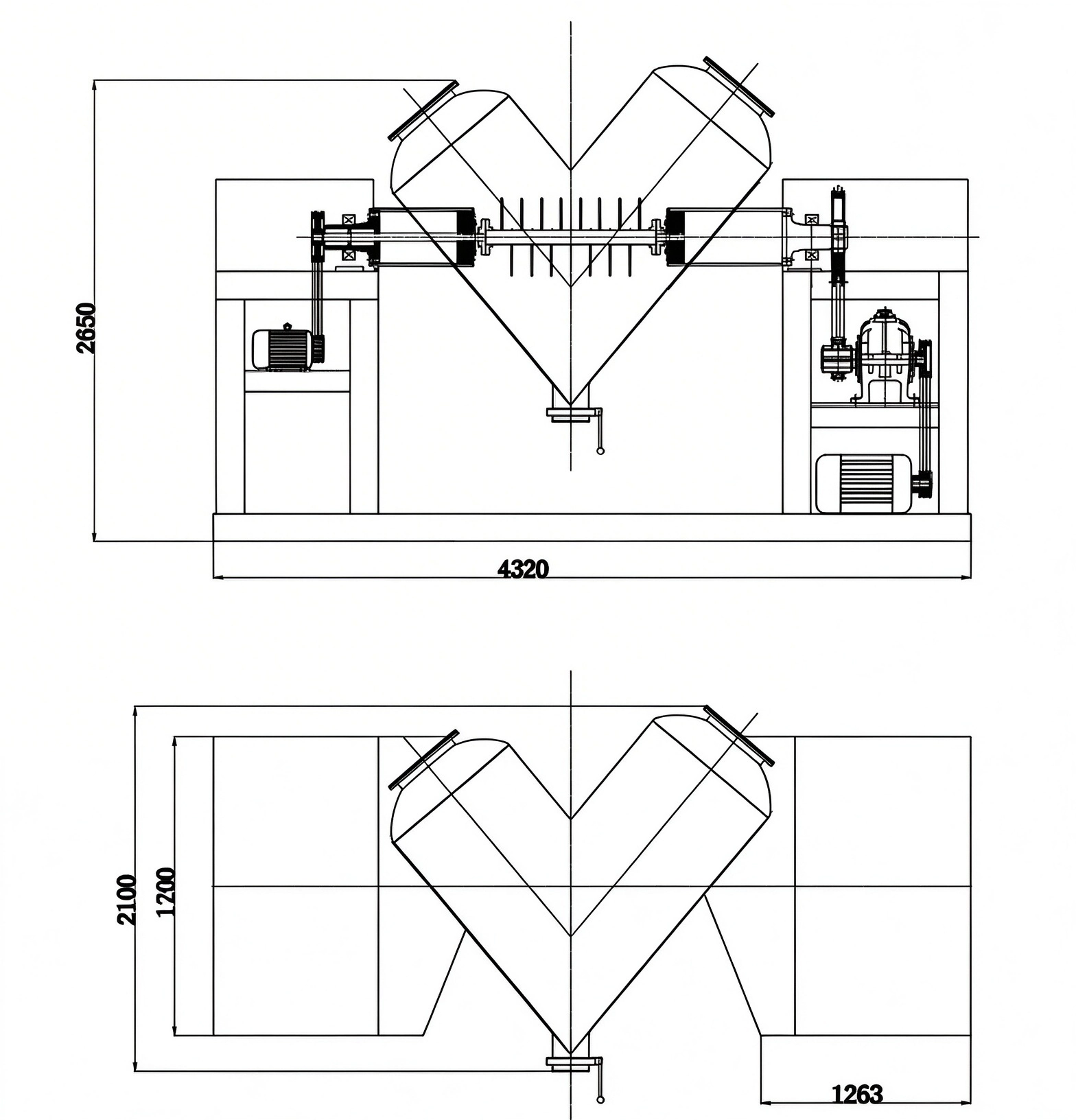
HV-150 Reference at a Glance
| What the buyer needs to check | HV-150 reference |
|---|---|
| Total vessel volume | 150 L |
| Maximum loading volume | 60 L |
| Maximum loading weight | 35 kg |
| Estimated volume of the example batch | 50 L at an assumed 0.50 kg/L |
V Blender vs Ribbon Blender vs Double Cone Blender
Compare the mixing mechanism and installation requirements before comparing machine size. The best fit depends on how the formulation flows, how much agitation it tolerates and how the batch is handled.
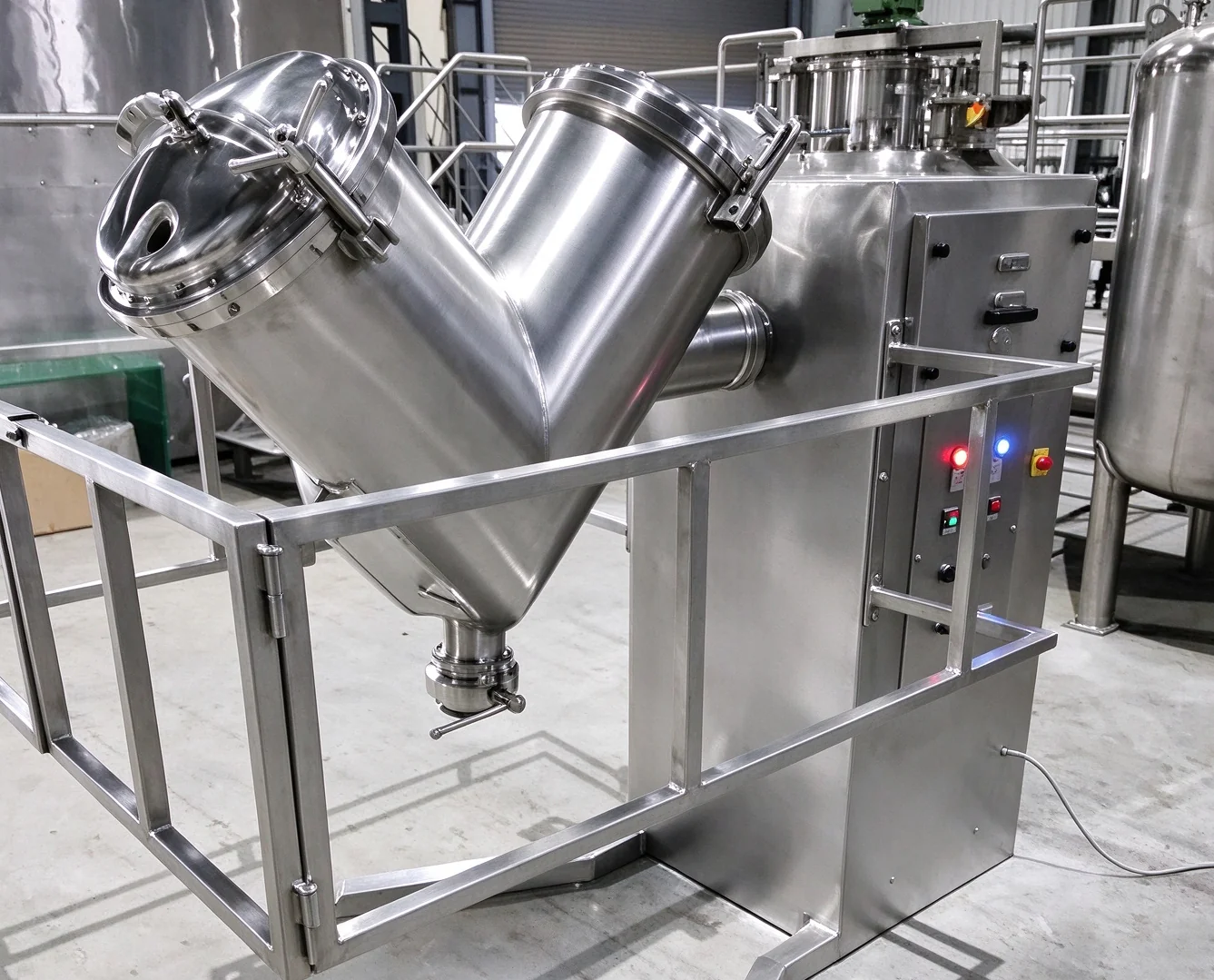
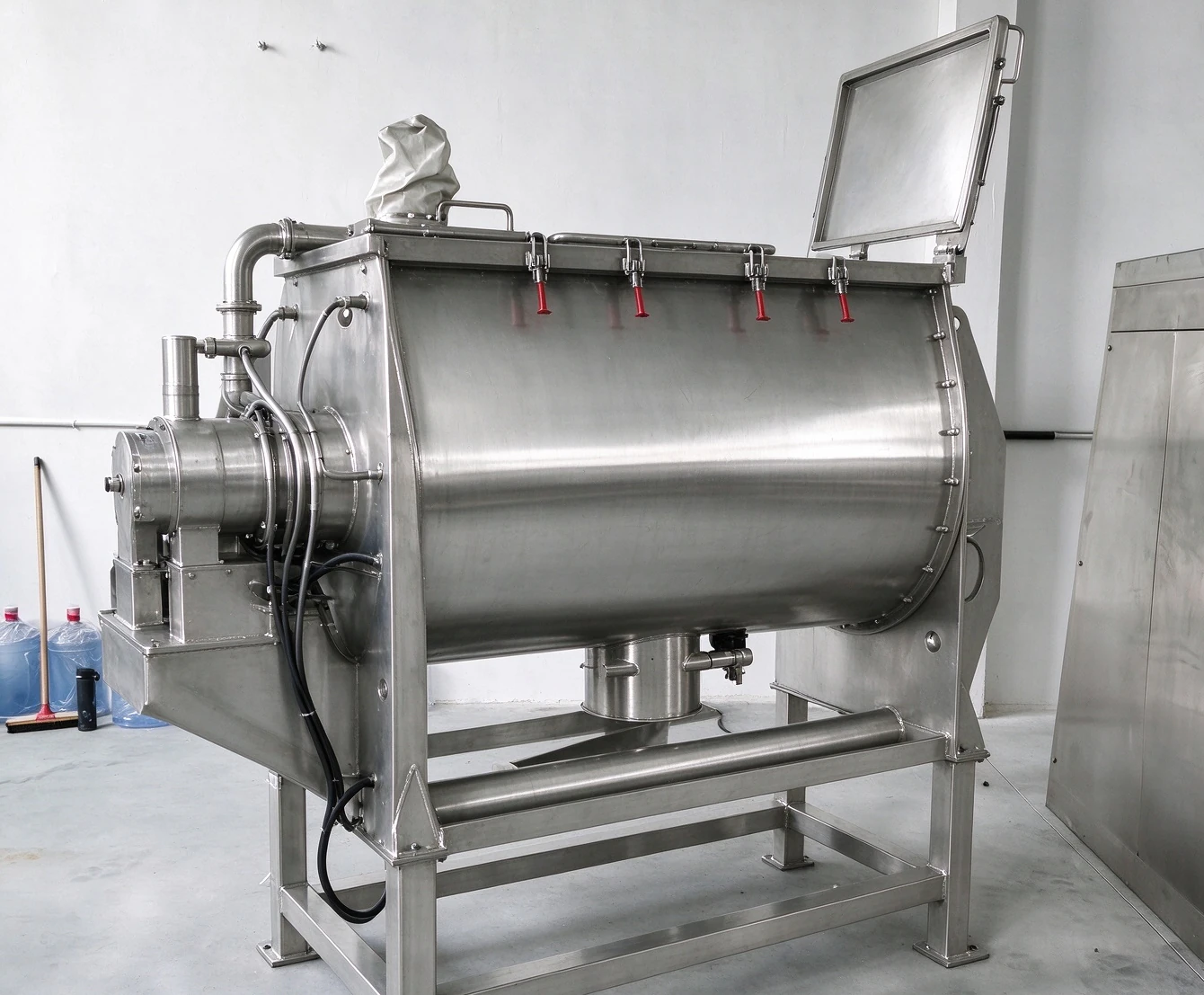
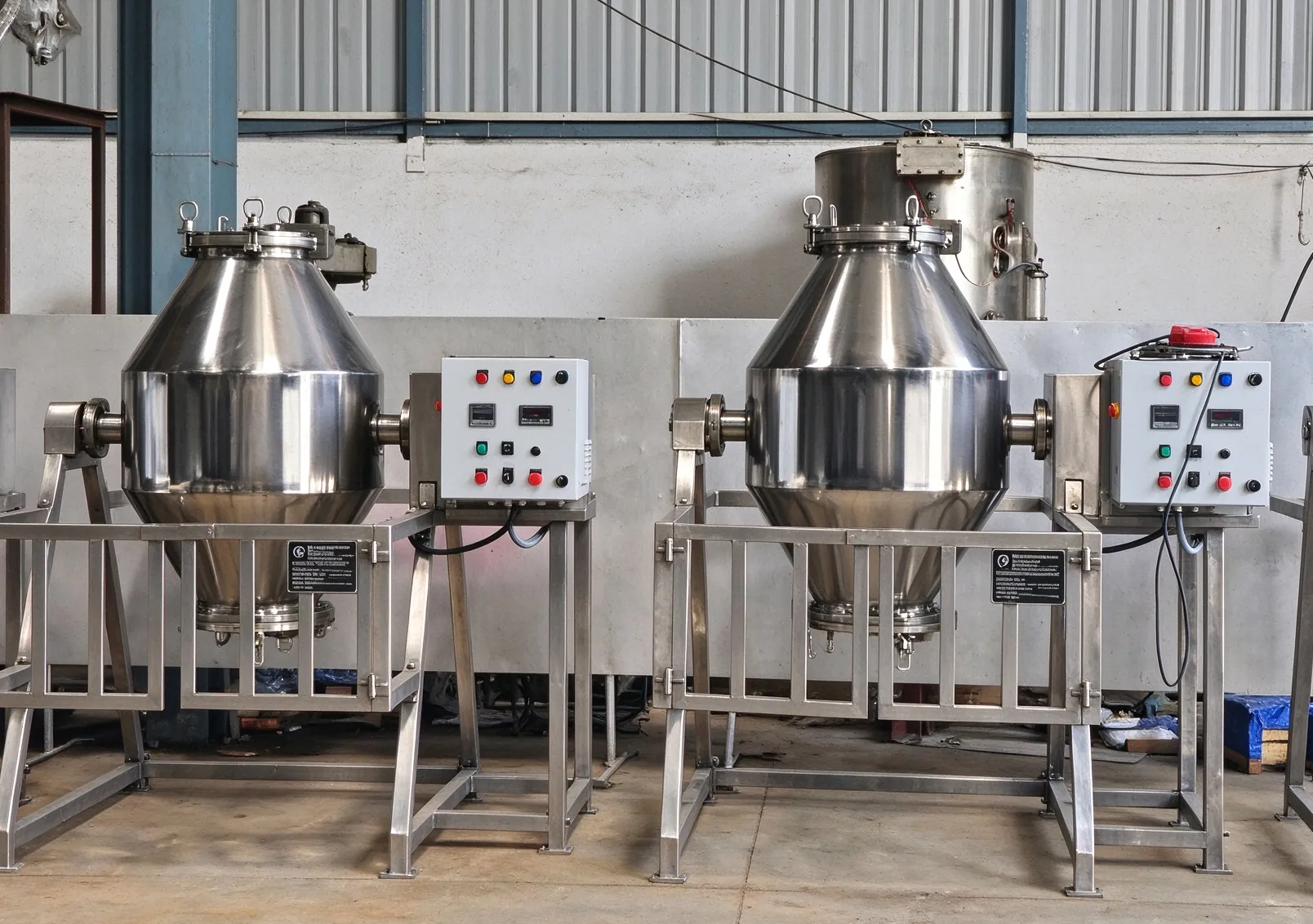
| Selection factor | Standard V blender | Ribbon blender | Double cone blender |
|---|---|---|---|
| Main mixing action | Gravity-driven division and recombination in a rotating V vessel | Convective movement from ribbons inside a stationary trough | Gravity-driven tumbling in a rotating double-cone vessel |
| Internal agitator | None in the standard configuration | Horizontal ribbon agitator | Typically none in the basic tumble configuration |
| Agglomerate handling | Tumble motion alone offers limited breakup | Depends on ribbon design and material behavior | Basic tumble motion offers limited breakup |
| Installation focus | Rotating envelope, loading access and outlet clearance | Trough access, shaft seals and discharge arrangement | Rotating envelope and loading/discharge clearance |
| Cleaning assessment | Vessel interior, ports, seals and outlet | Ribbons, shaft, trough and seals | Vessel interior, ports, seals and outlet |
Adding an intensifier bar changes the V blender’s agitation and cleaning requirements. Compare that configuration separately from a standard tumble blender.
Double-cone blending is also distinct from double-cone vacuum drying: a drying process requires an appropriately designed system.
Work with the Manufacturer on the Equipment Details
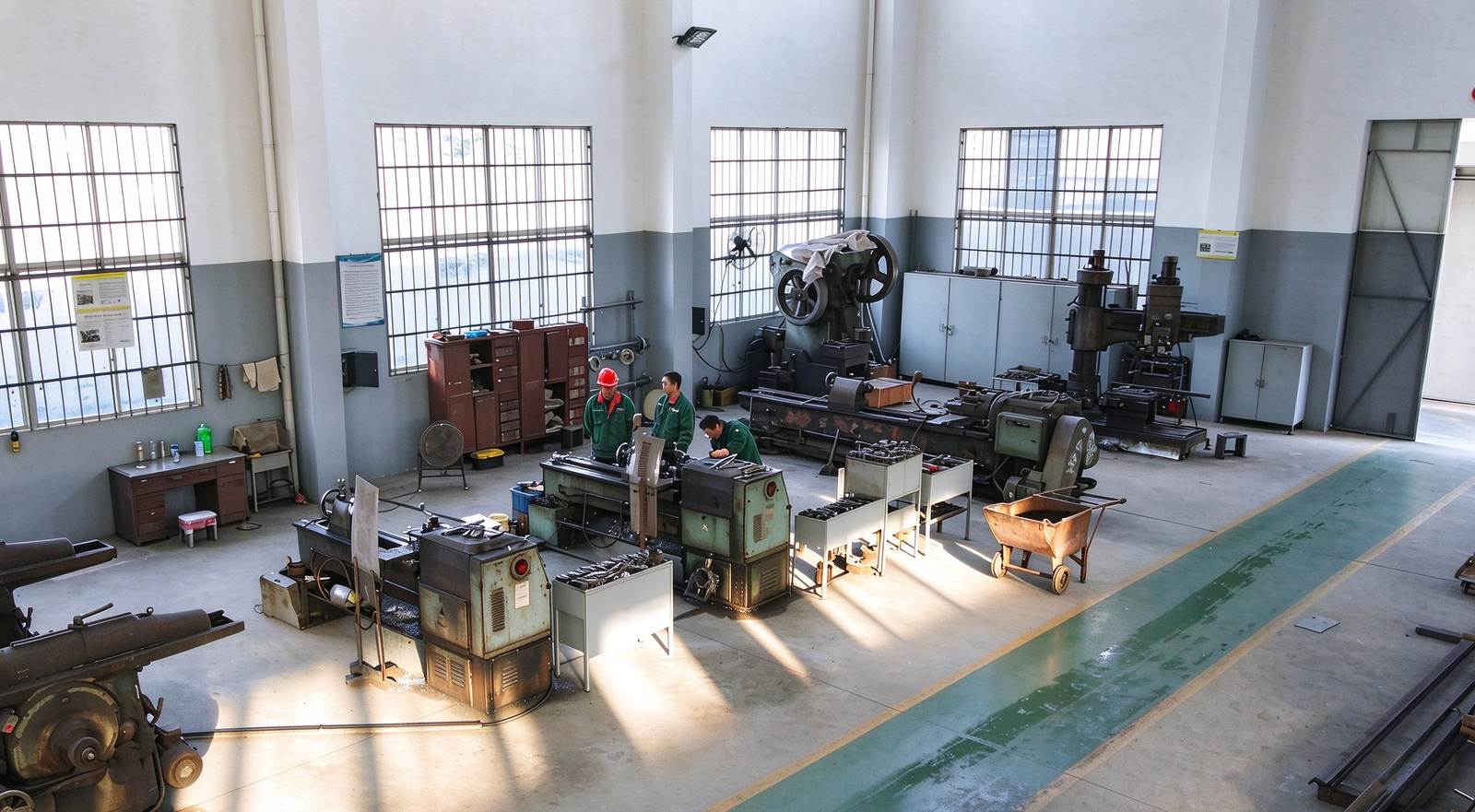
JEXDRY is the international brand of Jiangsu Xingxing Drying Equipment Co., Ltd., based in Changzhou, China. We manufacture industrial drying equipment and supporting mixing equipment.
For a V-blender project, useful technical details include the vessel construction, rotating envelope, loading and discharge interfaces, electrical supply and agreed inspection scope.
Layout and installation review
Review static dimensions alongside the rotating envelope, service access and the receiving-container position.
Construction and component definition
Identify product-contact materials separately from the frame, covers and other non-contact components.
Documentation and acceptance scope
Define the required drawings, material records, operating instructions and factory acceptance checks in the project agreement.


V Blender Selection and Purchasing FAQs
How do I choose the right V blender for my powder?
Start with powder flowability, loose bulk density and the minimum and maximum batch sizes. Free-flowing powders and fragile granules may suit the standard tumble configuration. Fine powders or soft agglomerates may require evaluation of the optional intensifier bar, including its effect on particle damage and cleaning.
Check working volume and mechanical load separately. Our HV-150 configuration example specifies a 150 L vessel, a maximum loading volume of 60 L and a maximum loading weight of 35 kg. A batch must satisfy both loading limits. Installation clearance, discharge height and site power also need to match the selected machine.
How does a V blender mix powders, and how is blend uniformity checked?
Vessel rotation repeatedly divides and recombines the powder bed. The outcome depends on fill level, speed, mixing duration, ingredient proportions and differences in particle size or density. The standard configuration relies on tumbling; an optional intensifier bar adds internal agitation.
Blend uniformity should be assessed using representative samples and a method appropriate to the formulation. Define the sampling locations, sample size and acceptance criteria before evaluation. Mixing for longer does not automatically improve the result, and a well-mixed batch can still segregate during discharge or subsequent handling.
What affects the purchase price and total installed cost of a V blender?
The quotation depends on vessel size, allowable batch weight, product-contact materials, surface finish, drive and controls, and whether an intensifier bar or vacuum-assisted loading is included.
Compare quotations with the same supply boundary. In addition to the mixer, a project may require transfer equipment, receiving containers, site electrical work, freight, installation support or agreed acceptance testing. Our HV-150 configuration is a technical reference, not a current price offer. Project pricing and included services are defined in the quotation.
What should I check when sourcing a V blender for pharmaceutical production?
Evaluate the equipment against the formulation and the facility’s cleaning, documentation and validation requirements. Review product-contact materials, seals, internal access and discharge-valve cleanability. An intensifier-bar configuration adds surfaces and interfaces that also need assessment.
For our V-blender projects, the required drawings, material records, operating instructions and factory acceptance checks should be defined in the technical agreement. Polished stainless steel alone does not establish suitability for a pharmaceutical process, and a general compliance statement does not replace application-specific review.
Need help narrowing down the configuration?
Share your powder properties, batch size and installation requirements with JEXDRY.
Discuss Your V Blender Requirements
Send your material name, bulk density and required batch size. Include any concerns about agglomeration, particle damage, cleaning or downstream connections so we can review a suitable configuration.
Interested in the HV-150 example? Mention the model and how your material or installation requirements differ.