
Industrial Vacuum Dryer Solutions
Tray, rake, double cone, and conical vacuum dryers, selected around your material, batch size, and drying requirements. Evaluate suitable equipment for heat-sensitive materials and processes requiring moisture or solvent removal.
- Four Dryer Types: Static, agitated, and tumbling configurations.
- Material-Based Selection: Engineering review based on viscosity, thermal limits, and bulk density.
- System Configuration: Condenser and receiver sizing for solvent applications.
Choose Your Vacuum Dryer Type
Evaluate the mechanical movement and heating structure that best fits your material's physical state during the drying process.
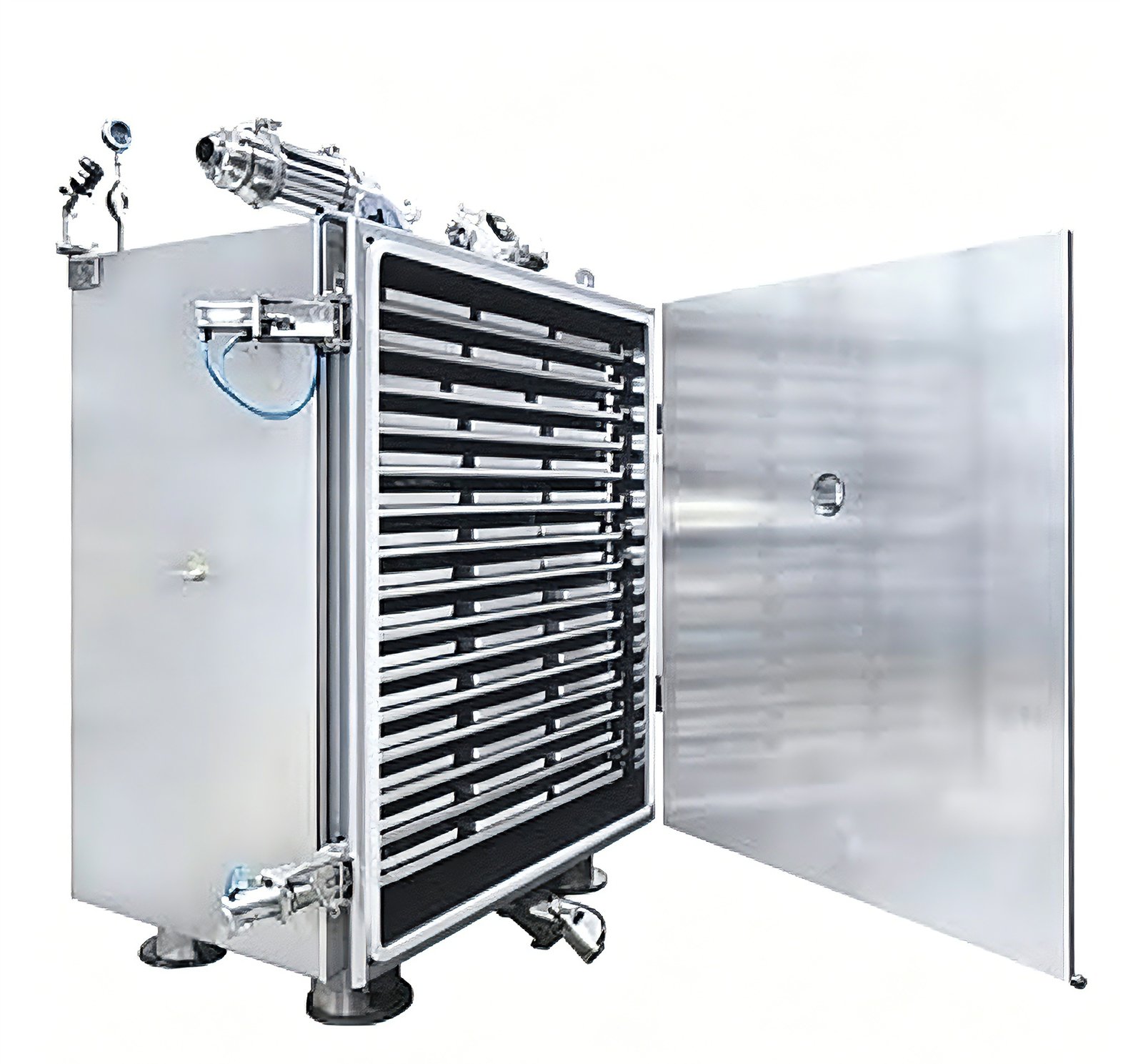
Vacuum Tray Dryer
Static Drying
Material rests statically on trays. Suitable for processes prioritizing minimal mechanical agitation and particle preservation. Requires evaluation of layer thickness and manual loading operations. (Also known as industrial vacuum shelf dryer).
View Specifications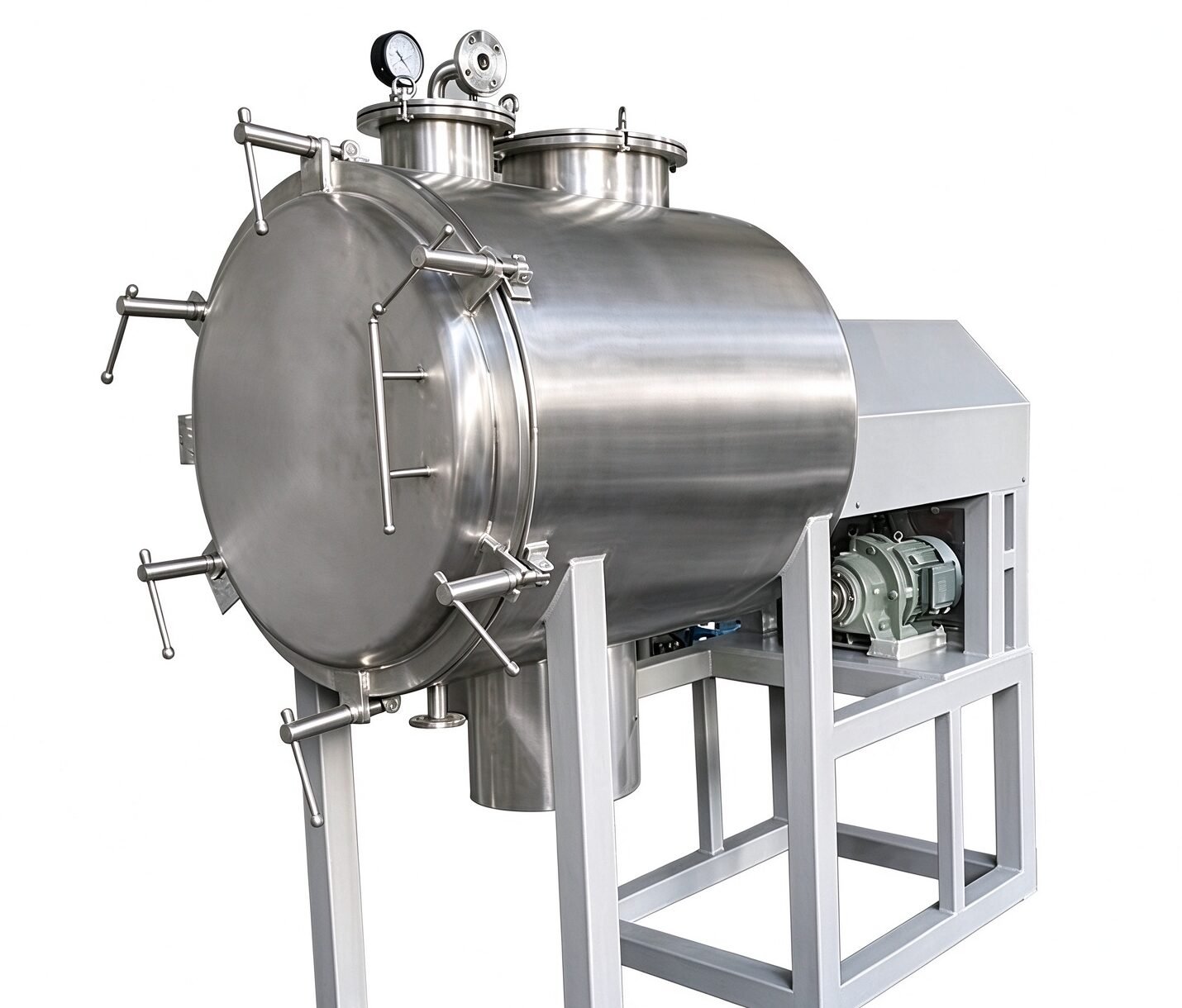
Vacuum Rake Dryer
Horizontal Agitated
Horizontal stationary vessel with internal rake agitator. Evaluated for slurries, pastes, and materials requiring continuous surface renewal. Viscosity changes, torque, and discharge behavior must be verified.
View Specifications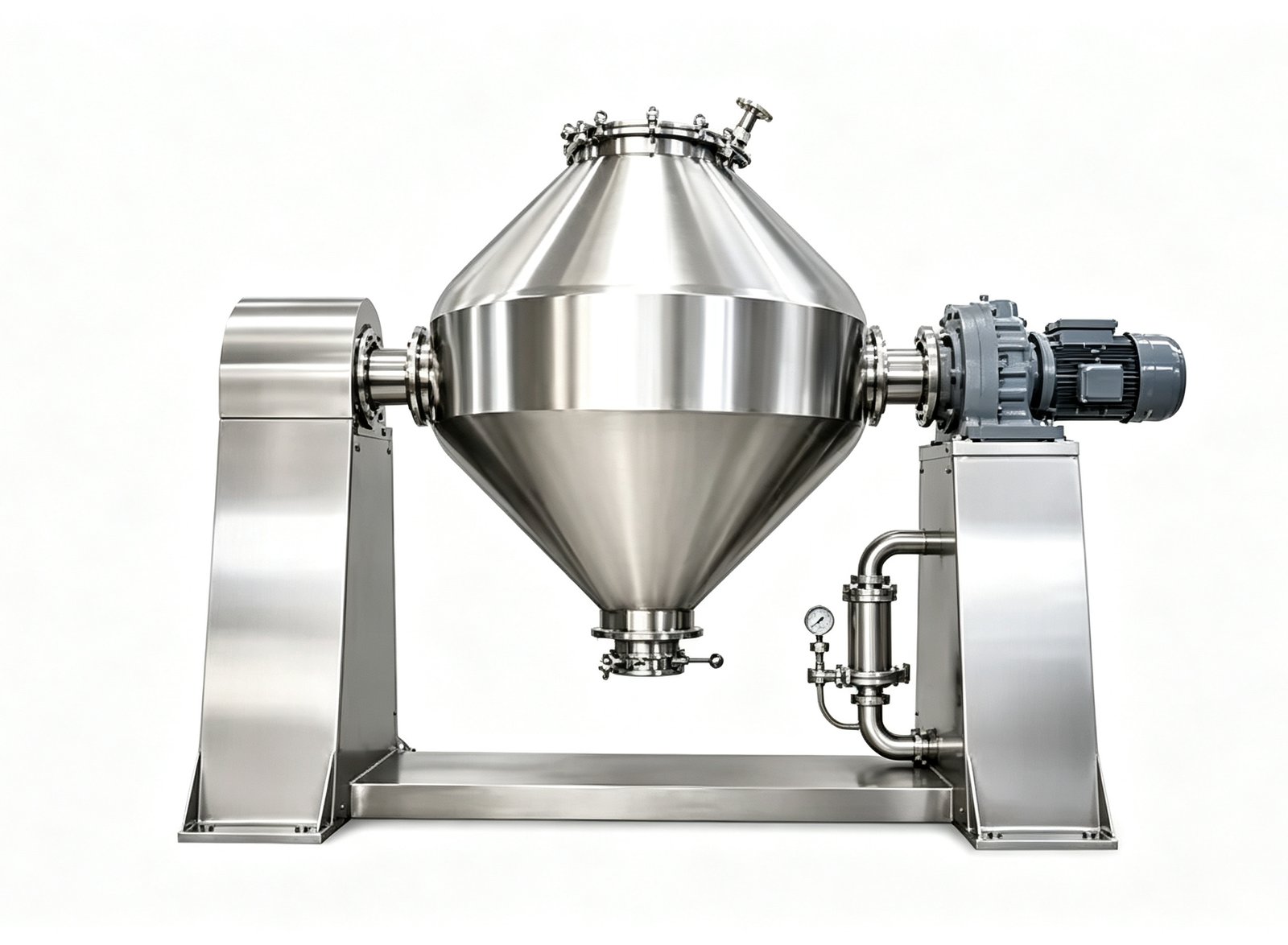
Double Cone Vacuum Dryer
Tumbling Vessel
The entire vessel rotates, tumbling the material against heated walls. Suitable for evaluating powders and granules requiring moderate agitation in batch processes. Particle integrity depends on material properties.
View Specifications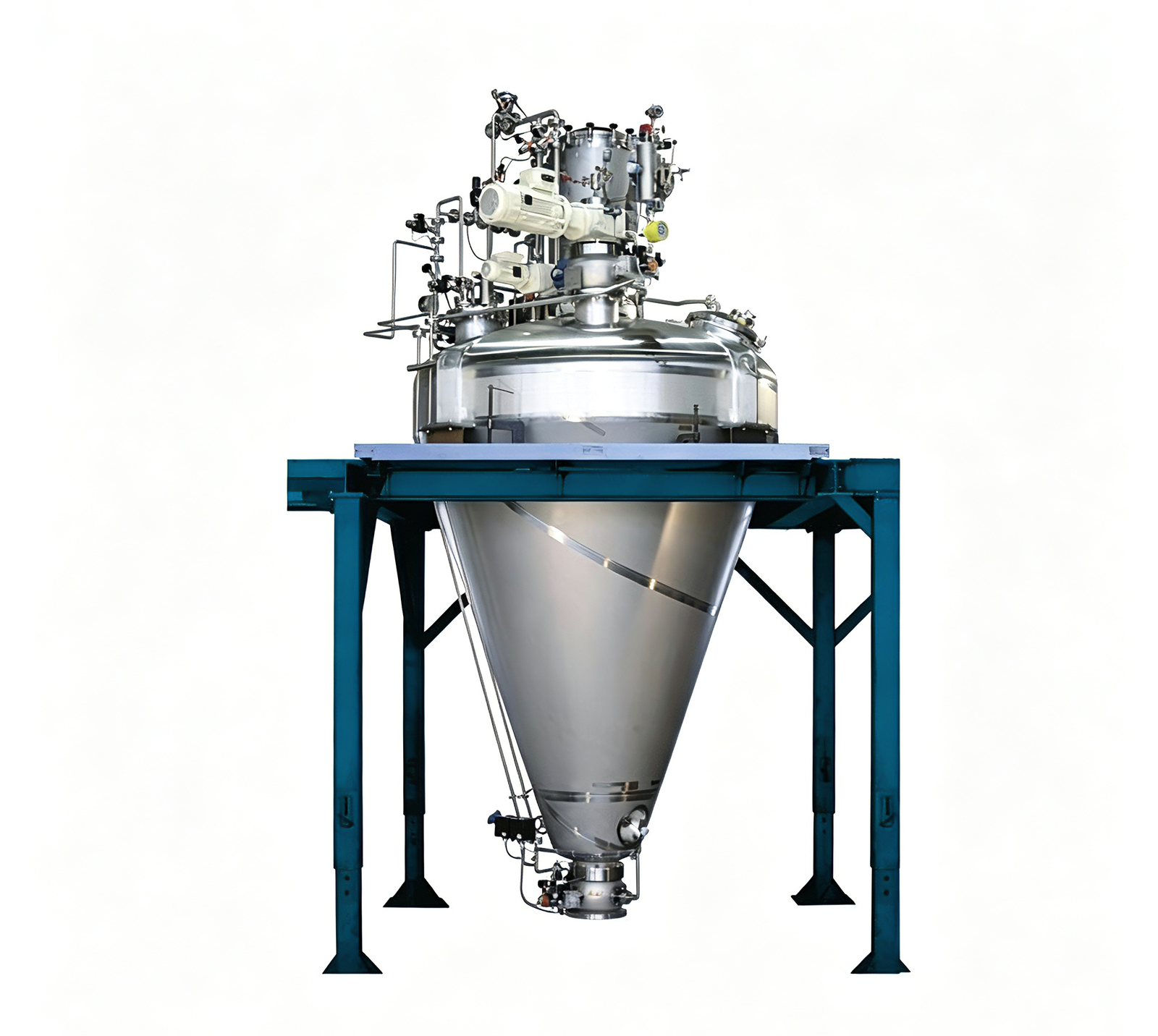
Conical Vacuum Dryer
Vertical Agitated
Vertical vessel incorporating internal agitation for mixing and heat transfer under vacuum. Specific agitator structures (ribbon/screw) and heating configurations require independent engineering confirmation based on your application.
Discuss RequirementsWhat Is a Vacuum Dryer and How Does It Work?
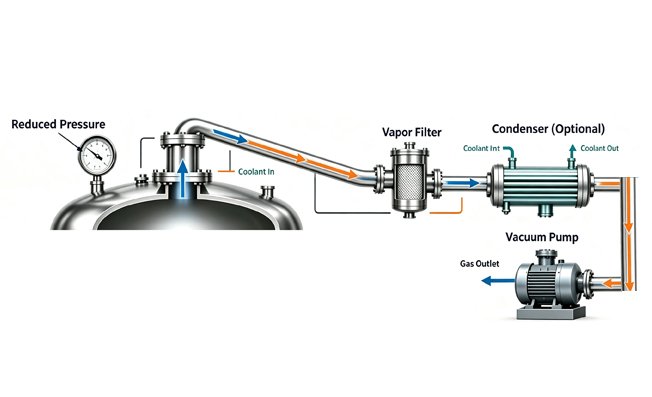
A vacuum dryer removes water or solvents from a material inside a sealed chamber at reduced pressure. Lower pressure lowers the liquid’s boiling temperature, while supplied heat provides the energy for evaporation. Vapour is removed through the vacuum system.
Core Principle: Lower pressure allows evaporation at a lower temperature. Heat is still needed.
Vacuum Drying Explained — Using a Tray Dryer as an Example
Load and Seal
Material is loaded into the chamber, and the vessel is completely sealed from atmospheric pressure.
Reduce Pressure
The vacuum system evacuates air, lowering the internal pressure and subsequently the boiling point of the liquid.
Supply Heat
Heat is transferred through jackets, shelves, or internal agitators to provide the latent heat of vaporization.
Remove Vapour
Vapour is drawn out by the vacuum pump. If configured, a condenser collects the vaporized liquid for recovery.
Match Drying Challenges to the Right Configuration
Different materials behave differently as moisture is removed. We review your specific constraints to evaluate the appropriate mechanical and thermal design.
Heat-Sensitive Materials
Process Constraint: Active ingredients or compounds degrade at standard atmospheric boiling temperatures.
Design Approach: Reduced pressure allows boiling point depression. The system is designed to operate below the material's thermal degradation limit.
Verification Needed: Maximum allowable product temperature, required residence time, and heat transfer efficiency at low pressure.
Solvent Recovery Requirements
Process Constraint: Organic solvents must be removed, contained, and collected rather than exhausted to atmosphere.
Design Approach: Closed-loop vapor piping integrated with a condenser and receiver tank sized for the solvent load.
Verification Needed: Solvent properties (boiling point, specific heat), peak vapor load, available cooling utility temperatures, and safety/inerting requirements.
Sticky, Clumping, or Uneven Heating
Process Constraint: Material forms lumps or sticks to walls as it dries, causing uneven moisture distribution and poor heat transfer.
Design Approach: Evaluate agitated designs like the vacuum rake dryer to continuously break lumps and renew the material in contact with heated surfaces.
Verification Needed: Viscosity changes through the drying curve, required agitator torque, and discharge mechanism effectiveness.
Fragile Particle Structure
Process Constraint: Crystals or formed granules must retain their shape, and strong mechanical agitation causes unacceptable breakage.
Design Approach: Evaluate static vacuum tray dryers for zero movement, or double cone dryers for gentle tumbling action.
Verification Needed: Acceptable drying time versus layer thickness (for trays), and physical testing of particle attrition (for tumbling vessels).
Construction and Preliminary Specifications
Compare the construction, material movement, capacity and heating arrangement of our four industrial vacuum dryer configurations. The right dryer depends on the material form, batch size, heat sensitivity, liquid to be removed, target moisture or residual-solvent level, and cleaning requirements.
Specification Disclaimer: Specifications are reference values from the supplied product catalog or model drawing. Final capacity, materials, operating conditions, auxiliary equipment and supply scope are subject to the latest confirmed datasheet, quotation and approved engineering drawings.
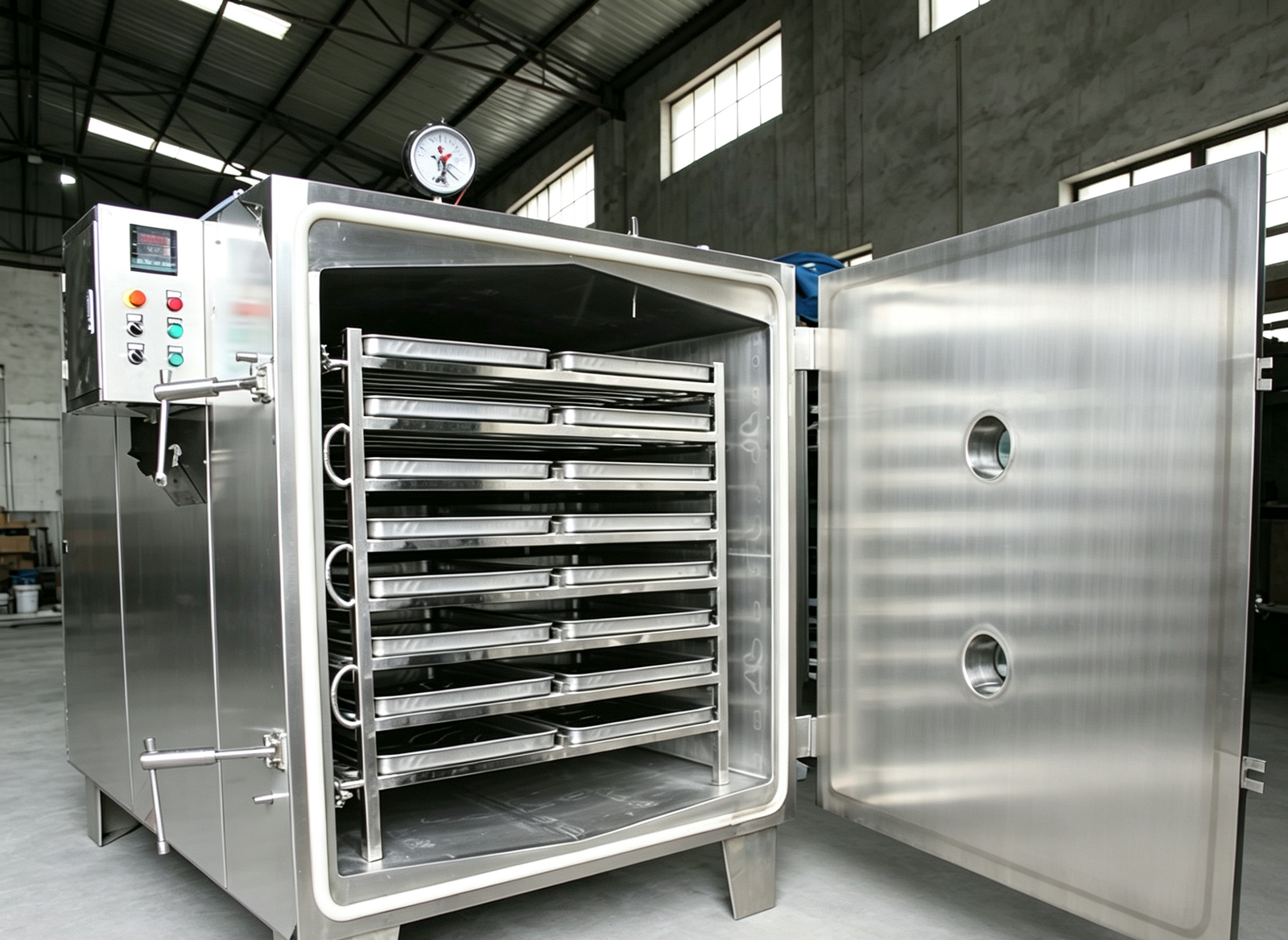
Vacuum Tray Dryer
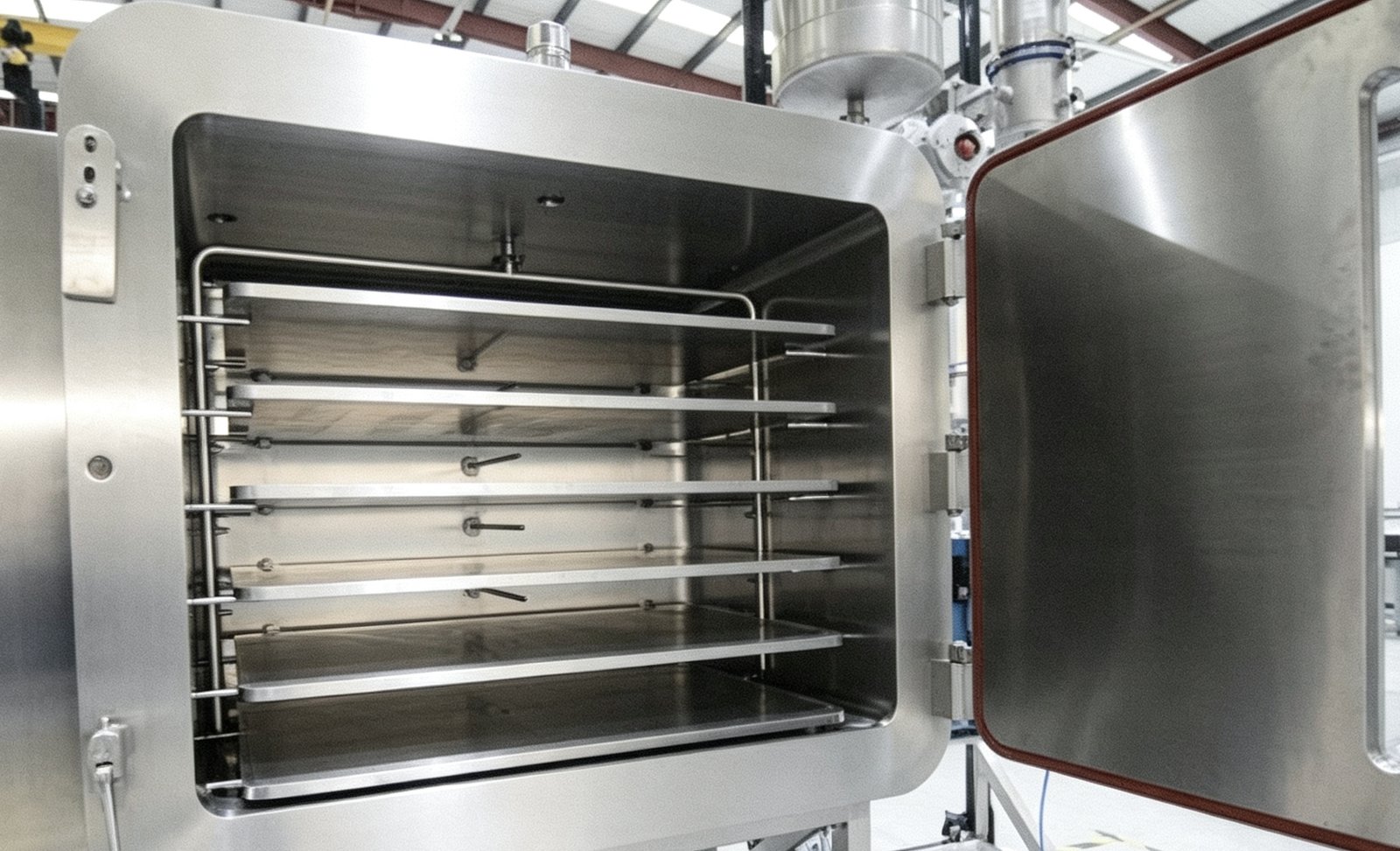
The GZY/GZF vacuum tray dryer is a static batch vacuum shelf dryer. Material remains stationary in removable trays while heat is transferred through the internal shelves and vapour is removed by the vacuum system.
- Construction: Sealed round or rectangular vacuum chamber, heated shelves, removable trays, access door and vacuum outlet.
- Material Movement: Static drying without mechanical agitation.
- Heating: Indirect heating by hot water or steam.
- Best Suited For: Tray-loadable materials requiring controlled batch drying with minimal mechanical movement.
| Parameter | Specification Range / Value |
|---|---|
| Model Series | GZY-600, GZY-1000, GZY-1400 and GZF-15 |
| Dryer Configuration | Static batch vacuum tray dryer / vacuum shelf dryer |
| Internal Chamber Dimensions | Φ600 × 976 mm, Φ1000 × 1572 mm, Φ1400 × 2054 mm, or 1500 × 1200 × 1400 mm, depending on model |
| Number of Trays | 4, 12 or 32, depending on model |
| Tray Dimensions | 310 × 600 × 45 mm or 460 × 640 × 45 mm |
| Number of Shelf Levels | 4, 6 or 8, depending on model |
| Shelf Spacing | 81, 102 or 122 mm, depending on model |
| Catalog Chamber Temperature Limit | ≤150°C |
| Heating Medium | Hot water or steam |
| Solvent-Recovery Arrangement | Condenser and collection system available according to process requirements |
Selection Note: The listed chamber temperature is an equipment limit, not the recommended drying temperature for every material. Tray loading depth, heat sensitivity, evaporation load and target moisture must be evaluated for each application.
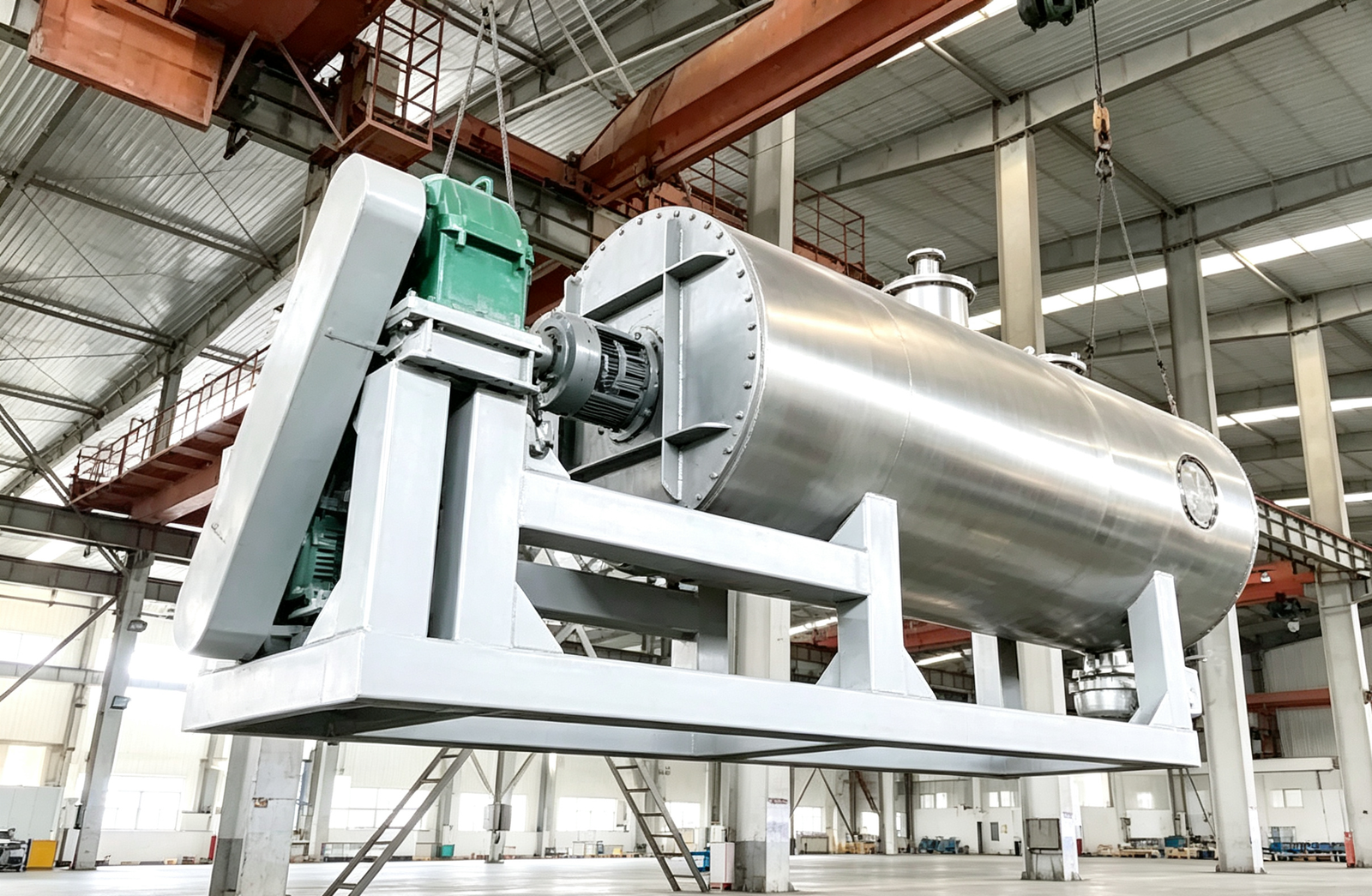
Vacuum Rake Dryer
The ZKG vacuum rake dryer is a horizontal agitated batch vacuum dryer designed for materials that benefit from mixing during drying. Heat is transferred through both the vessel jacket and the internal agitator.
- Construction: Horizontal stationary vessel, internal rake agitator, drive assembly, sealed shaft connections and bottom discharge.
- Material Movement: Low-speed rake agitation continuously renews material contact with heated surfaces.
- Heating: Indirect heating through the vessel jacket and internal agitator.
- Best Suited For: Pastes, pulps, cohesive powders and other materials requiring agitation, subject to process evaluation.
| Parameter | Specification Range / Value |
|---|---|
| Model Series | ZKG-500 to ZKG-6000 |
| Dryer Configuration | Horizontal agitated batch vacuum dryer |
| Working Volume | 300–3,600 L, depending on model |
| Heat-Transfer Area | 3.2–16.5 m², depending on model |
| Agitator Speed | 8–18 rpm |
| Motor Power | 4–22 kW, depending on model |
| Heating Arrangement | Vessel jacket and internal agitator heating |
| Material Movement | Low-speed rake agitation inside a stationary vessel |
| Typical Feed Forms | Powder, pulp and paste-like materials, subject to material testing |
| Solvent-Recovery Arrangement | Condenser and collection system selected according to the solvent and vapour load |
Selection Note: Working volume is not the same as total vessel volume. Selection should consider changing viscosity during drying, agitator torque, heat-transfer demand, solvent characteristics and final discharge behaviour.
Terminology Note: Some suppliers use “vacuum paddle dryer” or “vacuum harrow dryer” for related horizontal agitated vacuum dryers. These names are not universally interchangeable. Compare the actual agitator geometry, heated surfaces, torque, cleaning design and discharge arrangement.
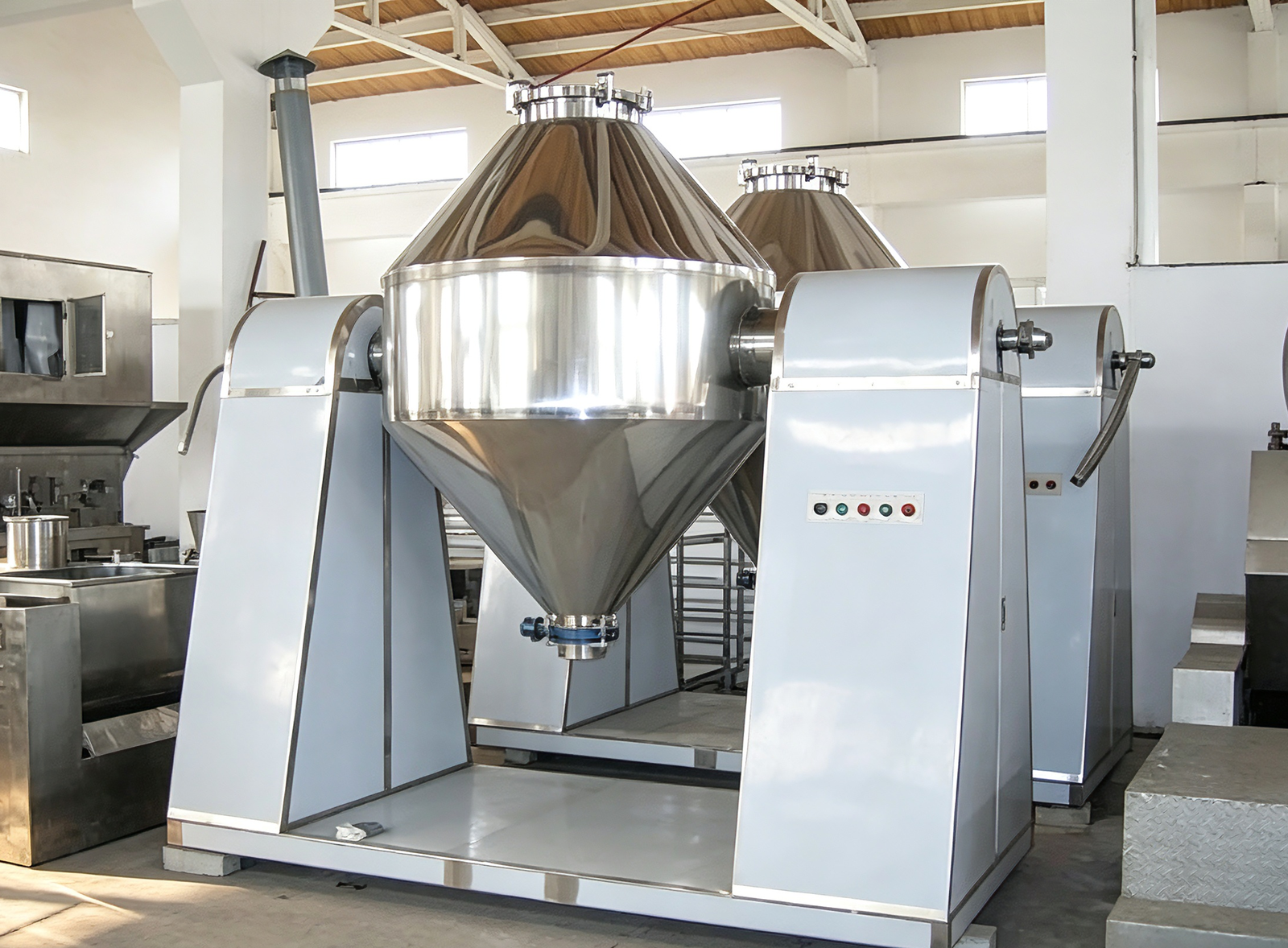
Double Cone Vacuum Dryer
The SZG double cone vacuum dryer is a rotating batch vacuum dryer. The entire double-cone vessel rotates, causing the material to tumble and repeatedly contact the indirectly heated vessel wall.
- Construction: Rotating double-cone vessel, heating jacket, two-sided supports, drive system and rotary vacuum and heating connections.
- Material Movement: Whole-vessel rotation with material tumbling.
- Heating: Indirect jacket heating by hot water, steam or thermal oil.
- Best Suited For: Free-flowing powders and granules that can be processed by tumbling, subject to particle-strength and flowability evaluation.
| Parameter | Specification Range / Value |
|---|---|
| Model Series | SZG-50 to SZG-3000 |
| Dryer Configuration | Double cone rotary batch vacuum dryer |
| Vessel Volume | 50–3,000 L, depending on model |
| Loading Factor | 0.4–0.6 |
| Catalog Maximum Loading Quantity | 25–1,200 kg, depending on model and material bulk density |
| Motor Power | 1.1–7.5 kW, depending on model |
| Heating Medium | Hot water, steam or thermal oil |
| Material Movement | Whole-vessel rotation with material tumbling |
| Available Variant | SZG-A with stepless speed adjustment and constant-temperature control, subject to model confirmation |
| Solvent-Recovery Arrangement | Condenser and receiving system configured according to process requirements |
Selection Note: The allowable batch mass must be confirmed against vessel volume, loading factor, material bulk density and operating requirements. Tumbling suitability should be checked for fragile, cohesive or poorly flowing materials.
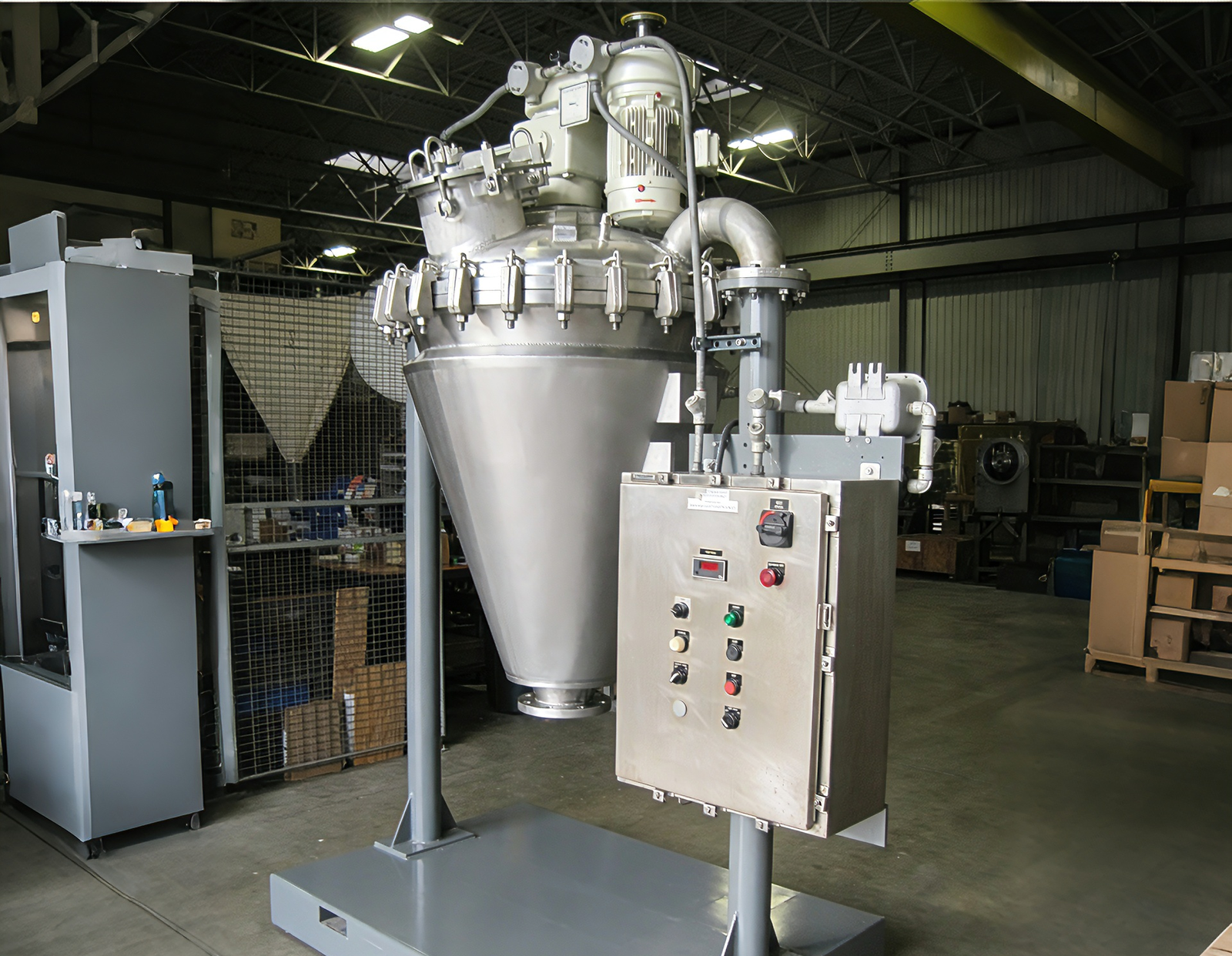
Conical Vacuum Dryer
The CHD vertical conical vacuum dryer is an agitated batch dryer with a top-mounted drive, internal helical agitator, jacketed conical vessel and bottom discharge. The following values refer specifically to the CHD-200 reference model.
- Construction: Vertical conical vessel, heating jacket, top-mounted drive, internal helical agitator and bottom discharge valve.
- Material Movement: Internal agitation moves material along the conical vessel wall during vacuum drying.
- Heating: Indirect heating through the jacket; the heating medium is selected for the required process temperature.
- Best Suited For: Selected powders and granular materials requiring an agitated vertical configuration and compact discharge arrangement.
| Parameter | Specification Range / Value |
|---|---|
| Reference Model | CHD-200 |
| Dryer Configuration | Vertical conical agitated batch vacuum dryer |
| Effective Volume | 0.2 m³ / 200 L |
| Heat-Transfer Area | 0.98 m² |
| Drive Power | 4 kW |
| Agitator Speed | 5–35 rpm |
| Main Vessel Material | 304 stainless steel, according to the CHD-200 drawing |
| Internal Surface Finish | 0.4 μm polishing requirement shown on the CHD-200 drawing |
| Inner-Vessel Design Pressure | −0.1 MPa, according to the drawing; pressure reference must be confirmed before final publication |
| Jacket Design Pressure | 0.6 MPa |
| Design Temperature | 300°C for the inner vessel and jacket |
| Heating Medium | Steam, thermal oil or hot water, subject to the selected configuration |
Selection Note: Design pressure and design temperature describe equipment design conditions; they are not automatic operating setpoints or recommended product temperatures. Final operating vacuum, heating temperature, agitator speed and batch loading must be determined from the material and drying target.
How to Choose the Right Vacuum Dryer
Do not select based on volume alone. Evaluate the initial and final moisture,
| Your Process Priority | Type to Evaluate | Key Engineering Checks |
|---|---|---|
| Static drying with minimal mechanical movement | Vacuum Tray Dryer | Layer thickness, tray loading ergonomics, heat transfer rate, handling methods. |
| Pastes or cohesive materials needing agitation | Vacuum Rake Dryer | Changing viscosity during drying, torque requirements, heated surface area, discharge efficiency. |
| Powders or granules suited to tumbling | Double Cone Vacuum Dryer | Material flowability, acceptable particle damage limits, loading factor, rotation clearance space. |
| A vertical agitated arrangement | Conical Vacuum Dryer | Confirmed agitator design, material behavior under vertical mixing, CIP cleaning, installation height. |
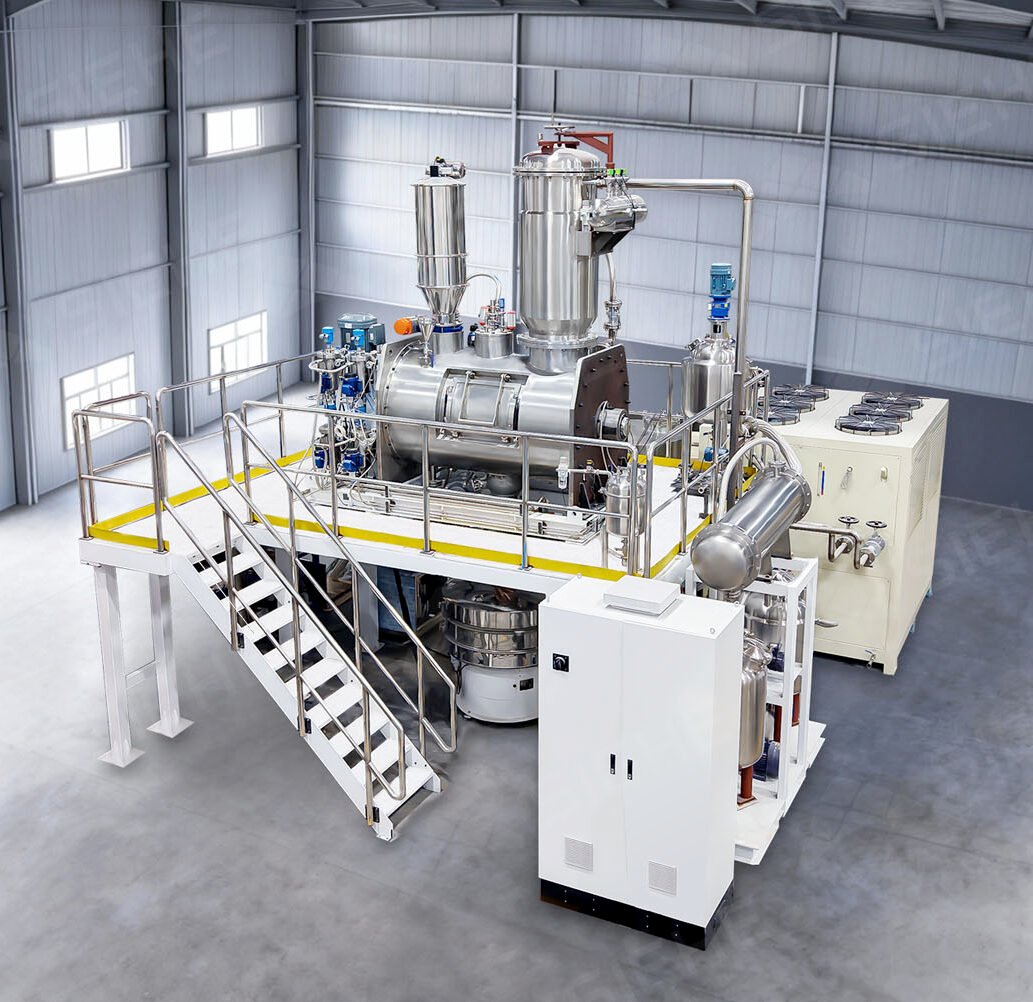
Simplified configuration. Filtration, condensation, and pump arrangements are determined by engineering design.
From a Vacuum Dryer to a Complete Drying System
A vacuum dryer is the core vessel, but operation requires supporting systems. We help you define the supply boundary based on your existing site utilities and process needs.
Typical System Components:
- ■ Dryer Vessel: The main heating and containment unit.
- ■ Dust Filtration: Prevents fine powder carry-over into the vacuum line.
- ■ Condenser & Receiver: Cools and collects vaporized solvents or water.
- ■ Vacuum Pump: Sized for the required ultimate pressure and vapor load.
- ■ Heating/Cooling Unit: Supplies thermal fluid, water, or steam.
For Organic Solvents: Proper evaluation of material compatibility, leak tightness, inerting, ignition source control, and exhaust treatment is required. Vacuum alone does not guarantee a zero-oxygen or naturally explosion-proof environment.
Applications to Evaluate
General directions where vacuum drying technology is commonly assessed.

Pharmaceutical & Chemical
Powders, granules, filter cakes, or solvent-wet intermediates. Focus on thermal sensitivity, residual solvent targets, and cleanability.

Food Ingredients & Extracts
Food components where high-temperature air drying causes unacceptable degradation. Temperature limits must be clearly defined.

Pigments & Resins
Specialty chemicals requiring solvent removal. Selection focuses on managing viscosity changes and preventing severe clumping.
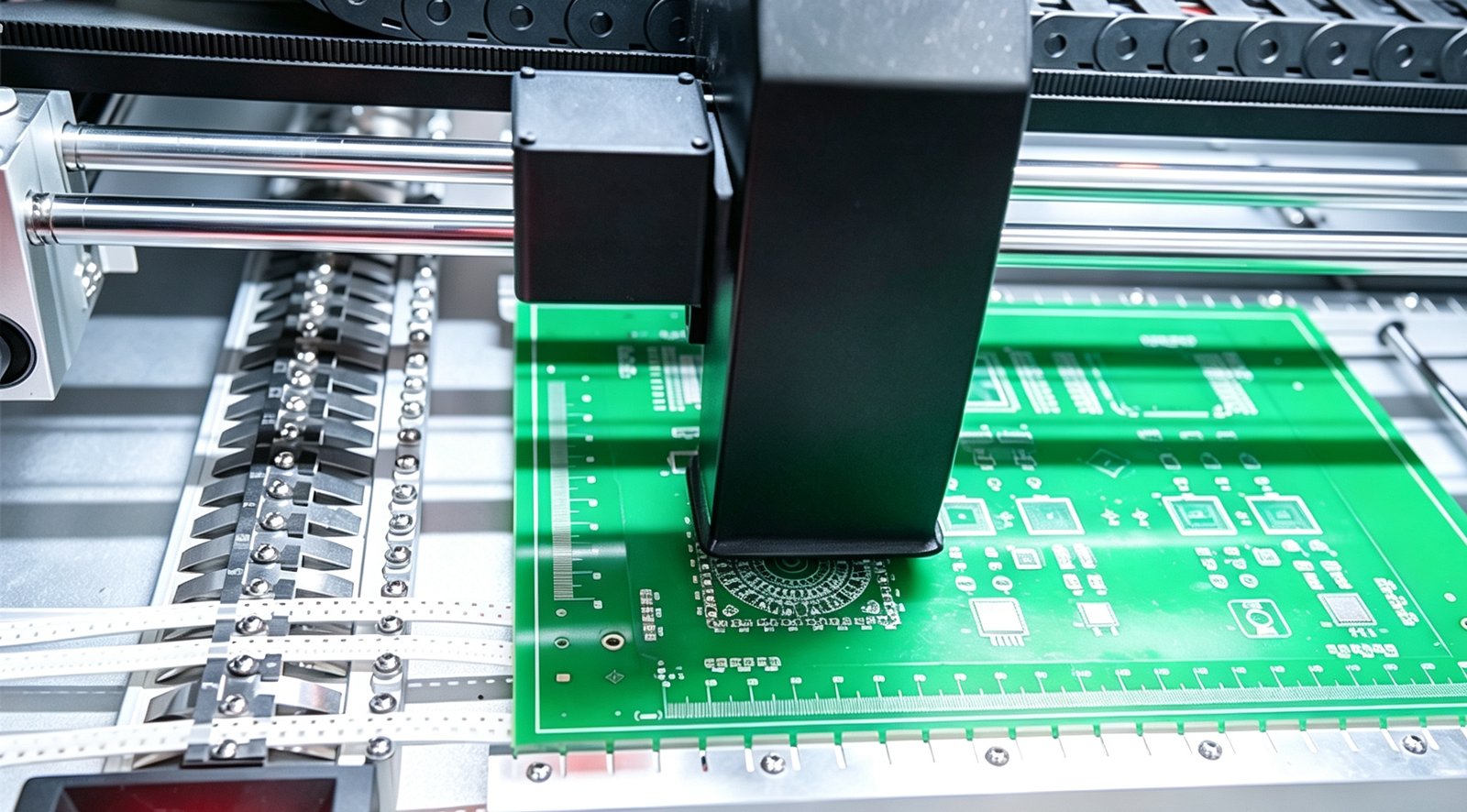
Selected Electronic Materials
Specific battery or electronic powders requiring low moisture. Strict verification of purity, contamination control, and material compatibility is necessary.
Define the Process Before Selection
Engineering confirmation requires concrete data. We guide you through evaluating the process parameters before finalizing the equipment size and type.
Review Material Data
Initial moisture, bulk density, thermal limits, and hazards.
Define Conditions
Determine required vacuum level, heating temperature, and batch time targets.
Check Product Results
Assess final moisture, residual solvent, and physical particle integrity.
Confirm Configuration
Finalize vessel size, agitator power, and auxiliary systems.
Manufacturing & Documentation You Can Verify
We build trust through transparent engineering and actual manufacturing evidence, not generic badges. Your project is supported by verifiable documentation.
-
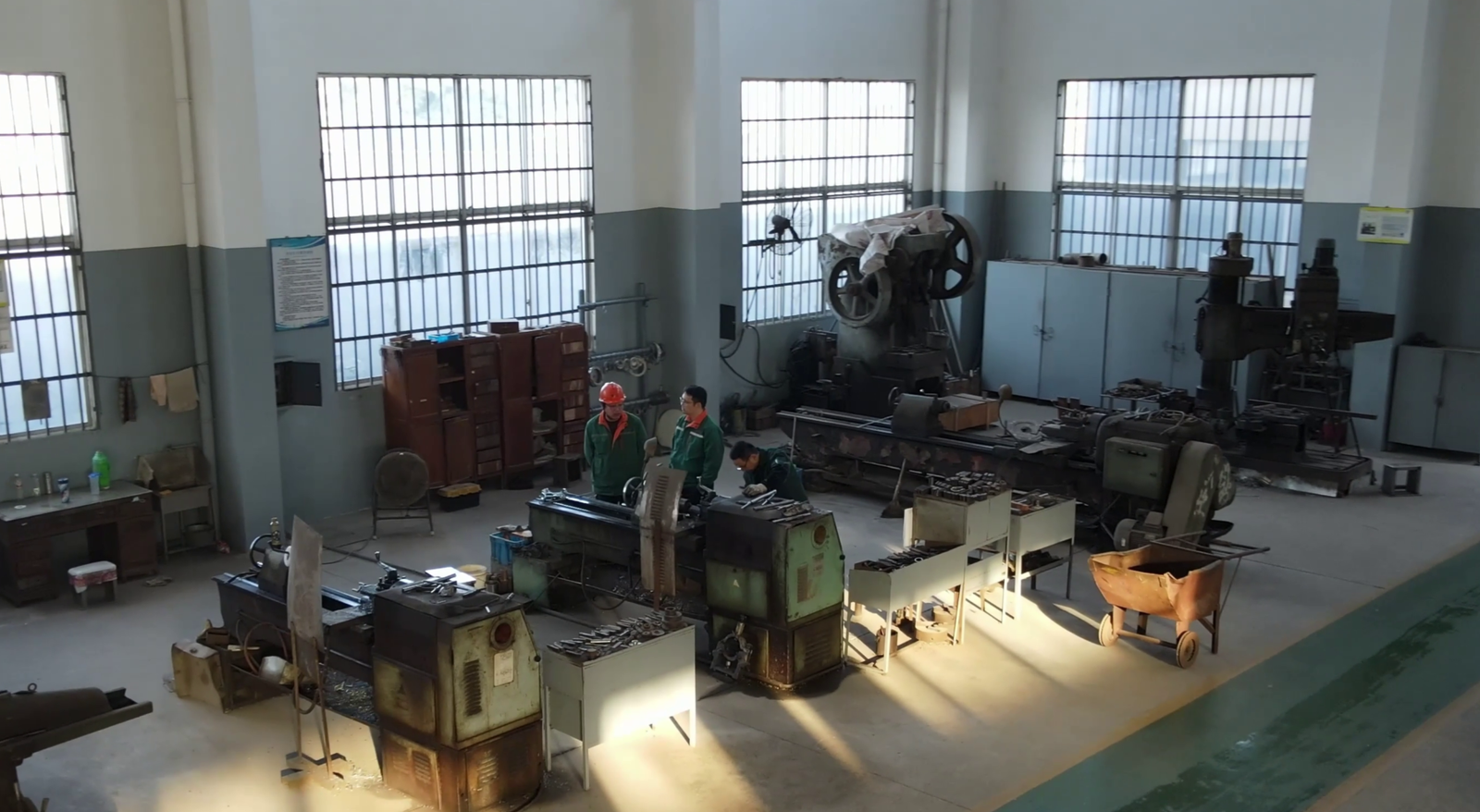
In-House Manufacturing
Vessel fabrication, welding, and assembly conducted at our facility, allowing for direct quality oversight.
-
Technical Documentation
Provision of general arrangement drawings, material certificates (e.g., 304/316L), and operational manuals upon order confirmation.
-
Factory Acceptance Testing (FAT)
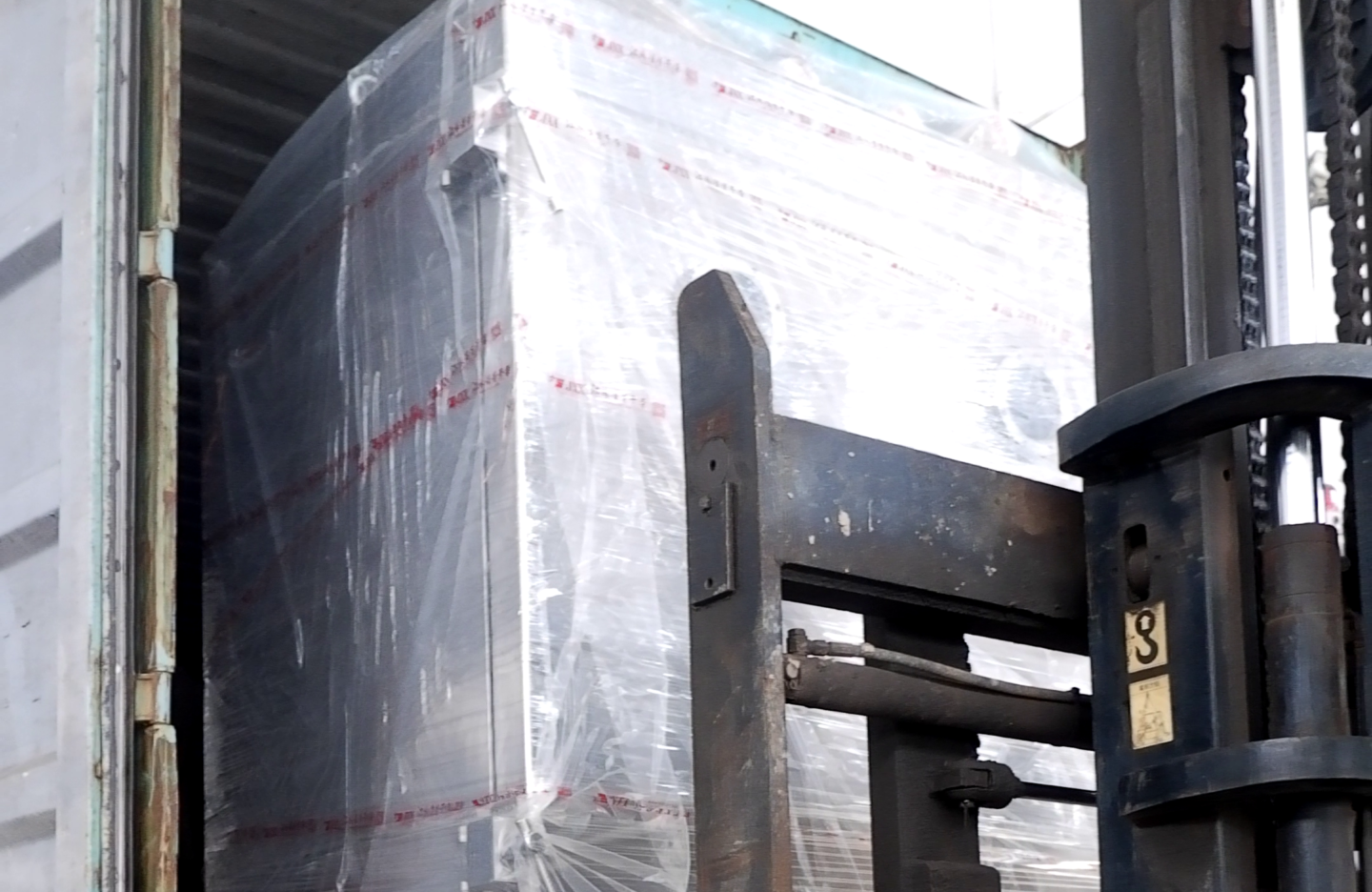
Equipment undergoes mechanical running tests and vacuum leak checks prior to shipment.
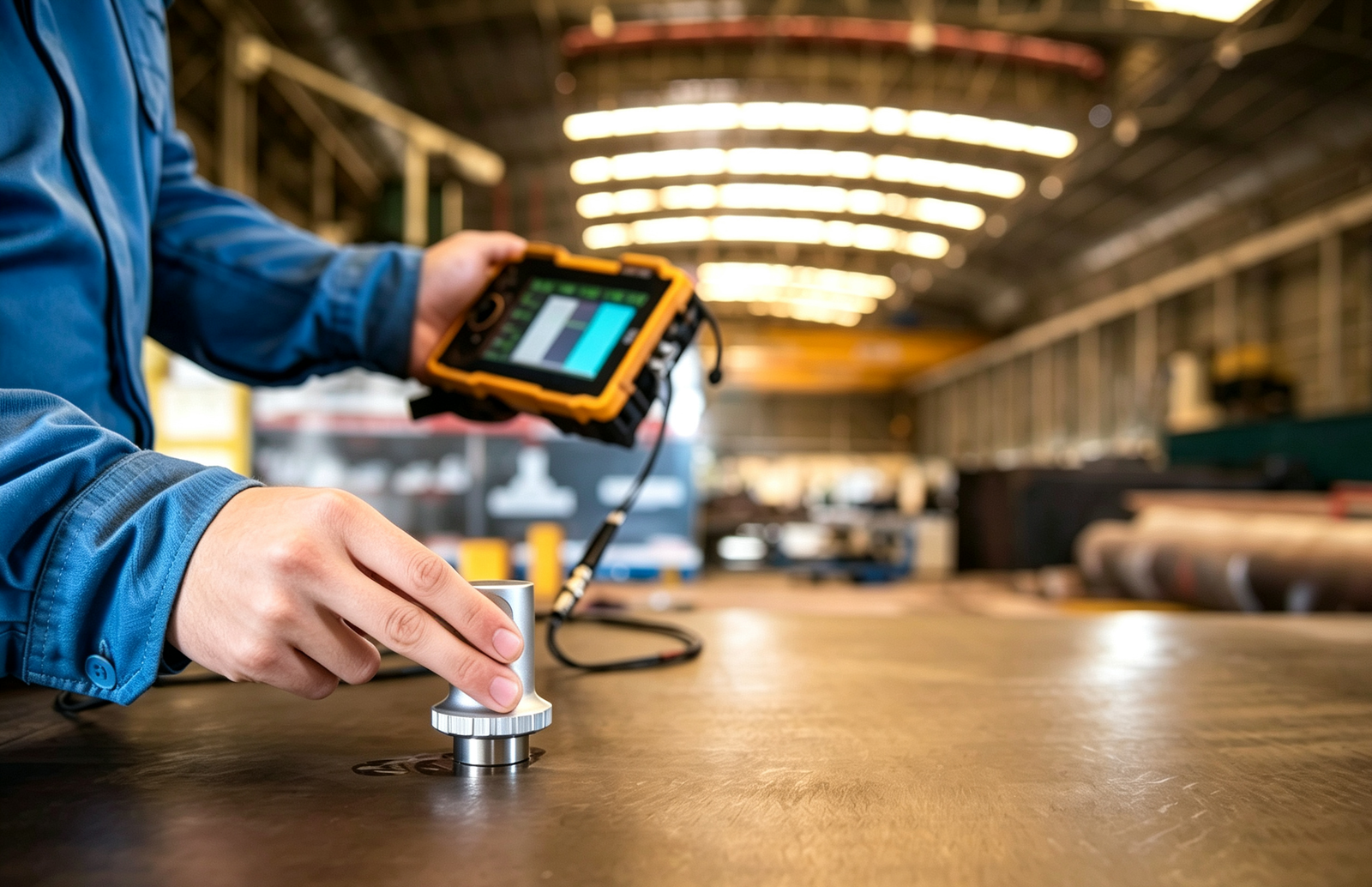
Vacuum Drying vs Other Methods
Understanding when to consider standard vacuum drying
Vacuum Drying
Combines reduced pressure (lowering boiling point) and conductive heat transfer. Vapour is extracted by a pump.
Best Evaluated For:
Heat-sensitive materials, solvent recovery, and processes requiring low residual moisture without extreme freezing.
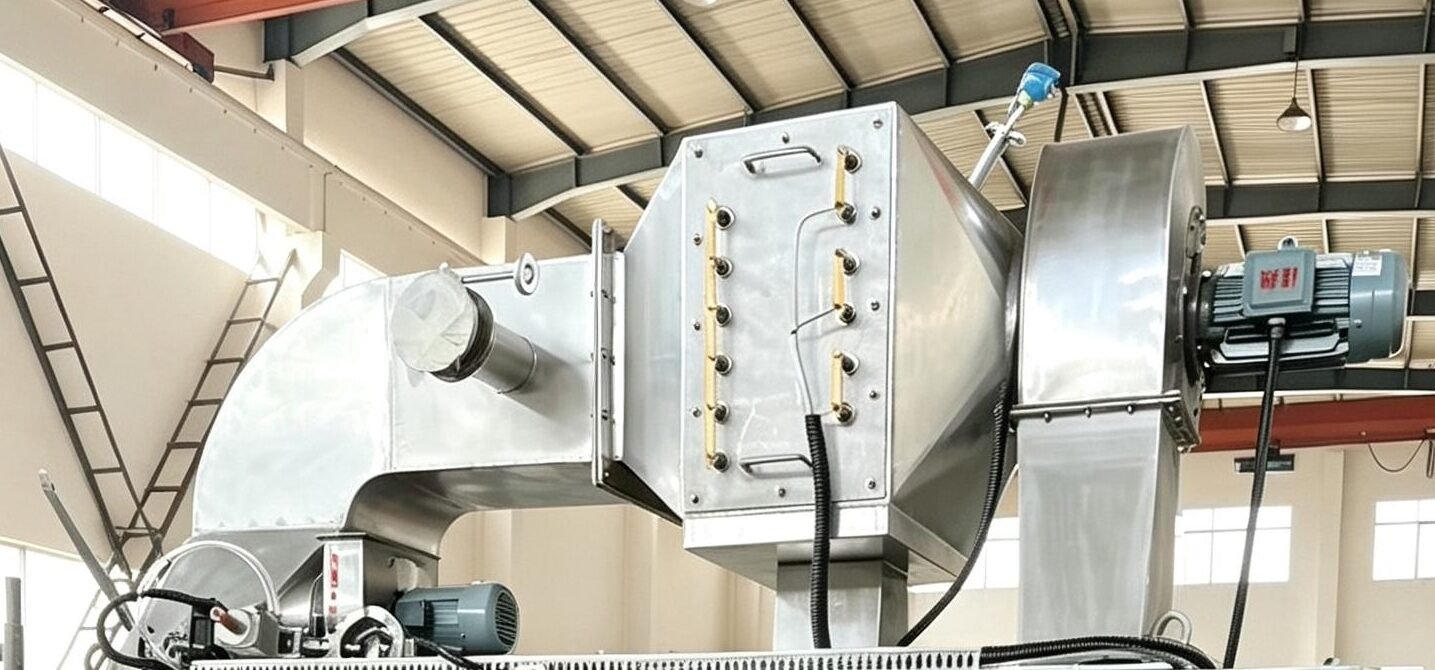
Hot-Air Drying
Utilizes heated gas streams for convective heat transfer and moisture removal at atmospheric pressure.
Best Evaluated For:
Robust materials that tolerate higher temperatures and oxidation, where high throughput is prioritized over solvent recovery.
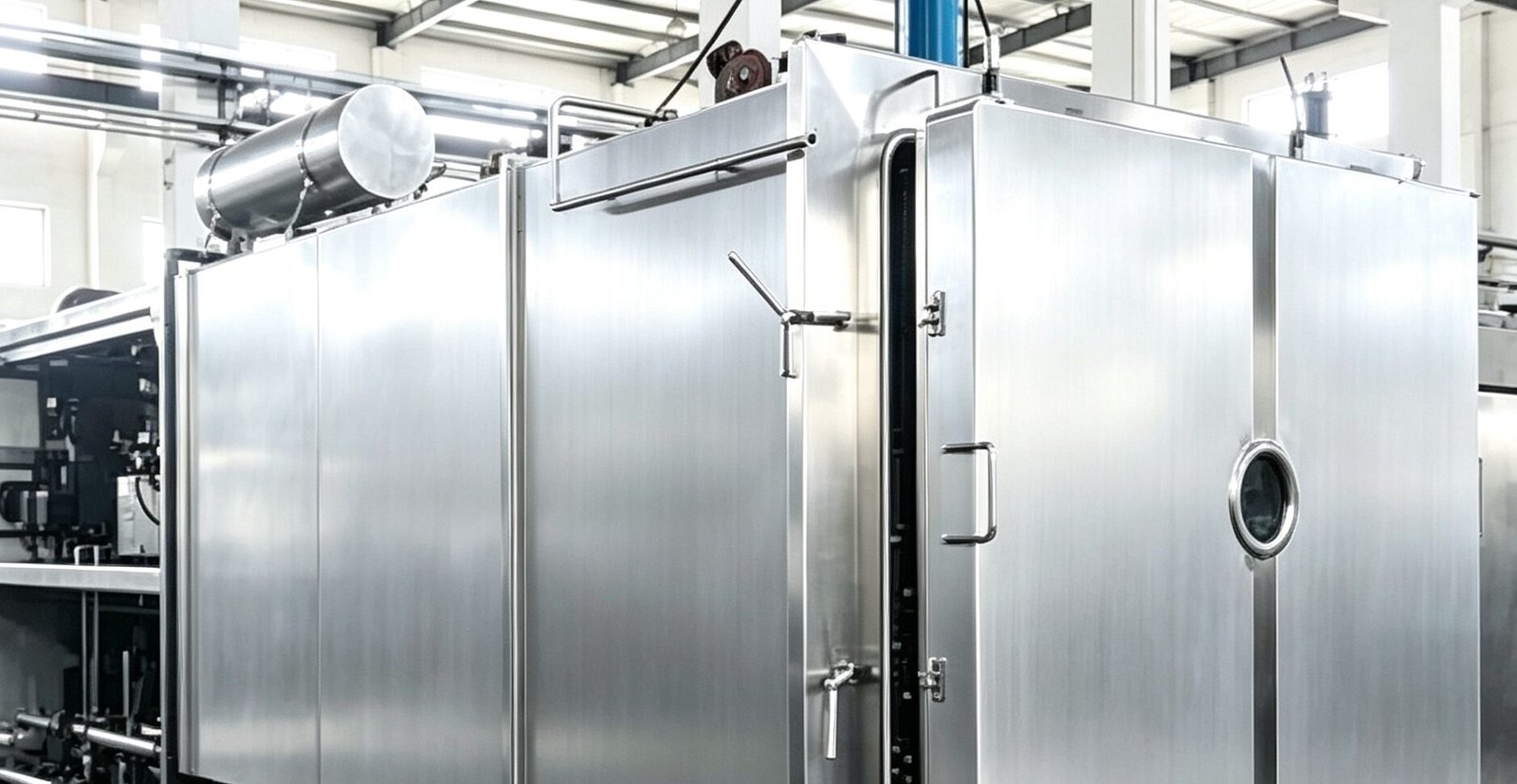
Freeze Drying
Material is frozen, then pressure is lowered to allow ice to sublimate directly to vapor. Requires phase-change energy.
Best Evaluated For:
Highly sensitive biologicals or pharmaceuticals requiring absolute structural preservation. Higher capital and operating cost.
What Determines Vacuum Dryer Cost?
Pricing is not universal; a single quote does not apply to all materials. The final investment is determined by the specific configuration required to meet your process targets safely and efficiently.
- 1. Machine Type & Size: Vessel volume and complexity of agitation.
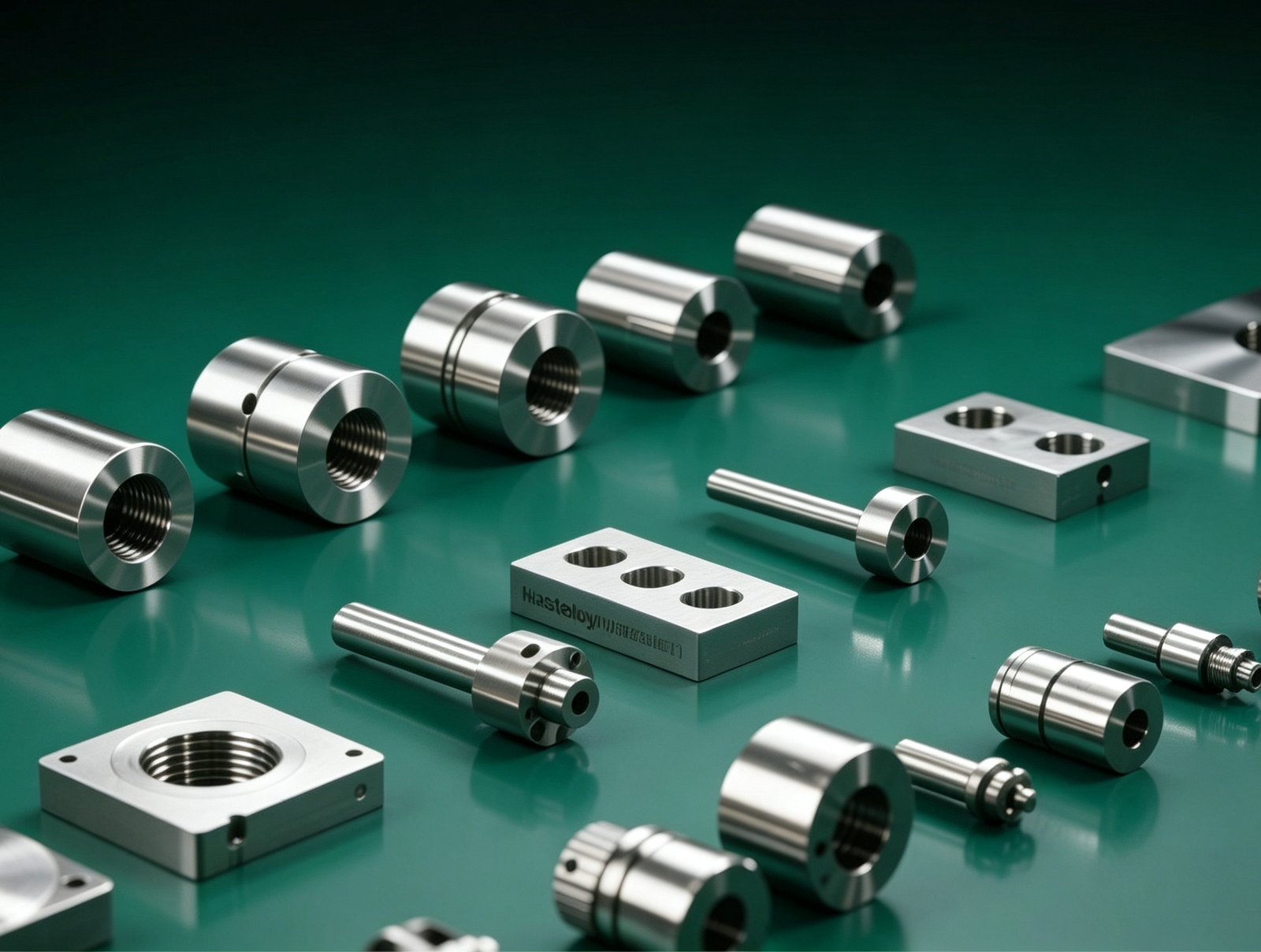
- 2. Contact Materials: 304, 316L, Hastelloy, or special coatings.
- 3. Thermal & Vacuum Setup: Jacket ratings and pump capacity.
- 4. Solvent Recovery: Addition of sized condensers and receivers.
- 5. Cleaning & Controls: CIP systems, polished finishes, PLC automation.
- 6. Delivery Scope: Bare unit versus fully integrated skid system.
Frequently Asked Questions
Technical clarifications on vacuum drying equipment selection.
Is a vacuum paddle dryer the same as a vacuum rake dryer?
The names are sometimes used interchangeably in the industry, but they should not be assumed identical. You must compare the actual agitator geometry (paddle blades vs. rake teeth) and heating design. For example, our ZKG vacuum rake dryer features both jacket and internal agitator heating.
What is the difference between a double cone and a conical vacuum dryer?
A double cone vacuum dryer (SZG) rotates the entire vessel to tumble the material. A conical vacuum dryer is typically a stationary vertical vessel with internal mechanical agitation (like a screw or ribbon). The specific internal structure of our conical options must be confirmed based on your application.
When should I choose a vacuum tray dryer instead of an agitated dryer?
Choose a static tray dryer when material movement is unacceptable (e.g., fragile crystals), or when the material undergoes a highly sticky phase that would stall an agitator. The trade-off involves longer drying times due to static heat transfer and manual loading/unloading.
Can a vacuum dryer recover solvents?
Yes, but the dryer vessel alone does not recover solvent. It requires a properly designed auxiliary system including a condenser and receiver tank. The actual recovery rate depends on the solvent's properties, cooling utility temperature, and system leak tightness.
What temperature and vacuum level do I need?
There is no universal setting. It depends entirely on the liquid being removed, the material's maximum allowable temperature, and the desired drying rate. Pressure values must always be specified as absolute or gauge pressure when discussing requirements.
How long does a batch take to dry?
Batch time cannot be guaranteed without process data. It is influenced by the material's thermal conductivity, initial/target moisture, batch size, available heating area, and the vacuum system's vapor handling capacity. Pilot testing or historical data is required to estimate cycle times.
Is vacuum drying suitable for heat-sensitive or oxygen-sensitive materials?
Yes, it is a primary evaluation direction for these materials. However, it does not guarantee zero thermal degradation or an absolute zero-oxygen environment. Highly oxygen-sensitive materials may require specific inert gas purging (nitrogen) in addition to vacuum.
What information is needed for a quotation?
We need to know the material name/state, required batch size or daily capacity, initial and target moisture/solvent content, specific liquid to be removed, temperature limits, and any site utility constraints.
Tell Us About Your Material and Drying Target
Provide preliminary details to start the engineering review. You do not need all technical parameters for initial contact; our team will guide you through the configuration process.
Direct Contact
zar@jexdry.com
+86 137 7501 3369
Jiaoxi Industrial Zone, Zhenglu Town, Tianning District, Changzhou, Jiangsu Province, China