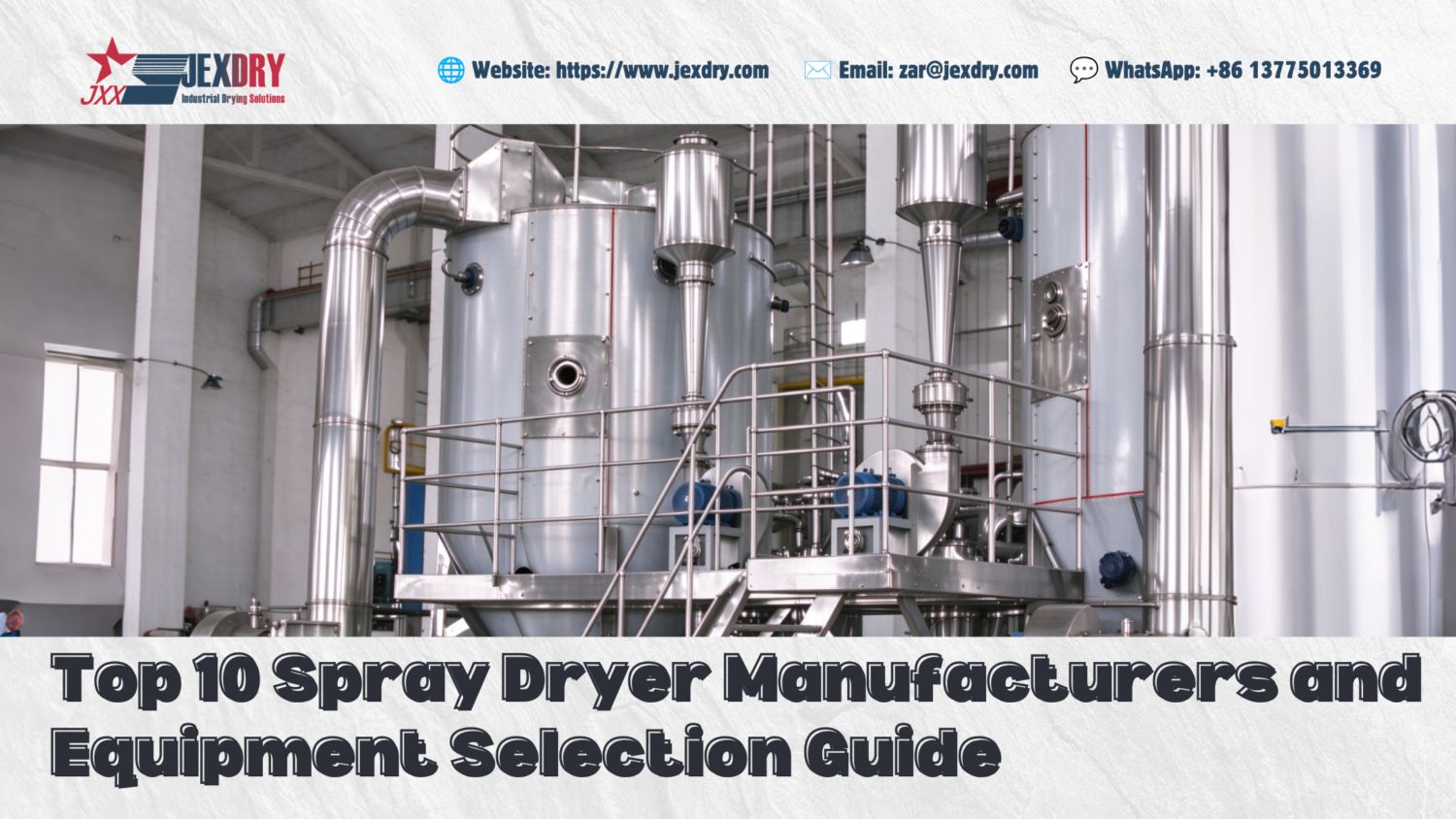
Choosing a spray dryer manufacturer starts with the powder you need to produce. A ceramic slurry intended for pressing requires different particle properties from an instant beverage ingredient or a pharmaceutical formulation. Feed solids, viscosity, solvent content, and the required powder moisture all affect the equipment selection.
The manufacturers below offer their own spray drying equipment or engineered systems. They appear alphabetically, without a ranking by sales or performance. The selection includes industrial production systems and equipment for process development and smaller commercial batches. JEXDRY publishes this article and is included under the same criteria.
Spray Dryer Manufacturers at a Glance
| Manufacturer | Location | Equipment to compare | Main point to investigate |
| ACMEFIL | India | Rotary, nozzle, and fluidized spray drying systems | Pilot testing and integration with feed concentration |
| ANDRITZ | Austria — group headquarters | Dedert single-stage and multi-stage spray dryers | Atomizer design, fines return, and fluid bed finishing |
| DORST Technologies | Germany | Spray dryers for powders and granules | Granule properties for downstream forming |
| European SprayDry Technologies | United Kingdom | Custom spray drying and powder processing systems | Plant layout and integration of surrounding process equipment |
| FREUND | United States | GENESIS spray drying systems | Particle development and smaller commercial production |
| GEA | Germany — group headquarters | Conventional and specialized spray drying systems | Process trials, powder handling, and plant configuration |
| JEXDRY | China | LPG centrifugal, YPG pressure, and extract spray dryers | Feed evaluation, evaporation duty, and system scope |
| SPX FLOW — Anhydro | Denmark — Anhydro office | Tall-form, spray bed, and small-scale systems | Powder properties and drying-stage configuration |
| Swenson Technology | United States | Spray dryers with different atomizers and airflow arrangements | Feed compatibility and open or closed-loop configuration |
| VetterTec | Germany — head office | Pilot and industrial spray drying systems | Atomization and downstream powder conditioning |
ACMEFIL
Location: Ahmedabad, Gujarat, India.
ACMEFIL manufactures spray drying systems using rotary discs, nozzle atomizers, and fluidized configurations. Its equipment portfolio also includes evaporators and powder collection equipment. An in-house pilot spray dryer supports material trials before production equipment is selected.
Consider when: A chemical or food ingredient project needs to assess spray drying together with feed concentration and powder recovery. Testing the concentrate can help establish whether it atomizes properly and whether deposits form in the chamber.
Discuss before ordering: Trial feed solids and viscosity, atomizer selection, powder moisture, and collection arrangements. Identify which concentration, air heating, filtration, and control equipment the quotation includes.
ANDRITZ
Location: Graz, Austria — group headquarters.
The ANDRITZ Dedert spray dryer range includes single-stage and multi-stage systems. Available arrangements include rotary or nozzle atomization, integrated or external fluid beds, and fines return for agglomeration. Its air-bearing rotary atomizer uses an oil-free design supplied with speed control and utility monitoring.
Consider when: A food or chemical project needs to compare a fine powder process with a multi-stage arrangement for agglomeration, final drying, or cooling.
Discuss before ordering: The atomizer configuration included, instrument air requirements, and the basis for selecting fluid bed finishing. Ask how fines are returned and how the complete system will be cleaned between products.
DORST Technologies
Location: Kochel am See, Germany — headquarters.
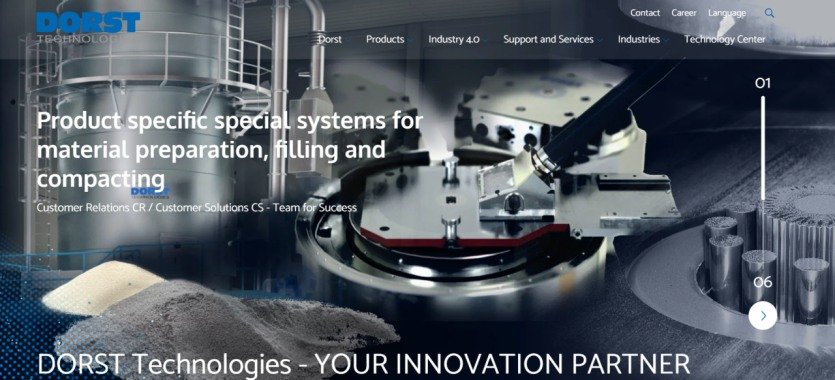
DORST spray dryers process water-based suspensions into powders or granules. The company’s applications include technical ceramics, tungsten carbide, cermets, metal alloys, and battery materials. Its range spans pilot equipment, compact systems, and industrial plants.
Consider when: Your slurry must become granules suitable for pressing or another forming process. The useful comparison extends beyond outlet moisture to the properties of the granules entering downstream equipment.
Discuss before ordering: Feed composition, solids loading, granule size distribution, bulk density, and forming requirements. Ask whether the evaluation can include both a spray drying trial and testing of the resulting granules.
European SprayDry Technologies
Location: United Kingdom.
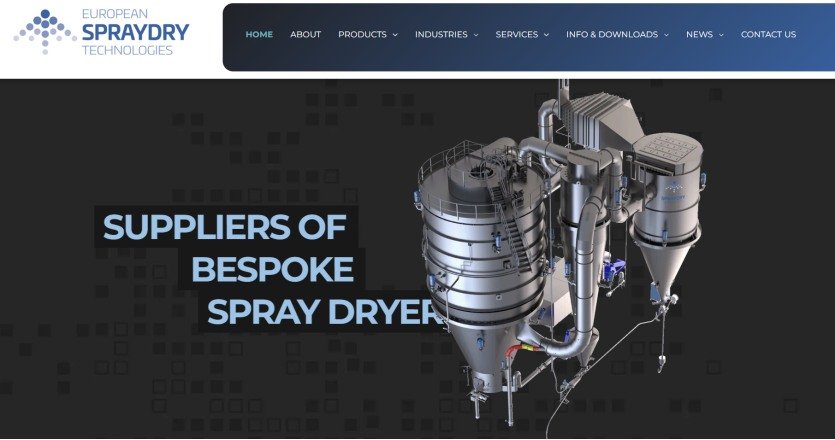
European SprayDry Technologies, trading through ESDT Operations Ltd, designs spray drying and related powder processing systems. Its offering includes spray dryers, fluid beds, evaporators, and associated equipment. The company describes UK-based engineering and manufacturing oversight for equipment made from stainless steel and other specified materials.
Consider when: A food, dairy, or chemical project needs the dryer integrated with feed preparation and downstream powder processing, particularly where the building layout requires a tailored arrangement.
Discuss before ordering: The proposed equipment boundary, product contact materials, and installation dimensions. Confirm who supplies feed preparation, secondary drying, cooling, powder transfer, and commissioning services.
FREUND
Location: United States, with product and process laboratories in Marion, Iowa.
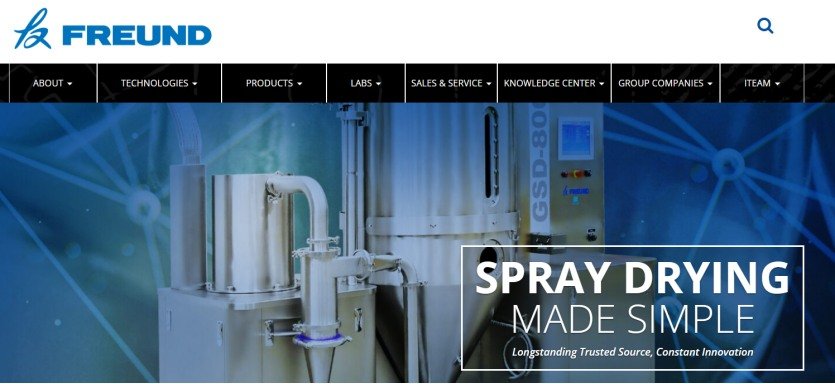
FREUND GENESIS production systems offer modular spray drying configurations for pharmaceutical materials, excipients, flavors, and industrial substances. Published options include two-fluid nozzles, pressure nozzles, and rotary atomizers. Its spray drying technology also includes closed-cycle arrangements for appropriate solvent-based processes.
Consider when: A formulation team needs to move from particle development toward smaller commercial batches while retaining flexibility in atomization and collection.
Discuss before ordering: The intended batch or campaign size, solvent properties, containment needs, and powder recovery method. Confirm which nozzle, chamber, cleaning system, and process documentation are included in the proposed configuration.
GEA
Location: Düsseldorf, Germany — group headquarters.

GEA offers a broad spray dryer portfolio for food, dairy, chemical, and pharmaceutical applications. Its conventional spray dryer provides a single-stage option, while other configurations address different particle and processing requirements. GEA also provides spray drying test facilities and plant upgrade services.
Consider when: A project needs to compare several processing arrangements or integrate drying into a wider powder production plant.
Discuss before ordering: The product properties to be demonstrated during trials and the equipment needed to achieve them. For an existing plant, separate the scope of a dryer upgrade from changes to air handling, powder collection, cleaning, and downstream processing.
JEXDRY
Location: Changzhou, Jiangsu, China.
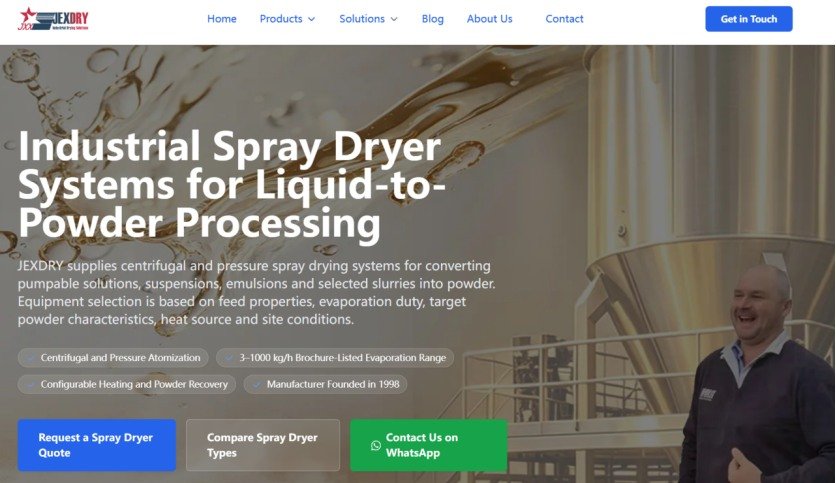
JEXDRY is the international brand of Jiangsu Xingxing Drying Equipment Co., Ltd. Its spray dryer range includes LPG centrifugal systems, YPG pressure-nozzle systems, and configurations for extract applications. Selection considers feed properties, water evaporation duty, powder characteristics, available heat, and installation conditions. Powder collection and auxiliary equipment are defined within the project scope.
Consider when: A production project needs to compare rotary and pressure atomization against its own feed and powder specification, with the tower and collection system coordinated around the available utilities and building.
Discuss before ordering: Feed solids, viscosity, pumpability, and temperature limits; required powder moisture, particle size, and bulk density; and the scope of feeding, heating, cyclones, filtration, controls, and installation support.
SPX FLOW — Anhydro
Location: Søborg, Denmark — Anhydro office.

The spray drying equipment associated with SPX FLOW is supplied under the Anhydro brand. ITT completed its acquisition of SPX FLOW in March 2026, and the current equipment pages use ITT Flow Technologies branding. ITT acquisition announcement
The Anhydro portfolio includes tall-form dryers, spray bed dryers, and smaller systems for development and production. Its spray bed design combines atomization, recycled fines, and an integral fluid bed for further drying.
Consider when: A dairy or food powder project needs to evaluate agglomeration and final moisture alongside the primary drying chamber.
Discuss before ordering: Required particle size, bulk density, dispersibility, and moisture. Confirm the drying stages, fines return arrangement, and responsibility for feed preparation, drying, cooling, and packaging.
Swenson Technology
Location: Crete, Illinois, United States.

Swenson spray dryers can use high-pressure nozzles, two-fluid nozzles, or centrifugal atomizers. Available airflow arrangements include parallel, reverse, and mixed flow. The equipment can incorporate cyclones, fabric filtration, and further exhaust treatment; closed-loop inert gas operation is also described.
Consider when: A chemical process needs the atomizer, gas flow arrangement, and exhaust system assessed together, particularly where the feed or solvent requires a dedicated process configuration.
Discuss before ordering: The proposed flow arrangement, feed compatibility, solvent recovery requirements, and collection efficiency measurement method. Confirm the engineering, fabrication, and system performance responsibilities in the supply agreement.
VetterTec
Location: Kassel, Germany — head office.

VetterTec spray dryers span pilot and industrial systems for food and chemical products. Its atomization options include rotary equipment, pressure nozzles, and twin-fluid nozzles. Downstream equipment can include fluid beds, coolers, and agglomerators to condition powder before packaging.
Consider when: The product needs further drying, cooling, or agglomeration after leaving the spray chamber, and those operations must fit the required powder specification.
Discuss before ordering: Which particle properties the atomizer must establish and which require downstream treatment. Review the test procedure, powder transfer interfaces, cleaning access, and supply boundary for the complete line.
Spray Dryer Selection Guide
Shortlist spray dryer manufacturers by what they can demonstrate with your feed. Before asking for a model, share the liquid composition, initial moisture or solids content, viscosity at the intended feed temperature, and any limits on heat exposure. Set targets for final moisture and particle size. With a planned feed rate, suppliers can use these inputs to estimate how much water or solvent to remove per hour and propose a trial that reflects your production needs.
Match the Dryer to the Feed
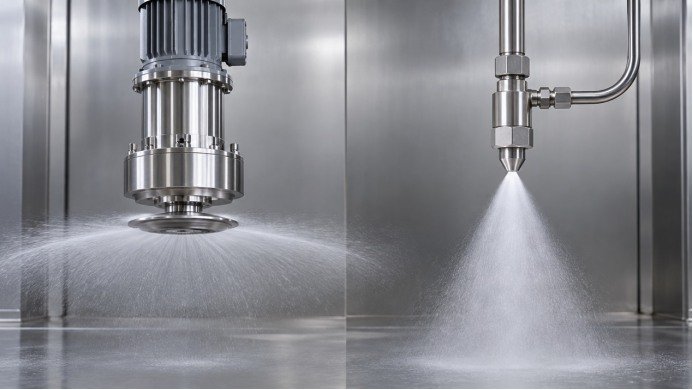
For a heat-sensitive feed such as a botanical extract or a biological formulation, ask the supplier to trial a co-current design. Have the lab measure the attribute you need to retain, such as active content, alongside powder moisture. Record the inlet and outlet temperatures and feed rate at which both targets are met, then ask how the supplier will use those results to size the production dryer. GEA small-scale spray drying guide
With a viscous or high-solids slurry, send viscosity at the intended feed temperature, solids concentration, and any suspended-particle size data. A rotary atomizer is worth testing when a nozzle tends to plug. A pressure nozzle is worth comparing when the slurry can pass through its orifice reliably and the target calls for coarser particles. Ask each supplier to show stable feeding and the resulting particle-size distribution on your sample. JEXDRY rotary and pressure-nozzle spray dryers
For a sticky or moisture-absorbing powder, inspect chamber and duct deposits after a representative run. Ask whether wall cooling, mechanical wall knockers, or dehumidified drying air addresses the observed problem. Compare powder recovery and time between cleanings.
If the feed contains a flammable solvent, provide its identity and concentration for a dedicated process safety review. Ask the manufacturer to assess a closed-cycle inert-gas system, solvent recovery, and the protection and monitoring needed for the actual feed. ANDRITZ pilot dryer configurations
Size the Dryer by Evaporation Duty
A lab dryer can produce formulation samples. A pilot trial should also show how the chosen atomizer and powder collection arrangement could transfer to production. For a continuous plant, give suppliers your normal and peak feed rates, seasonal air conditions, and available heat source. Compare installed cost and estimated utility demand at the same evaporation duty.
For example, an aqueous feed of 500 kg/h at 30% solids contains 150 kg/h of dry solids. At 4% final moisture by weight, the theoretical powder output is about 156 kg/h and the water evaporation duty is about 344 kg/h before collection losses. Ask each manufacturer to quote liquid feed, water evaporation, and collected powder separately so a throughput figure can be checked against the material balance.
Compare Technical Specifications Under the Same Conditions

Ask each supplier for the feed used to establish its evaporation rating, the feed rate and solids content, and the corresponding inlet and outlet temperatures. For a rotary atomizer, request the wheel diameter and tested speed range. For a pressure nozzle, request the orifice size and feed pressure. Ask to see the particle-size and moisture results at those settings. If two suppliers quote different wheel speeds, the wheel design and your feed properties help explain whether those speeds can produce comparable powder.
Review the drying tower diameter and installed height on a layout drawing. Include the cyclone, ducting, and the clearance needed to lift the atomizer out for service. If the ceiling limits tower height, ask how a revised chamber geometry would affect the spray pattern and wall deposits, and what trial evidence supports the change. This lets you check both the process design and whether the equipment can be installed and maintained in the available space.
Define Requirements for Food, Pharmaceutical, and Chemical Applications
If a catalyst or ceramic granule has a tight particle-size specification, give the supplier the acceptable size range and ask for the measured distribution from the trial. For an instant dairy or protein powder, set a dispersibility target and compare whether a single stage or fines return with fluid-bed finishing meets it. For a dairy line, confirm where feed concentration and homogenization end and where powder cooling and packaging begin. JEXDRY milk powder spray drying application
On a shared food line, review smooth, accessible product-contact surfaces, weld finish, drainage at low points, and areas where powder could collect. If frequent changeovers justify clean-in-place (CIP), ask the supplier to mark the chamber, cyclone, and duct sections covered and identify parts that need manual cleaning. That gives the plant team a way to assess allergen changeovers before approving the layout. FDA food equipment guidance
For pharmaceutical production, translate the applicable GMP requirements into an equipment specification. Request product-contact material certificates, surface finish records, and documents that support equipment qualification and cleaning validation. If the process requires sterilization in place (SIP) or containment during powder discharge, specify the requirement and how it will be verified. FDA guidance on drug manufacturing equipment
For a corrosive chemical feed, provide its composition, pH, process temperatures, and cleaning chemicals. Ask for a product-contact material schedule that identifies the stainless-steel grade, any proposed corrosion-resistant coating, and the seal materials. For flammable vapors or combustible dust, have the project team assess the hazards and specify the required sealing, monitoring, and fire or explosion protection for the process and installation site.
Use Trials to Assess Deposits and Powder Recovery
Use a representative feed sample and agree on acceptance criteria before the trial. Ask for a report with feed solids and viscosity, stable run time, inlet and outlet temperatures, and rotary wheel speed or nozzle pressure. Compare the measured final moisture, particle-size distribution, deposits, and saleable yield with your targets. Record the powder recovered from the cyclone and filter separately where they discharge into different containers.
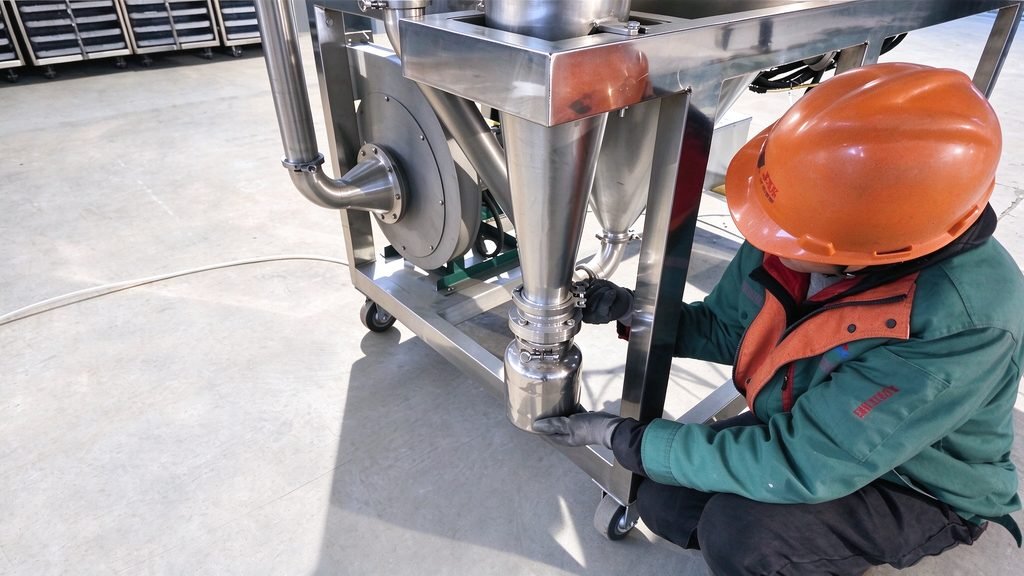
Agree how samples will be collected and tested. A moisture result from one collection point may not describe every powder fraction leaving the system. The manufacturer should explain how the trial supports the proposed production chamber, air handling, and recovery equipment.
How to Verify a Spray Dryer Manufacturer
Ask for a reference installation that processed a similar feed at a comparable evaporation rate. Find out who designed the chamber and controls, which components the supplier fabricates or assembles, and who signs off on final inspection. For an overseas order, ask to see the proposed factory acceptance test (FAT) plan before approving the purchase. Agree which checks cover materials and workmanship, such as material certificates and weld inspection records, and which checks cover functions such as interlocks and control sequences.
JEXDRY evaluates feed and powder requirements, can arrange a material trial, and manufactures, assembles, and inspects equipment at its Changzhou facility. For a project comparing its LPG rotary and YPG pressure-nozzle designs, ask which trial configuration represents the proposed production line and what the test report will include. Agree separately on the pre-shipment FAT and any performance tests that require your material or site utilities. JEXDRY engineering and factory testing
What Should a Spray Dryer Quotation Include?
Use the equipment list and site drawing to check what is included from the feed connection to powder discharge.
| Item | What to confirm |
| Feed system | Tank and pump scope, filtration, allowable solids and viscosity, and feed temperature |
| Atomization | Atomizer type, adjustment range, wear components, and maintenance access |
| Drying chamber | Dimensions, installation height, product contact materials, insulation, and cleaning access |
| Air heating and handling | Heat source, filtration, fans, ducting, and the conditions behind utility estimates |
| Powder recovery | Cyclones, final filters, collection vessels or conveyors, and the recovery measurement basis |
| Cleaning and changeover | Manual, wash-in-place, or clean-in-place scope; drainage and access for inspection |
| Controls and documentation | Instruments, operating records, drawings, manuals, and agreed factory tests |
| Installation and support | Supply exclusions, site responsibilities, commissioning scope, and operating spares |
For solvent-based or oxygen-sensitive feeds, ask the supplier to list the gas circuit, solvent recovery equipment, instrumentation, and protection measures included in the quoted configuration. Confirm which equipment and site provisions fall within the buyer’s scope.
Agree on Commissioning, Training, and After-Sales Support
Before signing, confirm who installs the tower and connects utilities, who supervises startup, and whether commissioning includes a run with your feed. Ask for a training plan covering normal operation, shutdown, cleaning, and first-line troubleshooting. JEXDRY can arrange commissioning guidance and operator training. Confirm the delivery format, language, on-site days where applicable, and travel costs in the proposal. JEXDRY spray dryer installation and training
Put the warranty period and start date in the purchase agreement, along with repair responsibilities, support channels, and expected response times. Ask for separate lead times for wear parts such as nozzle inserts or seals and for critical components such as an atomizer assembly. If your plant has little room for downtime, agree which spares should ship with the dryer and when remote assistance can be escalated to an on-site visit.
Spray Dryer Manufacturer FAQs
Which spray dryer manufacturers are based in North America?
FREUND’s U.S. operation has product and process laboratories in Marion, Iowa, and supplies GENESIS systems for process development and smaller commercial batches. Swenson Technology in Crete, Illinois, offers engineered spray dryers with several atomizer and airflow options. For a North American installation, ask where your trial will run and who will handle commissioning and supply spare parts after startup.
Where can I buy an industrial spray dryer, and how do I compare energy use?
Request proposals directly from manufacturers such as JEXDRY and ANDRITZ Dedert. Give each supplier the same feed solids, evaporation duty, and target powder moisture. Ask for heat use per kilogram of water evaporated and separate electricity estimates for the fans, atomizer, and any fluid bed. If a supplier proposes exhaust heat recovery, ask for estimates with and without it at your site’s operating conditions.
Which spray dryer models are suitable for pharmaceutical applications?
Compare GEA’s PHARMA-SD range for development through commercial production and Anhydro’s small-scale pharmaceutical spray dryers for pilot work or smaller production runs. Give both suppliers your solvent composition and containment target. Ask which gas circuit, product-contact material certificates, and factory acceptance test documents are included in the proposed configuration.
How do you choose a pilot-scale spray dryer for trials or small-batch production?
Ask the manufacturer to run your feed at the lowest stable rate you expect to use and measure how much saleable powder is collected. For scale-up, ask which atomizer and collection arrangement will carry over to production. If the unit will make your first commercial batches, compare installed cost including the feed pump, exhaust filtration, and utility connections. ANDRITZ Dedert pilot spray dryers are one option to evaluate.
How do you choose a spray dryer manufacturer for food processing?
Start with a trial using your actual concentrate and agree on powder moisture, bulk density, and any dispersibility target before the run. For an instant dairy powder, ask the manufacturer to test whether fines return and fluid bed finishing help the powder disperse as required. On a shared food line, review the chamber drainage and which powder-contact parts operators must remove between products. See how these requirements affect milk powder spray dryer selection.
What should a spray dryer supplier provide for cleaning and maintenance?
Ask for an access drawing, a cleaning scope, and a spare parts list before approving the layout. If the quotation includes clean-in-place (CIP), have the supplier mark which parts of the chamber, cyclone, and powder ducts it covers and which parts operators must clean separately. Check the clearance needed to remove the atomizer and ask for lead times for nozzle inserts or rotary atomizer wear parts so you can plan changeovers and shutdowns.
Is a spray drying service company the same as an equipment manufacturer?
No. A contract spray drying company processes material on its own equipment, while an equipment manufacturer supplies a system for installation at the buyer’s site. Some businesses provide both services. Confirm whether the proposal is for equipment, trial work, contract production, or a combination.
Is a rotary atomizer better than a pressure nozzle?
The choice depends on the feed and required powder. Compare viscosity, suspended solids, abrasion, particle targets, and maintenance conditions. Ask the manufacturer to explain the selection and, where needed, demonstrate it with a representative trial.
What information is needed for a spray dryer quotation?
Provide feed composition, solids content, viscosity, solvent information, liquid feed rate, and operating hours. Add the required powder moisture, particle properties, temperature limits, available utilities, and installation dimensions. These inputs help define the atomizer, chamber, collection equipment, and supply scope.
Discuss Your Spray Drying Project with JEXDRY
Send JEXDRY your feed data, required powder specification, production schedule, available heat source, and site drawing. Include a sample or existing trial results where available. Contact the JEXDRY team to discuss atomization options, material testing, and a spray drying system configured around your production requirements.